
To access our unique news archive of over 1,400 articles with insights on over 500+ sustainable sports organisations, join the GSS Network today.
Login here if you are a registered network subscriber.
News article
From Measurement to Movement: Sport Tackles the Carbon Cost of Spectator Travel
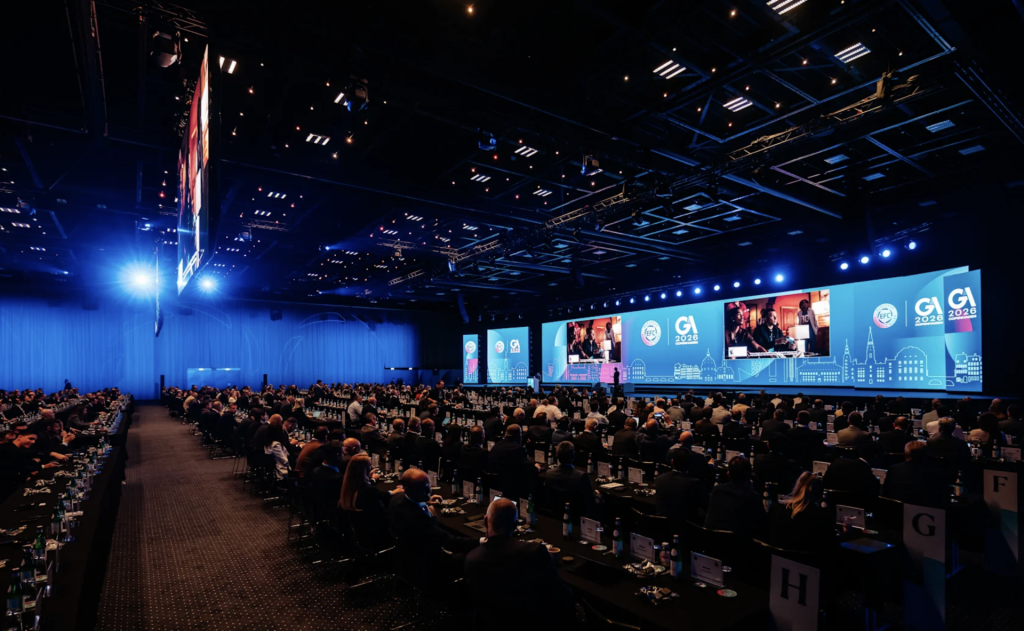
More than 100 delegates from across football and many of the world’s other major sports joined a UEFA-hosted workshop today to tackle one of the most significant – and difficult to measure – sources of sport’s carbon footprint: how spectators travel to and from events. Bringing together expertise from UEFA, the Premier League, Ligue de Football Professionnel (LFP), Paris Saint-Germain and Brentford FC, the workshop explored not only how spectator travel emissions can be measured more consistently, but how better data can be transformed into practical action.
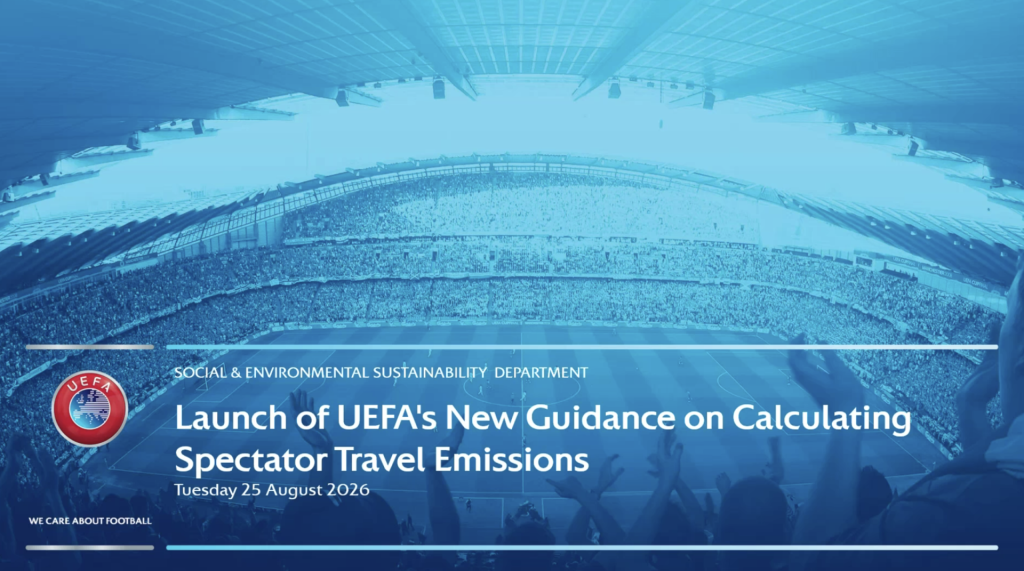
At the heart of the discussion was a much bigger challenge for sport. Spectator mobility can account for between 40% and 70% of a football organisation’s Scope 3 emissions, yet reliable data has historically been difficult to obtain and organisations have frequently adopted different methodologies, boundaries and assumptions.
UEFA’s newly launched guidance on calculating spectator travel emissions seeks to address that gap. Developed alongside the Premier League, LFP and Deutsche Fußball Liga (DFL), it has been integrated into UEFA’s Carbon Footprint Calculator and is designed to give clubs, leagues and national associations a more consistent way of measuring the environmental impact of supporters travelling to and from matches.
But, as today’s workshop demonstrated, measurement is only the starting point.
Establishing a common language
Vincent Reulet, Senior Environmental Impact Expert at UEFA, opened the session by setting out why spectator travel has become such an important focus.
“You cannot reduce what you don’t measure.”
UEFA’s methodology is aligned with the Greenhouse Gas Protocol but adapted specifically for football. Spectator mobility sits within Scope 3 Category 9 – downstream transportation and distribution – with clubs encouraged to use a “fan-led” approach, accounting for the travel of their own supporters to both home and away fixtures.
The value of consistency extends beyond calculating a carbon footprint. Using common boundaries and methodologies should allow organisations to monitor their own progress more effectively, improve transparency and, over time, create the foundations for meaningful benchmarking.
Reulet stressed that the longer-term ambition is also to use football’s influence to encourage greater use of active and lower-carbon mobility. That requires understanding where supporters come from, how they travel and what realistic alternatives can be provided.
“You cannot reduce what you don’t measure.”
Premier League helps build the methodology
Will Hutton, Head of Sustainability at the English Premier League, explained how an 18-month project involving Premier League clubs helped shape the new approach.
Initial research found that around half of Premier League clubs were attempting to measure fan travel emissions, but were doing so using different scopes and methodologies. Clubs were also struggling to generate sufficient responses from supporters.
A working group involving Brentford, Brighton & Hove Albion, Chelsea, Newcastle United and Wolverhampton Wanderers was deliberately selected to represent different geographical locations, stadiums and transport patterns.
The project established common principles around what clubs should measure, how emissions should be calculated and how supporter data should be collected. Importantly, the methodology has been designed to evolve.
“We think we’ve got a reasonable methodology now. It’s well tested, but we’ll iterate it over the coming years,” said Hutton.
Questions remain around international supporters, appropriate sample sizes and attribution. A successful domestic or European cup run can also significantly increase a club’s travel emissions from one season to another.
The objective is therefore not to create a perfect methodology from day one, but a consistent framework that can improve as the evidence base grows.
“We think we’ve got a reasonable methodology now. It’s well tested, but we’ll iterate it over the coming years,”
France moves towards collective measurement
Mathilde Chamak, CSR Project Manager at LFP, provided an important illustration of why standardisation matters at league level.
By 2023/24, 27 French clubs had measured their carbon footprint at least once during the previous four years. But because clubs had effectively adopted their own methodologies, LFP could do relatively little with the collective results.
LFP subsequently developed a common methodology aligned with UEFA and the GHG Protocol and began integrating carbon measurement into its club licensing requirements.
“It helped us to consolidate the Ligue 1 and Ligue 2 carbon footprint… and mostly to define reduction targets,” said Chamak.
That represents an important transition from individual reporting towards a league-wide understanding of environmental impact. Better data has enabled LFP to work collectively with clubs on a 2030 roadmap, using measurement as the foundation for future reductions.
“It helped us to consolidate the Ligue 1 and Ligue 2 carbon footprint… and mostly to define reduction targets,”
PSG uses supporter insight at scale
Paris Saint-Germain demonstrated how dramatically the quality of spectator travel data can improve.
Yann Pasiecznik, CSR Project Manager at PSG, explained that the club’s first spectator travel assessment in 2021/22 was based on just 400 supporter responses, with limited transport modes and geographical coverage.
By 2024/25, PSG had collected around 11,500 responses, expanded the range of transport assessed, included supporters from across France and incorporated away matches, women’s football and handball.
“Measuring our footprint provides the foundation for effective climate action and demonstrates our commitment to leading by example,” said Pasiecznik.
“Measuring our footprint provides the foundation for effective climate action and demonstrates our commitment to leading by example,”
Noé Le Masson, Customer Experience & Insights Manager at PSG, demonstrated how that measurement has been incorporated into the club’s wider supporter research.
After every men’s home fixture, PSG sends a post-match survey to 4,000 supporters, divided between season-ticket holders and non-season-ticket holders. For smaller audiences elsewhere within the club, QR codes provide an alternative means of gathering information.
Questions cover travel time, modes of transport and more detailed information such as car sharing and the specific public transport services used.
“The same survey can support both environmental objectives and much broader fan experience and club needs,” said Le Masson.
This is where the value of the exercise begins to extend beyond carbon. Travel data can reveal congestion, accessibility issues and transport pressures while helping clubs understand the overall supporter journey.
PSG is already using those insights to work on public transport provision, bicycle parking, carpooling and communications promoting more sustainable travel.
“The same survey can support both environmental objectives and much broader fan experience and club needs,”
Brentford turns insight into action
Brentford FC provided perhaps the clearest example of how measurement can translate into intervention.
James Beale, Head of Sustainability & Community at Brentford FC, described the club’s approach as a continuous cycle: collect data, analyse it, develop a plan, implement actions and then measure again.
But he also highlighted one of sport’s central mobility challenges.
“We can influence fan travel, but we can’t control fan travel.”
Brentford’s data demonstrates why targeted intervention matters. Around a third of supporters drive to games, but those journeys generate approximately 90% of the club’s fan travel emissions.
The club has responded with a series of practical initiatives. Bike to Brentford rewards supporters who cycle to games, while temporary bike parks supplement existing infrastructure. Rail discounts have been offered for away fixtures and the club has worked directly with train operators to extend services where existing timetables would otherwise make rail travel difficult.
During the 2024/25 season, around 21% of eligible away supporters used Brentford’s train discount on average, with 40% of those indicating that they switched to rail from another form of transport.
Brentford has also developed an app-based ride-sharing service and this summer launched the Brentford FC Fan Travel Group, bringing together transport operators, local authorities, mobility providers and supporter representatives.
“By pulling it all together in this fan travel group, we can now formally work together to reduce emissions,” said Beale.
It demonstrated one of the workshop’s strongest themes: sports organisations may not own or control the transport networks their spectators use, but they can bring together the organisations that do.
“We can influence fan travel, but we can’t control fan travel ... by pulling it all together in this fan travel group, we can now formally work together to reduce emissions
From football to the wider sports industry
The presence of more than 100 delegates from football and other major sports pointed towards an opportunity that extends well beyond UEFA’s own competitions.
Towards the end of the workshop, Reulet was asked by GSS whether the methodology could translate to other sports. His response was clear.
“I think this could be very much replicated for other sports.”
The underlying challenge is shared across the industry. Whether spectators are travelling to football, rugby, athletics, tennis or another major sporting event, organisations need to understand where journeys begin, which forms of transport are being used and where interventions could make lower-carbon alternatives easier, cheaper or more attractive.
Reulet challenged clubs and national associations to undertake at least one spectator travel survey during the 2026/27 season, helping to establish a stronger evidence base from which the sector can progress.
“I think this could be very much replicated for other sports.”
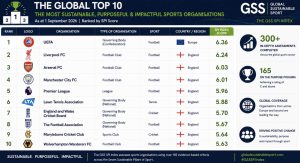
The organisations helping to lead that work are already among the stronger performers in the Global Sustainable Sport SPI Index. UEFA is currently ranked in the Global Top 5 with a Grade B, the Premier League sits in the Top 10 with a C+, while Brentford FC is ranked in the Top 50 with a C.
Those rankings provide useful context, but the wider significance of today’s workshop lies in the collaborative model being developed. UEFA can establish a common framework. Leagues can create consistency across competitions. Clubs can gather detailed supporter insight. Transport providers and local authorities can help deliver practical solutions.
Bringing more than 100 representatives from football and the wider sports industry into that conversation is an important step towards taking the approach beyond individual clubs and competitions.
The challenge now is to turn a common methodology into common action – using better measurement not simply to calculate the carbon cost of spectator travel, but to help reshape how supporters travel to sport.
























Join the GSS Alliance Partners programme today
Stay ahead of the game with our FREE weekly newsletter, delivering the latest sport and sustainability news from around the globe straight to your inbox


11th Hour Racing
Join the GSS Network programme today

15-16 October, 2026
Gtech Community Stadium,
London (UK)
The SPX Purpose League Summit is a working summit for decision-makers interested in activating sport in a purpose-led way. Attendees will leave with an aligned peer network, data-backed insights, and the strategic commercial toolkits to transform sponsorship from an outsourced marketing expense into the single greatest driver of value.



Register for GSS Workshops today
Join the GSS Education programme today