
To access our unique news archive of over 1,400 articles with insights on over 500+ sustainable sports organisations, join the GSS Network today.
Login here if you are a registered network subscriber.
News article
Defining a new landscape: the pivotal moment for women’s sport and creating a sustainable commercial ecosystem
Women’s sport has moved beyond being a growth story. It is increasingly recognised as a commercial opportunity in its own right. But with growing audiences, investment and visibility comes a new challenge: how can this momentum be transformed into a sustainable sporting ecosystem that delivers long-term commercial, social and economic value?
By Phoebe Head, Global Sustainable Sport
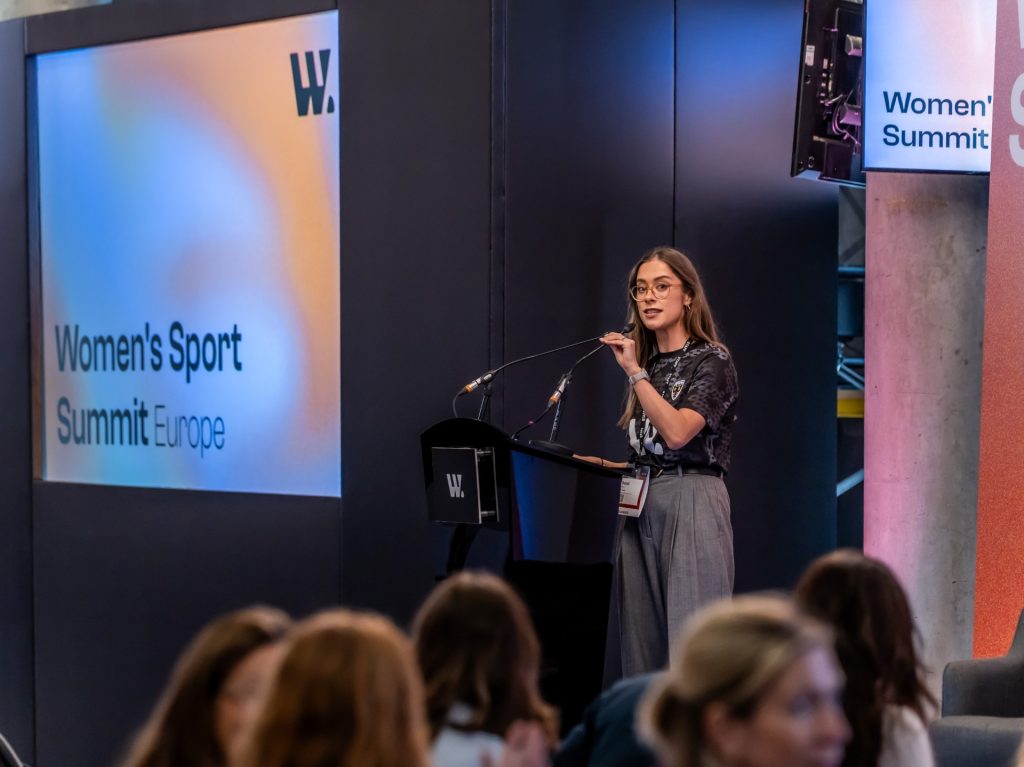
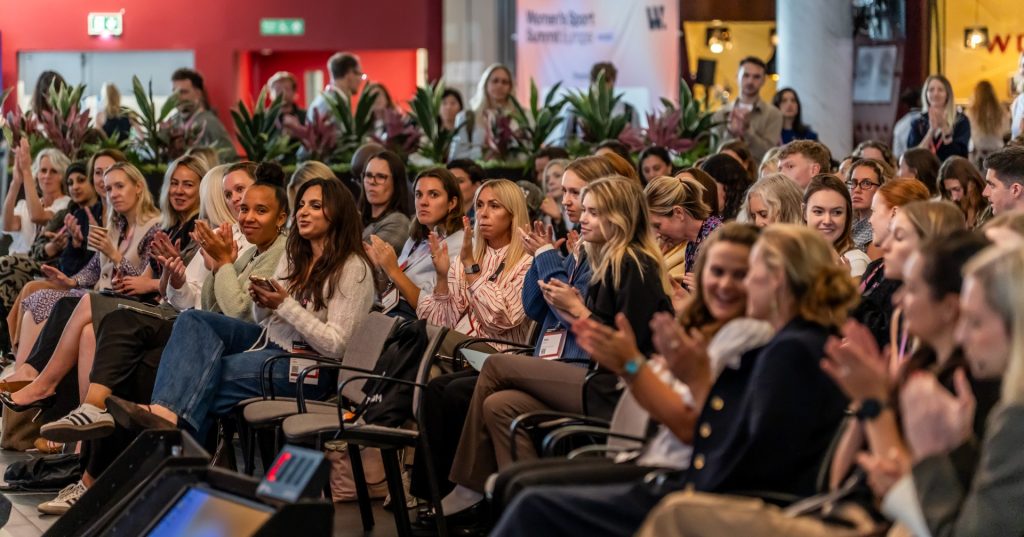
This was the central question at the Women’s Sport Summit Europe 2026, held at Arsenal’s Emirates Stadium on 6 October, bringing together rights holders, brands, investors, broadcasters and innovators to explore how women’s sport can evolve from a “cultural moment to a commercial category”, as Bobbi Nunes, Head of Content at Women’s Sport, described it.
The setting was particularly appropriate. Arsenal Women attract average crowds of around 30,000, as highlighted by Hugo Sever of APEX, demonstrating both the opportunities and expectations now surrounding the women’s game.
From momentum to sustainable growth
Opening the summit, Natalie Pirks, broadcaster at In The Frame Media, asked panellists to identify the moment when they realised women’s sport had become an established commercial proposition.
In response, Omar Shaikh, Chief Revenue Officer at Arsenal, offered a revealing anecdote about his seven-year-old daughter, who, until recently, “didn’t know there was a men’s team” at Arsenal.
For a new generation, women’s sport is not necessarily secondary to the men’s game. It is simply sport.
Fellow panellist Kerstin Lutz, CEO of Mercury 13, highlighted the opportunities emerging from investment in standalone professional women’s football clubs. She emphasised the need for creativity in developing the women’s game sustainably:
“We should push back a little bit more. What can we do differently? We’re still copying and pasting from the men’s game… and we should really take a step back and rethink this.”
“We should push back a little bit more. What can we do differently? We’re still copying and pasting from the men’s game... and we should really take a step back and rethink this.”
Rather than simply replicating established men’s football structures, women’s sport has an opportunity to create something different, with new approaches to ownership, partnerships, fan engagement and community participation.
The importance of these new approaches became a recurring theme throughout the summit.
Selling the sport, not the progress
One of the strongest messages emerging from the discussions was the need to change how women’s sport is presented.
On a panel focused on the legacy of major tournaments, Beth Barrett-Wild, Tournament Director of the ICC Women’s T20 World Cup 2026 at the England and Wales Cricket Board, highlighted a fundamental shift in how women’s sport should be promoted:
“At ECB we try to sell the sport and not the progress. We worked really hard, from a World Cup perspective, to demonstrate that this is world-class cricket, and that was part of our audience strategy.”
“At ECB we try to sell the sport and not the progress. We worked really hard, from a World Cup perspective, to demonstrate that this is world-class cricket, and that was part of our audience strategy.”
Barrett-Wild emphasised that the focus should increasingly be on the quality of the sporting competition itself, rather than continually highlighting how far the women’s game has developed.
“Let’s just talk about the action on the field, and not so much about how far the women’s game has come.”
“Let’s just talk about the action on the field, and not so much about how far the women’s game has come.”
Arsenal has adopted a similar philosophy through its integrated ‘One Club’ approach. As Shaikh explained, the club brings together men’s and women’s football across partnerships, communications and supporter engagement.
However, recognising women’s sport as simply sport should not mean ignoring its distinctive qualities.
New audiences, different matchday experiences, greater accessibility and stronger connections between athletes and supporters offer opportunities to develop commercial models that are not constrained by traditional sporting structures.
The challenge is to build on these differences rather than eliminate them.
Purpose and commercial value working together
Purpose emerged as another defining characteristic of women’s sport, particularly in attracting brands seeking meaningful connections with audiences. Lutz elaborated on the opportunity:
“What a lot of women’s sports are doing out at market is banking on purpose… and that is stronger in the women’s game than the men’s …. We have to work with the brands to find the angle that works for them.”
“What a lot of women’s sports are doing out at market is banking on purpose... and that is stronger in the women’s game than the men’s .... We have to work with the brands to find the angle that works for them.”
However, discussions on return on investment challenged the assumption that purpose and profitability are competing objectives.
Increasingly, purpose can drive commercial value through stronger brand trust, deeper engagement and more enduring relationships.
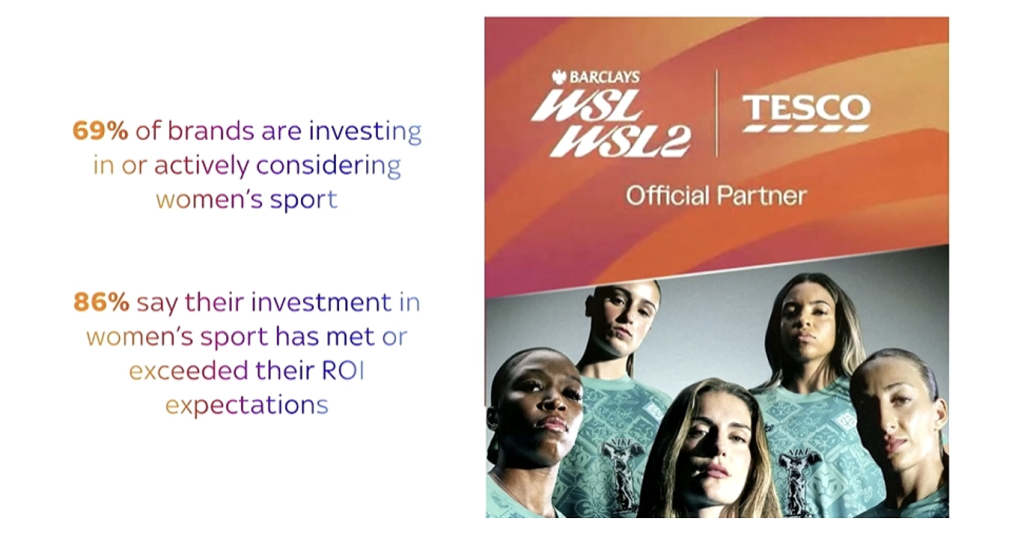
Alongside the summit, Sky Media’s Women’s Sport – The Good Growth Blueprint webinar, presented by Jo Rossi, Communications Strategy Controller at Sky Media, reinforced this message with some compelling statistics.
According to the figures presented, 69% of brands are investing in, or actively considering, women’s sport, while 86% say their investment has met or exceeded their return-on-investment expectations.
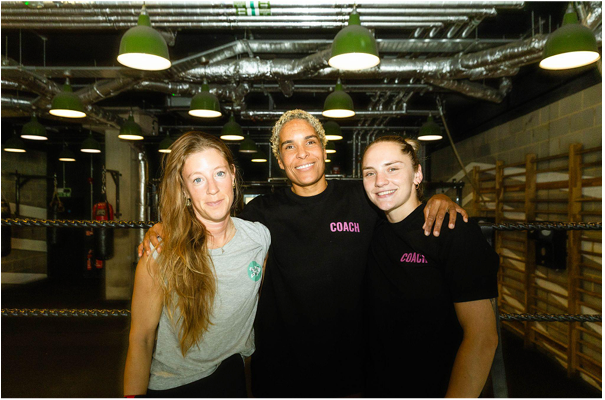
This alignment between commercial viability and social purpose is also being demonstrated through the recent announcement of Fight Back Promotions’ The Fight Back, an all-female fight night designed to fund programmes supporting women affected by domestic abuse and gender-based violence.
The initiative demonstrates how a social mission can strengthen, rather than dilute, commercial appeal.
As co-founder Poppy Mason-Watts explained:
“We want to build fight nights that people want to attend and brands want to support, and use that business to fund more places for women who otherwise couldn’t take part.”
“We want to build fight nights that people want to attend and brands want to support, and use that business to fund more places for women who otherwise couldn’t take part.”
For sport, this reinforces the importance of assessing success through a broader framework than financial performance alone.
As the Fight Back initiative illustrates, commercial prosperity, participation, partnerships and social impact are not competing priorities. They can be mutually reinforcing.
Equality requires systemic change
Despite growing commercial confidence, significant structural inequalities remain.
During a discussion involving Sally Munday, CEO of UK Sport, and Ali Donnelly, Corporate Affairs Director at England Rugby, five priorities emerged for establishing the UK as a global leader in women’s sport: equal opportunities in schools, equal media relevance, equal access to facilities, equal workforce opportunities and equal governance.
Munday captured the scale of the challenge:
“We don’t need to change all the women, but we do need to change the systems that women are operating in… And one of the best ways to do that is by changing the decision-making at the top.”
“We don’t need to change all the women, but we do need to change the systems that women are operating in... And one of the best ways to do that is by changing the decision-making at the top.
Her underlying message was particularly powerful: rather than expecting women to adapt to sporting systems historically designed around men, the systems themselves must change.
The discussion also highlighted the importance of investment and governance in ensuring that progress extends beyond elite competitions into grassroots participation and professional opportunities.
Visibility may inspire young girls to participate, but sustainable pathways require accessible facilities, appropriate coaching and opportunities to progress.
Collaboration rather than isolated success
Perhaps the greatest challenge is ensuring that success becomes widespread rather than concentrated among a handful of leading organisations.
Arsenal’s attendances demonstrate what is possible, but investors at the summit cautioned against allowing exceptional examples to disguise uneven growth across the wider Women’s Super League.
The success of individual clubs must strengthen entire competitions.
That requires greater collaboration between clubs, leagues, broadcasters and commercial partners, alongside coordinated scheduling, shared knowledge and more consistent investment.
Sky’s Good Growth Blueprint brought these themes together through a model illustrating how visibility, fandom, participation, commercial value and investment reinforce one another.
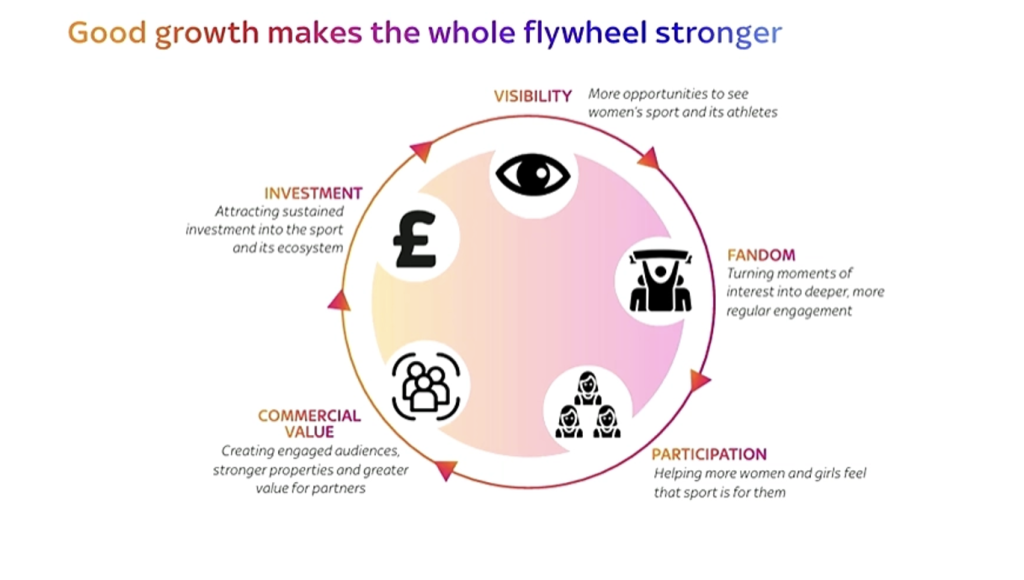
Each element is connected. Sustainable growth depends on strengthening the entire cycle rather than focusing on individual measures of success.
Defining the next chapter
Women’s sport has reached a pivotal moment, but commercial momentum alone will not guarantee lasting success.
As Jo Rossi emphasised during Sky’s webinar:
“We need to be deliberate about what comes next.”
“We need to be deliberate about what comes next.”
The next phase requires bold investment, creative thinking, stronger governance and a willingness to challenge traditional sporting structures.
The importance of this broader approach is reflected in the GSS SPI Assessment Programme, which evaluates sporting organisations across the Seven Sustainable Pillars of Sport, examining how sustainability, purpose and impact are embedded in their activities.
Three organisations represented at the summit have already reached the GSS Purpose Podiums. Arsenal sits in the Global Top 5 with a B rating, while the England and Wales Cricket Board (ECB) is ranked in the Global Top 10 with a C+ rating and a score of 5.70. England Rugby is also on the Purpose Podiums, ranking in the Global Top 100 with a C rating. Their achievements reflect the progress being made in embedding sustainability, purpose and impact across their organisations.
Above all, the future of women’s sport requires collaboration that ensures opportunities are shared across sports, organisations and communities.
The question is no longer whether women’s sport has a future. It is whether those responsible for shaping that future can turn today’s momentum into lasting, sustainable impact.
Read moreWomen's Sport Summit Europe 2026

















Join the GSS Alliance Partners programme today
Stay ahead of the game with our FREE weekly newsletter, delivering the latest sport and sustainability news from around the globe straight to your inbox


11th Hour Racing
Join the GSS Network programme today

15-16 October, 2026
Gtech Community Stadium,
London (UK)
The SPX Purpose League Summit is a working summit for decision-makers interested in activating sport in a purpose-led way. Attendees will leave with an aligned peer network, data-backed insights, and the strategic commercial toolkits to transform sponsorship from an outsourced marketing expense into the single greatest driver of value.




Register for GSS Workshops today
Join the GSS Education programme today