
To access our unique news archive of over 1,400 articles with insights on over 500+ sustainable sports organisations, join the GSS Network today.
Login here if you are a registered network subscriber.
News article
Top storyUN Climate Change launches new framework to turn sport’s climate commitments into measurable action
The United Nations Framework Convention on Climate Change (UNFCCC) has launched an updated Sports for Climate Action Framework, calling on the global sports industry to move beyond environmental commitments and demonstrate meaningful, measurable progress through partnerships, communication and climate resilience. The new framework was presented at the Sport Positive Summit 2026, held virtually on 6–7 October in collaboration with UN Climate Change and the International Olympic Committee (IOC), with speakers highlighting the opportunity for sport to become a catalyst for wider societal change.
A new direction for climate action in sport
Presenting the updated framework, Lindita Xhaferi Salihu, Sectors Engagement in Climate Action Lead at UNFCCC, emphasised that sport must accelerate its contribution to addressing climate change.
“We now need to move from a narrow road of good examples to a multi-lane, top-speed highway of action. This is not sport’s job alone, but sport has to be part of it because it reaches people that climate policy often does not.”
Building on the original initiative launched in 2018, the framework introduces four interconnected principles: developing credible net-zero strategies; building partnerships to deliver joint climate action; championing change through storytelling and communication; and strengthening climate resilience and global solidarity.
"We now need to move from a narrow road of good examples to a multi-lane, top-speed highway of action. This is not sport's job alone, but sport has to be part of it because it reaches people that climate policy often does not."
Xhaferi Salihu stressed that the framework was intended to drive implementation rather than simply recognise commitments.
“It is not a badge. It is not a communication device, and it is not a one-size-fits-all check. It is a shared framework for action designed to help every part of sport understand its footprint, reduce its emissions, and prepare for climate impact.”
Signatories are expected to establish measurable emissions reduction targets, develop transparent transition plans and report annually on their progress, challenges and learning.
"It is not a badge. It is not a communication device, and it is not a one-size-fits-all check. It is a shared framework for action designed to help every part of sport understand its footprint, reduce its emissions, and prepare for climate impact."
Beyond emissions: sport’s wider influence
One of the most significant developments is the introduction of three new Spheres of Collaboration, complementing traditional Scope 1, 2 and 3 emissions accounting.
These recognise sport’s ability to influence communities and cities (Sphere C), engage fans and participants (Sphere F), and mobilise its global reach to encourage climate action (Sphere X).
Xhaferi Salihu argued that sport must look beyond its own operations and build partnerships with organisations capable of addressing shared challenges.
“The organisations making the most progress are often those that see themselves not just as sports organisations, but as part of a wider ecosystem of climate action.”
"The organisations making the most progress are often those that see themselves not just as sports organisations, but as part of a wider ecosystem of climate action."
This approach acknowledges that sport’s greatest environmental contribution may extend well beyond its direct operational footprint.
Making sustainability the norm
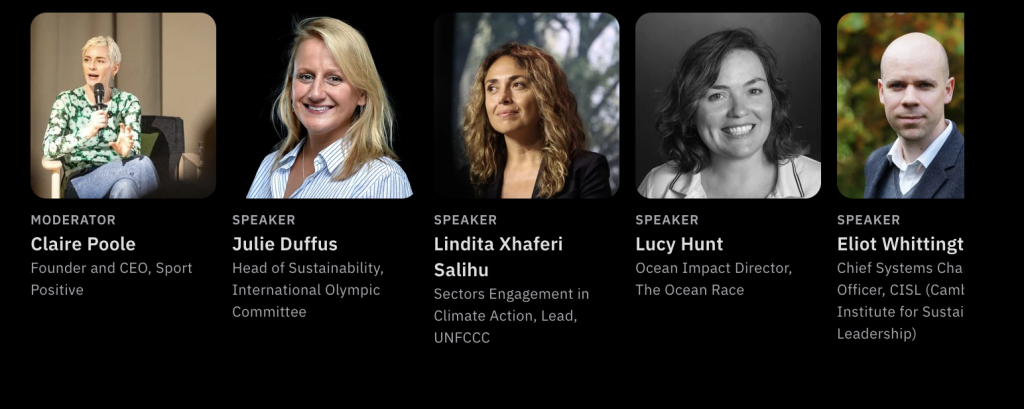
The Summit discussion, moderated by Sport Positive Founder and CEO Claire Poole, explored how successful initiatives could become standard practice.
Julie Duffus, Head of Sustainability at the IOC, highlighted the progress already achieved through renewable energy, public transport, circularity and more sustainable Olympic infrastructure.
However, she challenged the industry to move beyond celebrating isolated achievements.
“When do we stop talking about some of these projects as fantastic examples and innovation, but actually when does it become an expectation that it’s just the normal thing that we should be doing?”
"When do we stop talking about some of these projects as fantastic examples and innovation, but actually when does it become an expectation that it's just the normal thing that we should be doing?"
Duffus argued that replication was the real challenge, with successful initiatives needing to be implemented across hundreds or thousands of sporting organisations.
Lucy Hunt, Ocean Impact Director at The Ocean Race, emphasised the importance of sustainable event delivery and creating lasting benefits for host communities.
“How do we leave a place better than it was when we arrived?”
Hunt highlighted education, ocean-health initiatives and collaboration between sailors, engineers, scientists and boat builders as examples of how sporting events can generate benefits extending beyond competition.
"How do we leave a place better than it was when we arrived?"
Claire Poole, Founder and CEO of Sport Positive and moderator of the opening session, emphasised the opportunity to mobilise athletes across different sports and communities, rather than relying on a handful of high-profile ambassadors.
“I think having one big spokesperson is great, but if we can have hundreds or thousands of athletes globally talking authentically in a way that’s right for them, that’s actually really powerful.”
"I think having one big spokesperson is great, but if we can have hundreds or thousands of athletes globally talking authentically in a way that's right for them, that's actually really powerful."
The Summit itself demonstrated the value of accessibility, bringing together participants from more than 50 countries through its virtual format, enabling wider participation from grassroots organisations and the Global South.
From commitments to implementation
Eliot Whittington, Chief Systems Change Officer at the Cambridge Institute for Sustainability Leadership (CISL), argued that the climate debate must now focus on delivering solutions at scale.
“We’ve moved away from the conversations around climate action, where it is very, very broad. It’s very much: are you committing to action? Are you setting big targets? That’s really important, but it’s not sufficient. And actually, now it’s about taking those solutions and scaling them.”
"We've moved away from the conversations around climate action, where it is very, very broad. It's very much: are you committing to action? Are you setting big targets? That's really important, but it's not sufficient. And actually, now it's about taking those solutions and scaling them."
Whittington identified electrification, sustainable diets and circularity as practical opportunities, while emphasising sport’s ability to give communities confidence that change is possible.
He argued that sport’s influence lies not simply in encouraging people to act, but in demonstrating successful solutions and giving communities a sense of agency.
The power of storytelling and trust
Communication is central to the updated framework, recognising that athletes, clubs and major events can reach audiences beyond traditional environmental campaigns.
Xhaferi Salihu described trust as one of sport’s greatest assets.
“Trust is arguably the most valuable currency we have today. There are very few institutions or brands or public figures that can reach people across generations and geographies and viewpoints. And I think sport can.”
"Trust is arguably the most valuable currency we have today. There are very few institutions or brands or public figures that can reach people across generations and geographies and viewpoints. And I think sport can."
Hunt reinforced the importance of supporting athletes as advocates, highlighting how The Ocean Race’s sailors have become ambassadors for ocean science through onboard research programmes.
The Summit itself demonstrated the value of accessibility, bringing together participants from more than 50 countries through its virtual format.
From awareness to measurable impact
The revised framework also places greater emphasis on climate adaptation and resilience, recognising the growing threats from extreme heat, flooding, drought and severe weather.
For sport, its significance lies in recognising that climate leadership must extend beyond policies, targets and operational emissions.
Awareness must translate into activity, and activity must deliver measurable impact.
Duffus captured the wider challenge in her closing remarks:
“The future will not be determined by what a few organisations like us do alone. It will be determined by how quickly we can turn evidence into action, those actions into scale, and scale into systems change.”
"The future will not be determined by what a few organisations like us do alone. It will be determined by how quickly we can turn evidence into action, those actions into scale, and scale into systems change."
The real test of the new UNFCCC framework will not be how many organisations endorse its principles, but how effectively sport converts its extraordinary global influence into meaningful, measurable and lasting climate action.
Read moreUNFCCC















Join the GSS Alliance Partners programme today
Stay ahead of the game with our FREE weekly newsletter, delivering the latest sport and sustainability news from around the globe straight to your inbox
11th Hour Racing
Join the GSS Network programme today
15-16 October, 2026
Gtech Community Stadium,
London (UK)
The SPX Purpose League Summit is a working summit for decision-makers interested in activating sport in a purpose-led way. Attendees will leave with an aligned peer network, data-backed insights, and the strategic commercial toolkits to transform sponsorship from an outsourced marketing expense into the single greatest driver of value.


Register for GSS Workshops today
Join the GSS Education programme today