
To access our unique news archive of over 1,400 articles with insights on over 500+ sustainable sports organisations, join the GSS Network today.
Login here if you are a registered network subscriber.
News article
Thirty Years of the Johan Cruijff ArenA: From Stadium to Sustainable Living Lab
Thirty years after opening its doors, the Johan Cruijff ArenA (JCA) has marked its anniversary with a milestone that points as much towards its future as its past. The Amsterdam venue has become the first stadium in the world to achieve B Corp certification, recognition of a sustainability journey that has evolved from environmental innovation into a much broader examination of how a major sports and entertainment venue creates impact.
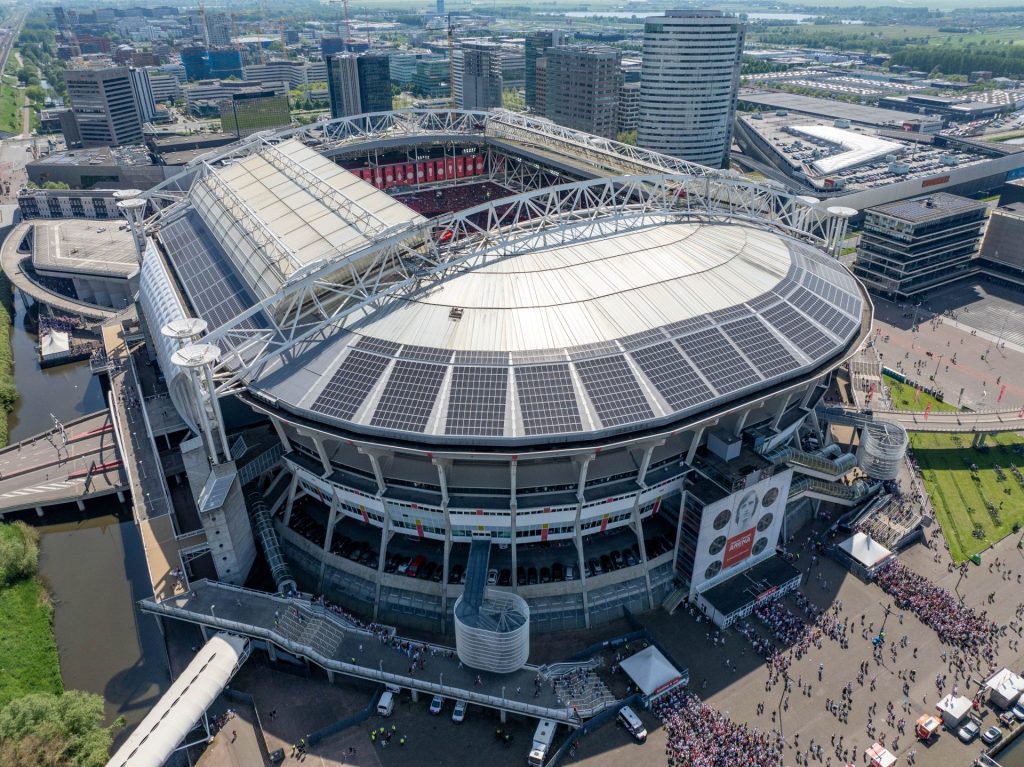
Opened in 1996, the ArenA has become home to Ajax, one of Europe’s major concert venues and a focal point for Amsterdam-Zuidoost. Despite its age, it remains a stadium that continues to evolve.
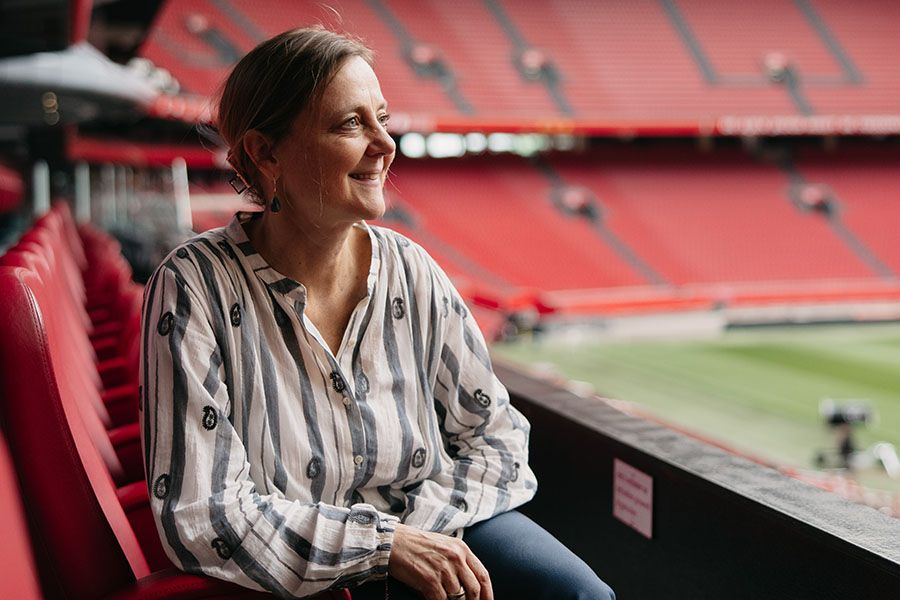
For Tanja Dik, CEO of Johan Cruijff ArenA, B Corp certification provides both recognition of that journey and a platform for what comes next:
“This recognition confirms that we are doing the right things. Certification is not an endpoint; it is a next step. We will continue to invest in sustainable and social initiatives and share our knowledge with stadiums and other organisations. In this way, we demonstrate how sustainability and social impact can go hand in hand with future-proof business practices.”
But perhaps the bigger story of its first 30 years is how the ArenA has continually reinvented what a stadium can be.
“This recognition confirms that we are doing the right things. Certification is not an endpoint; it is a next step. We will continue to invest in sustainable and social initiatives and share our knowledge with stadiums and other organisations. In this way, we demonstrate how sustainability and social impact can go hand in hand with future-proof business practices.”
From stadium to living laboratory
Sustainability has been part of the ArenA’s development since its earliest years, but the focus accelerated significantly from around 2012 through collaboration with the City of Amsterdam.
Pelle de Laaf, Manager Finance & Reporting at Johan Cruijff ArenA, explained how the stadium increasingly became a testing ground for new ideas:
“We see the ArenA as a living lab. We can bring companies, start-ups and public organisations together and test solutions in a real environment with 55,000 people for a football match and more than 70,000 for a concert.”
“We see the ArenA as a living lab. We can bring companies, start-ups and public organisations together and test solutions in a real environment with 55,000 people for a football match and more than 70,000 for a concert.”
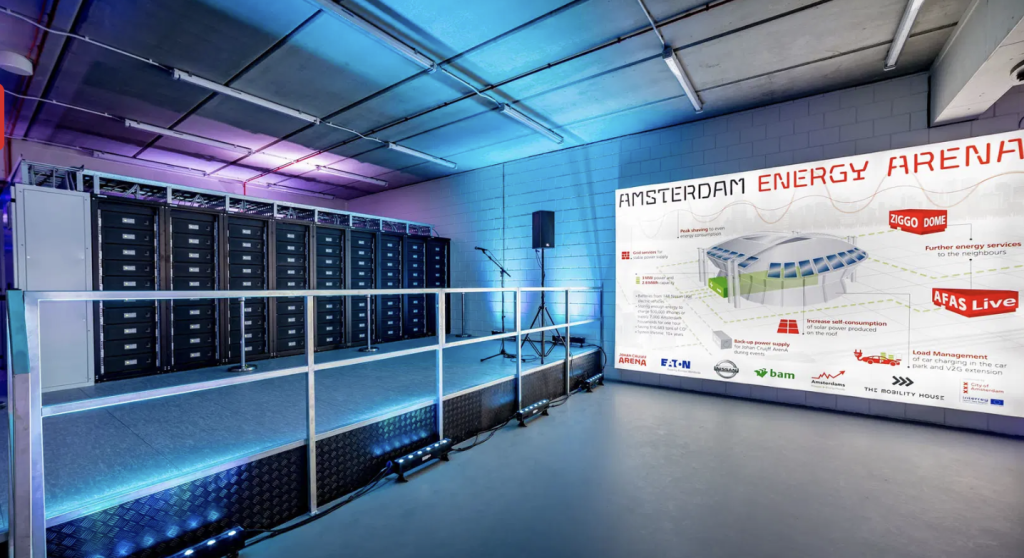
That philosophy has produced tangible results. Thousands of solar panels now cover the roof, the stadium operates without natural gas and investment in large-scale battery storage means renewable electricity can increasingly be retained and deployed when required. Energy-efficient cooling, dispensing systems and smart sensors have contributed to a reported 22% reduction in energy consumption.
Sometimes the events themselves have accelerated innovation. De Laaf highlighted Coldplay’s 2023 concerts as an important moment:
“Coldplay came with very strong sustainability requirements and that showed us that our existing battery capacity was not enough. That helped accelerate the investment in the second battery. We now have 8.6 megawatts of battery capacity and last season we were able to run the opening Ajax match completely on our own green energy.”
“Coldplay came with very strong sustainability requirements and that showed us that our existing battery capacity was not enough. That helped accelerate the investment in the second battery. We now have 8.6 megawatts of battery capacity and last season we were able to run the opening Ajax match completely on our own green energy.”
Moving beyond Planet
The next phase of JCA’s sustainability journey is becoming broader.
Its first impact report for 2024/25 begins to formalise that transition. The Net Positive strategy encompasses carbon and energy reduction, circularity and water, but also accessibility and social safety, talent development and community engagement.
For Junior Sustainability Consultant Philine Dekkers, that broader definition is increasingly reflected in her own work:
“Sustainability is really embedded throughout the organisation. My role includes accessibility, our impact on the neighbourhood and local recruitment. But we are also looking at where we need to go further, including areas such as human rights, diversity, equity and inclusion.”
“Sustainability is really embedded throughout the organisation. My role includes accessibility, our impact on the neighbourhood and local recruitment. But we are also looking at where we need to go further, including areas such as human rights, diversity, equity and inclusion.”
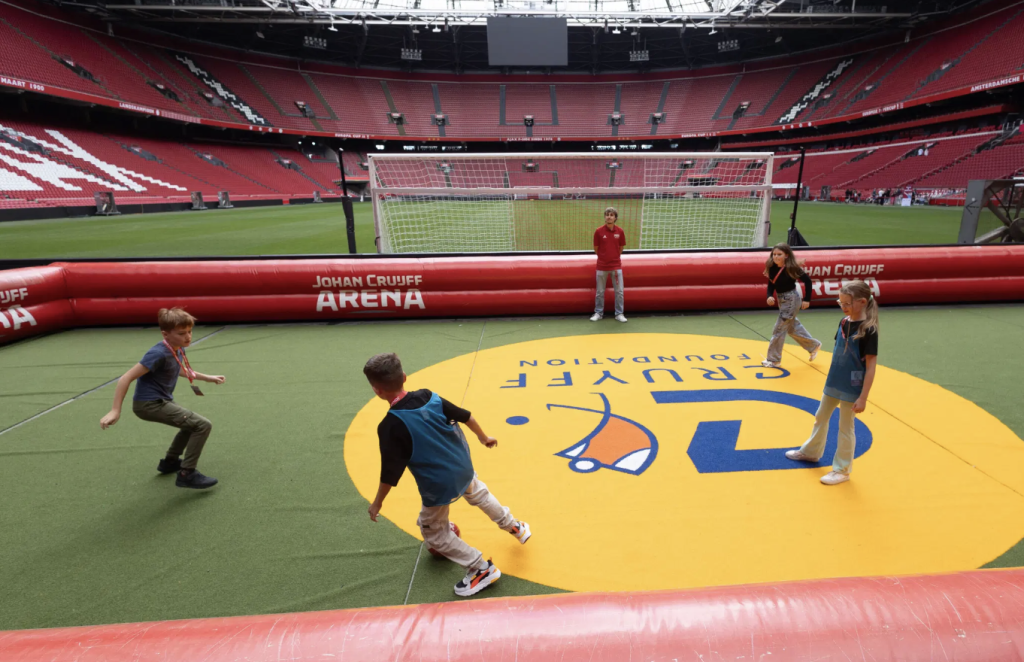
The relationship with Amsterdam-Zuidoost is particularly important. JCA aims to welcome at least 5,000 local residents annually through Neighbour Days, youth programmes, education and employment initiatives and access to concerts for people who might otherwise be unable to attend.
De Laaf believes the planned energy hub with neighbouring organisations could eventually extend that impact even further:
“We are working with seven or eight organisations around us to share energy and battery capacity. Ultimately, we would also like to be able to support people living in the neighbourhood, particularly where there is energy poverty. At the moment legislation does not allow us to do that, but it shows where this could go.”
“We are working with seven or eight organisations around us to share energy and battery capacity. Ultimately, we would also like to be able to support people living in the neighbourhood, particularly where there is energy poverty. At the moment legislation does not allow us to do that, but it shows where this could go.”
B Corp – milestone rather than destination
B Corp therefore arrives at an important moment in that evolution.
Becoming the world’s first B Corp-certified stadium recognises environmental and social performance alongside transparency and accountability. But the process itself also challenged JCA to examine where it could improve.
De Laaf said:
“Environmentally, we were already doing a lot. B Corp made us look much more closely at areas such as governance and social impact. It gives you a checklist of things you can improve, so certification does not mean the work is finished.”
For JCA, that is perhaps the real significance of B Corp. It provides independent recognition of progress, but also a framework against which the organisation can identify gaps and continue improving. The certification becomes part of the journey towards Net Positive rather than the culmination of it.
“Environmentally, we were already doing a lot. B Corp made us look much more closely at areas such as governance and social impact. It gives you a checklist of things you can improve, so certification does not mean the work is finished.”
The challenge of 2030
The next target is considerably more ambitious: JCA wants to become Net Positive by 2030.
Dekkers believes one challenge is translating a powerful organisation-wide ambition into specific responsibilities:
“Everyone supports the Net Positive ambition, but the next question could be what it means for every department. How does each team contribute and what are the actions they need to take? That is something we still need to develop further.”
“Everyone supports the Net Positive ambition, but the next question could be what it means for every department. How does each team contribute and what are the actions they need to take? That is something we still need to develop further.”
She also identified greater visitor participation as an opportunity:
“We need to talk more directly with our visitors. We can develop projects and methods ourselves, but we also need to ask visitors what they think and involve them more in what we are trying to achieve.”
Circularity, sustainable procurement, waste and Scope 3 emissions remain significant environmental challenges. The ArenA’s impact reporting identifies catering, purchased goods and services, capital goods and waste treatment among its major indirect emissions sources, with JCA targeting a 25% absolute reduction in Scope 3 emissions by 2030/31 against its 2023/24 baseline.
“We need to talk more directly with our visitors. We can develop projects and methods ourselves, but we also need to ask visitors what they think and involve them more in what we are trying to achieve.”
Turning activity into visible impact
There is another challenge: making the scale of that work visible.
The GSS SPI Assessment currently places Johan Cruijff ArenA just outside the Purpose Podiums with D+: Sustainability Developing. The assessment identifies considerable evidence across partnerships, Planet and Prosperity, but comparatively limited publicly available evidence around Participation, governance documentation and measurable impact.
De Laaf acknowledged the gap:
“We are probably doing more than we are showing. We have focused on doing the work, but we need to become better at communicating it and making the information available.”
“We are probably doing more than we are showing. We have focused on doing the work, but we need to become better at communicating it and making the information available.”
That may be one of the most important lessons as the ArenA enters its fourth decade. Thirty years ago, the challenge was to create a stadium capable of serving Ajax, Amsterdam and some of the world’s biggest events.
Today, the ambition is much bigger: to use the stadium, its technology, partnerships and audiences to create more positive impact than it consumes, while strengthening its relationship with the communities of Amsterdam-Zuidoost and continuing to test, develop and share solutions that can influence the wider sports and entertainment sector.
B Corp provides an important marker of how far Johan Cruijff ArenA has travelled. Its next challenge is to turn Net Positive from an ambition into measurable impact, for the stadium, for its local community and, ultimately, as a model for how major venues can help lead the transition towards a more sustainable future.
Read moreJohan Cruijff ArenA


















Join the GSS Alliance Partners programme today
Stay ahead of the game with our FREE weekly newsletter, delivering the latest sport and sustainability news from around the globe straight to your inbox


11th Hour Racing
Join the GSS Network programme today

15-16 October, 2026
Gtech Community Stadium,
London (UK)
The SPX Purpose League Summit is a working summit for decision-makers interested in activating sport in a purpose-led way. Attendees will leave with an aligned peer network, data-backed insights, and the strategic commercial toolkits to transform sponsorship from an outsourced marketing expense into the single greatest driver of value.

From European Voice to Global Ambition: EFC Sets Out a New Future for Football Clubs


Register for GSS Workshops today
Join the GSS Education programme today