
To access our unique news archive of over 1,400 articles with insights on over 500+ sustainable sports organisations, join the GSS Network today.
Login here if you are a registered network subscriber.
News article
Top storyUdinese and Cagliari put sustainability into play in Serie A
When Udinese host Cagliari at Bluenergy Stadium on Saturday 19 September, the club will not simply be attempting to stage a more sustainable Serie A fixture. The match will become the starting point for an ambitious three-year experiment in how football can measure, test and ultimately embed sustainability into everyday matchday operations.
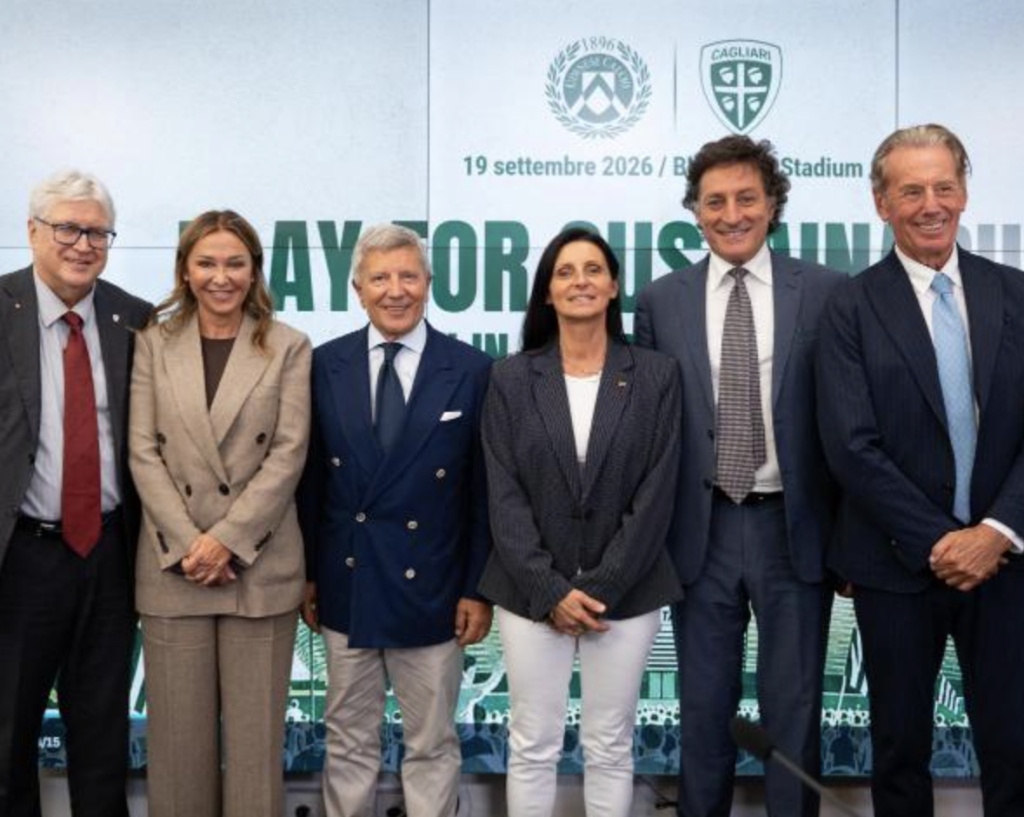
Under the banner Play for Sustainability – Our Planet, Our Game, Udinese will use the fixture as a practical testing ground for measures covering renewable energy, waste management, responsible catering, accessibility and supporter mobility. Fans are being encouraged to travel to the stadium by bicycle, while the club will collect data to understand the impact of the match and establish a baseline against which future progress can be measured.
But perhaps the most significant aspect is what happens afterwards.
Rather than presenting 19 September as a showcase event, Udinese intends to use what it learns to improve its operations progressively over the next three years – turning individual interventions into permanent practices wherever possible.
From guidance to action
Udinese will be the first club to use UEFA’s Football Event Sustainability Manual as the framework for a dedicated domestic league fixture. Developed by UEFA in collaboration with European Leagues, the manual is designed to help national associations, leagues and clubs incorporate meaningful sustainability measures into their day-to-day operations.
For the Udinese-Cagliari fixture, it will provide a framework stretching from planning through to post-event evaluation.
That transition from guidance to implementation is important. Sustainability strategies, commitments and toolkits across sport have grown substantially in recent years. The challenge increasingly is not whether organisations understand what they should do, but whether those ambitions translate into measurable changes in everyday operations.
Filippo Veglio, UEFA Chief of Social & Environmental Sustainability, told Global Sustainable Sport: “UEFA is pleased to support Udinese in staging their low-emission match, demonstrating how sustainability can be integrated into the organisation of a regular league fixture. We want to show how the practical actions contained in the manual can be adopted across European football.”
UEFA has subsequently highlighted Udinese as an example of how its guidance can produce practical results. Veglio said the initiative demonstrates how sustainability can be embedded into core matchday operations “in a pragmatic and effective way”, describing Udinese as setting a powerful example for the wider football community.
“UEFA is pleased to support Udinese in staging their low-emission match, demonstrating how sustainability can be integrated into the organisation of a regular league fixture. We want to show how the practical actions contained in the manual can be adopted across European football.”
A three-year laboratory
The most interesting element of the project, however, may be its timeframe.
Speaking directly to Global Sustainable Sport ahead of the match, Magda Pozzo of Udinese Calcio revealed that the Cagliari fixture represents the beginning of a broader three-year programme.
“Our objective is not simply to organise a ‘sustainable match’, but to use the match as a practical laboratory: measuring our environmental and operational impact, identifying areas for improvement and progressively introducing new practices that can become permanent within the Club and the Bluenergy Stadium,” she explained.
That approach changes the definition of success.
A sustainable match can create awareness and demonstrate individual interventions. A three-year programme potentially creates something more valuable: an evidence base showing which interventions work, which do not, where the greatest impacts occur and how operational practices can evolve.
The 2026 fixture will therefore establish the benchmark rather than represent the finished product. UEFA’s own assessment confirms that measurement is central to the programme, with this year’s edition being used to establish that starting point.
“Our objective is not simply to organise a ‘sustainable match’, but to use the match as a practical laboratory: measuring our environmental and operational impact, identifying areas for improvement and progressively introducing new practices that can become permanent within the Club and the Bluenergy Stadium,”
Measurement before claims
For Pozzo, establishing a credible baseline is fundamental.
“A particularly important aspect for us is therefore the monitoring and measurement process. We want to understand where we are today, establish a credible baseline and then measure our progress year after year,” she stated.
This is an increasingly important distinction in sport’s sustainability journey.
Awareness and activity matter, but ultimately organisations need to understand the impact those activities are creating. Without measurement, it becomes difficult to distinguish between an initiative that communicates sustainability effectively and one that actually changes environmental or social outcomes.
Udinese is therefore approaching the fixture as the beginning of a learning cycle: measure, understand, improve and measure again.
The initiative also builds on existing infrastructure at the club. More than 2,400 solar panels have already been installed on the stadium roof, while the programme complements Serie A’s Road to Zero sustainability programme, developed in collaboration with UEFA and aligned with UEFA’s Strength Through Unity sustainability strategy.
“A particularly important aspect for us is therefore the monitoring and measurement process. We want to understand where we are today, establish a credible baseline and then measure our progress year after year,”
A model beyond football’s biggest clubs
There is another important dimension to Udinese’s ambition.
Much of the sustainability conversation in European football inevitably focuses on the continent’s largest clubs, which have significant financial resources, global commercial partnerships and dedicated sustainability teams.
Udinese wants to demonstrate that leadership does not have to be restricted to football’s biggest organisations.
“The initiative has also been developed taking inspiration from the UEFA Event Sustainability Management System guidelines and reflects our ambition to demonstrate that clubs of our size can play a meaningful role in accelerating sustainability within football,” Pozzo said.
“The initiative has also been developed taking inspiration from the UEFA Event Sustainability Management System guidelines and reflects our ambition to demonstrate that clubs of our size can play a meaningful role in accelerating sustainability within football,”
That could ultimately be one of the project’s most important contributions. If practical sustainability measures can be integrated into the normal operations of clubs with very different budgets, stadiums and organisational structures, the potential for replication becomes significantly greater.
Serie A President Ezio Simonelli also sees that opportunity, saying: “We hope that Udinese’s example will be followed by many other clubs. Sustainability is a challenge that football must address together through concrete and increasingly ambitious actions that engage the entire community.”
“We hope that Udinese’s example will be followed by many other clubs. Sustainability is a challenge that football must address together through concrete and increasingly ambitious actions that engage the entire community.”
Two Purpose Podium clubs on the pitch
There is an additional significance to Saturday’s fixture from a Global Sustainable Sport perspective.
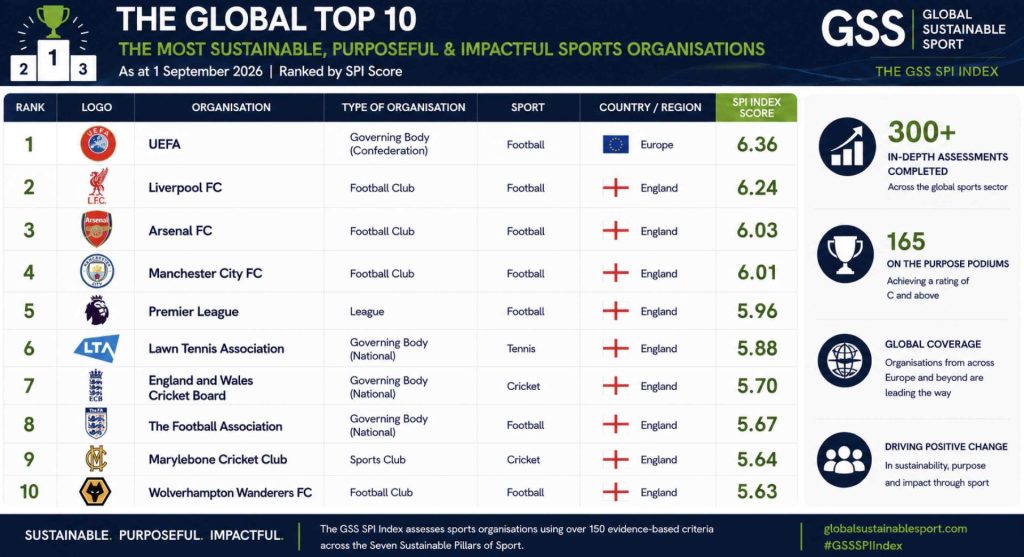
Both Udinese and Cagliari have already reached the Global Sustainable Sport SPI Purpose Podiums, making this a meeting between two Italian clubs whose wider sustainability, purpose and impact activities have been recognised through the assessment.
They are two of only five Serie A clubs currently on the Purpose Podiums, alongside Juventus, AC Milan and AS Roma.
Juventus leads the Italian contingent, ranking inside the Global Top 50 with a C+ : Purpose Advanced rating. Udinese, Cagliari, AC Milan and AS Roma all sit within the Global Top 150, achieving C : Purpose Established.
That makes the fixture particularly interesting. Two clubs already demonstrating broader evidence of purposeful activity will come together for a match explicitly designed to examine how sustainability can become part of football’s everyday operations.
Cagliari’s involvement also matters even though Udinese is driving the initiative. Sustainability cannot ultimately be addressed by individual clubs acting in isolation. Matchdays connect home and visiting clubs, supporters, leagues, governing bodies, partners, suppliers, cities and communities.
Beyond one match
The real test of Play for Sustainability will therefore come well after the final whistle.
Success should not simply be measured by the number of bicycles outside Bluenergy Stadium, the waste diverted from landfill or the renewable energy used on 19 September. It will be determined by what Udinese learns from those interventions and what changes because of that evidence.
If the club can establish a credible baseline in 2026, demonstrate measurable improvement over the following three years and convert successful experiments into permanent operational practices, the project could offer something valuable beyond Udine.
It could provide a practical model for other clubs looking to move from sustainability commitments to measurable impact.
And if UEFA’s Football Event Sustainability Manual can help turn one Serie A match into a laboratory for that transition, the bigger opportunity is clear: taking what works in Udine and making it part of the way football matches are routinely organised across Europe.
Read moreUdinese













Join the GSS Alliance Partners programme today
Stay ahead of the game with our FREE weekly newsletter, delivering the latest sport and sustainability news from around the globe straight to your inbox

11th Hour Racing
Join the GSS Network programme today

15-16 October, 2026
Gtech Community Stadium,
London (UK)
The SPX Purpose League Summit is a working summit for decision-makers interested in activating sport in a purpose-led way. Attendees will leave with an aligned peer network, data-backed insights, and the strategic commercial toolkits to transform sponsorship from an outsourced marketing expense into the single greatest driver of value.



Register for GSS Workshops today
Join the GSS Education programme today