
To access our unique news archive of over 1,400 articles with insights on over 500+ sustainable sports organisations, join the GSS Network today.
Login here if you are a registered network subscriber.
News article
The Purpose Podiums Break 150: A New Way of Measuring the Value of Sport
When Global Sustainable Sport launched the GSS SPI Index in mid-June, just over 100 sports organisations had earned a place on the Purpose Podiums. Ten weeks later, that number has grown to 165, providing an increasingly detailed picture of where sustainability, purpose and impact leadership is emerging across global sport.
Since June, comprehensive assessments have been completed across athletics, basketball, cricket, football, golf, motor racing, rowing, rugby, tennis and volleyball.
But the ambition behind the SPI Index extends far beyond creating another sporting league table.
The SPI Index is seeking to create another way of understanding the value of sport, one built around Sustainability, Purpose and Impact and the contribution that clubs, leagues, federations and other sporting organisations make to society and the planet.
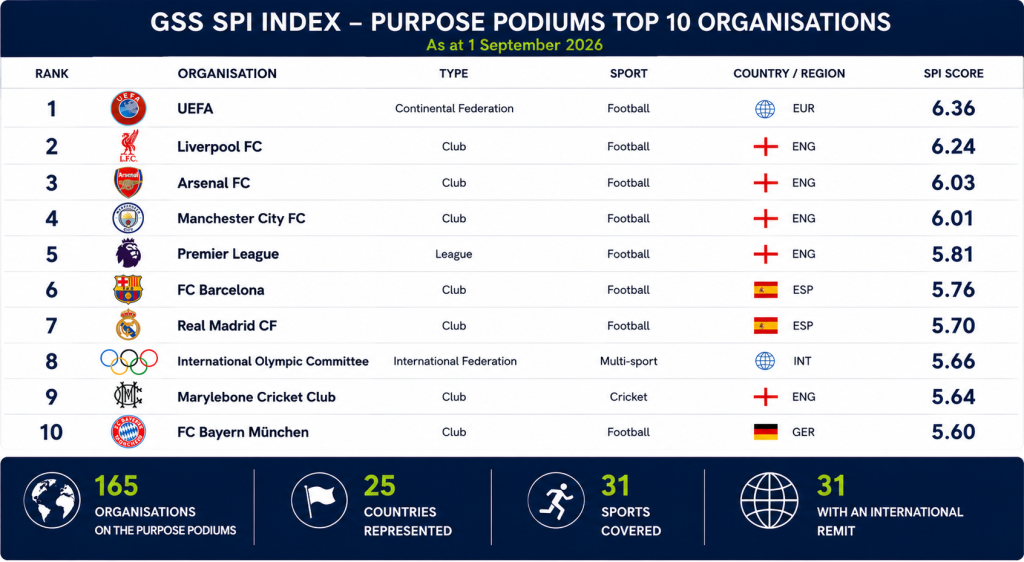
With 165 organisations across 25 countries and 31 sports, alongside 31 with an international remit, the Index is beginning to show what sustainability looks like in practice and how sports organisations communicate with their wider stakeholder groups.
From 5,000 organisations to 165 Purpose Podiums
Global Sustainable Sport began with a universe of more than 5,000 sports organisations worldwide. Around 2,000 could not progress because they had no identifiable website or sufficient public digital presence, leaving approximately 3,000 for a first phase of high-level analysis, the dataset behind the June findings.
From that group, more than 300 organisations have now undergone a second-phase, in-depth assessment. Of those, 165 have reached the minimum C rating, Purpose Established, requiring an SPI score of 4.00 or higher.
Each in-depth assessment goes significantly beyond the headline SPI score. The analysis provides a detailed evaluation across the seven Sustainable Pillars of Sport, identifying areas of strength, gaps in evidence and opportunities for improvement. The results are available through the GSS DataHub, with individual SPI Assessment Reports also being developed to provide sports organisations, investors, sponsors and other stakeholders with a detailed analysis of an organisation’s sustainability, purpose and impact performance, highlighting areas of strength, gaps in evidence and opportunities for future improvement.
Importantly, the Podiums build throughout the year rather than operating as a continuously changing league table. Once an organisation qualifies for 2026 it remains on the Podiums until the final review phase, when all organisations are reassessed for the end-of-year GSS SPI Index, Report and Awards programme. The growth from 100 organisations to 165 therefore reflects the expanding assessment programme rather than movement up and down the rankings.
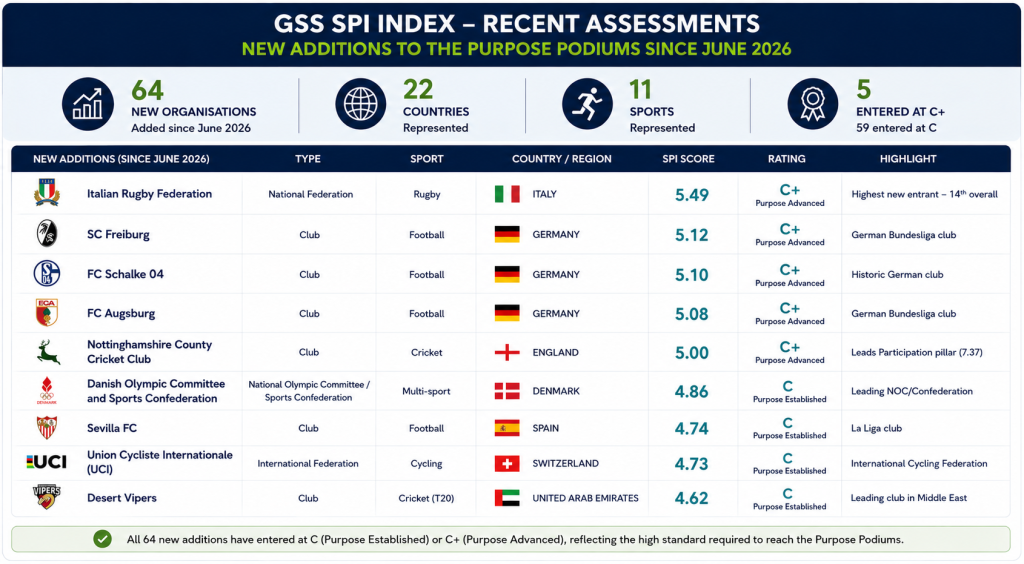
Of the 65 organisations added since launch, 60 have entered at C and five at C+, demonstrating how challenging it remains to progress beyond an established level of sustainability, purpose and impact.
The leaders remain difficult to dislodge
The highest new entrant is the Italian Rugby Federation, entering at 14th with an SPI score of 5.49. It is followed by SC Freiburg on 5.12, FC Schalke 04 on 5.10, FC Augsburg on 5.08 and Nottinghamshire County Cricket Club on 5.00.
At the top, the leading group remains unchanged. UEFA is first with 6.36, ahead of Liverpool FC on 6.24, Arsenal on 6.03 and Manchester City on 6.01.
They remain the only four organisations to have reached the B level, while no organisation has yet achieved an A or A+ rating.
Mike Laflin, Founder and CEO of Global Sustainable Sport, said: “Reaching over 300 in-depth assessments was always the point at which the Index becomes genuinely comparative. With 165 organisations making the podiums across 25 countries and 31 sports, we can now say something meaningful about how a German club compares with a Spanish one, or how a county cricket club compares with an international federation. That was not possible in June.”
"Reaching over 300 in-depth assessments was always the point at which the Index becomes genuinely comparative. With 165 organisations making the podiums across 25 countries and 31 sports, we can now say something meaningful about how a German club compares with a Spanish one, or how a county cricket club compares with an international federation. That was not possible in June."
Seven Pillars reveal different forms of leadership
The picture changes when the overall rankings are broken down across the seven Sustainable Pillars of Sport.
No organisation leads them all.
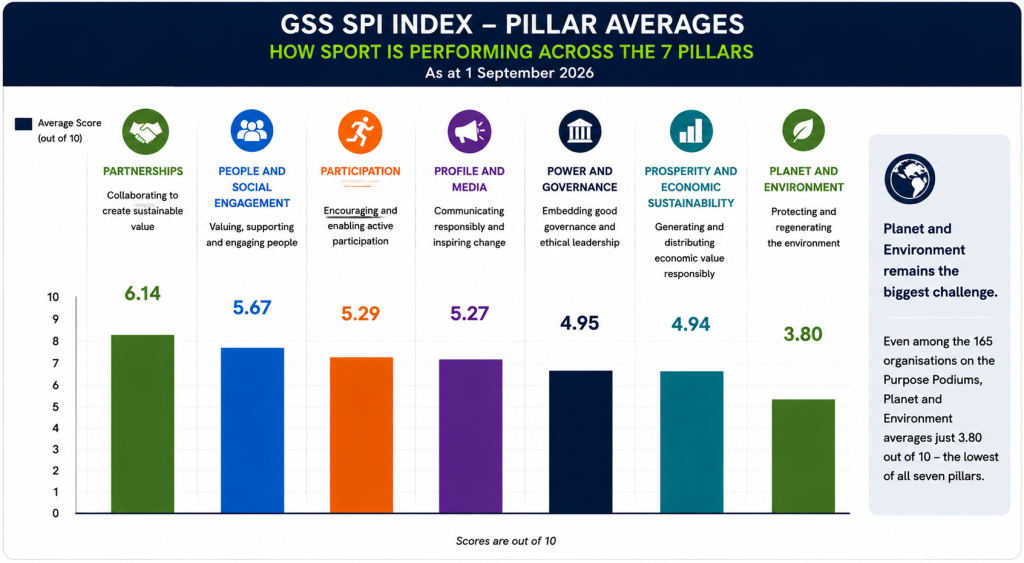
The Premier League leads Partnerships with 8.12, ahead of the International Olympic Committee on 8.10 and UEFA on 8.05. Across the Podiums, Partnerships averages 6.14, with 95 of the 165 organisations scoring above 6.00.
Nottinghamshire County Cricket Club provides the most striking result: despite entering the overall Index at 47th, it leads Participation with 7.37.
Arsenal leads People and Social Engagement on 7.48, while the Premier League tops Power and Governance on 6.53. UEFA leads Prosperity and Economic Sustainability with 6.20.
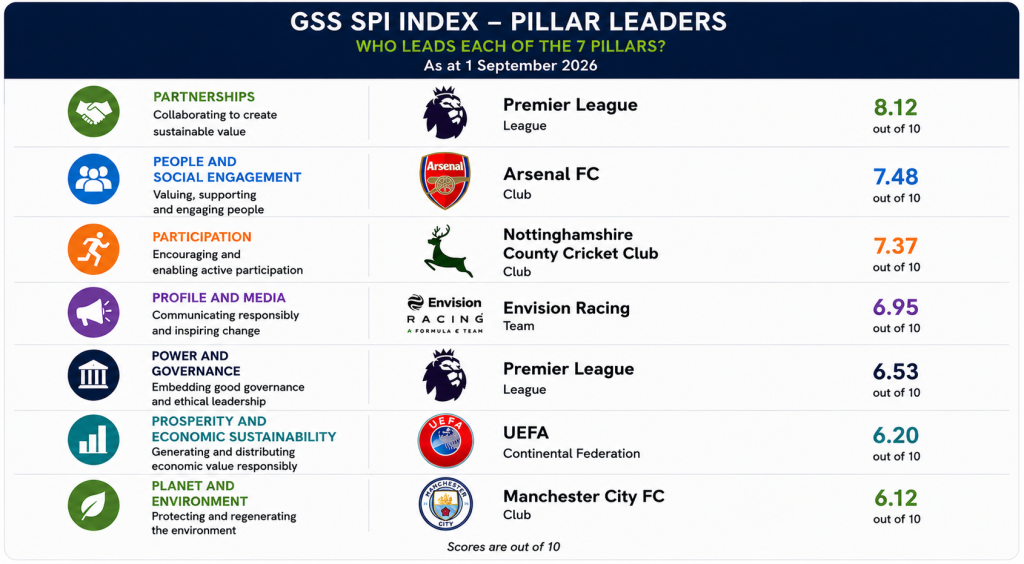
Envision Racing is another example. Despite sitting outside the overall Top 100, the Formula E team leads the entire Index on Profile and Media, scoring 6.95. Manchester City leads Planet and Environment on 6.12, followed by 11th Hour Racing, Formula E and SailGP.
It demonstrates that leadership does not belong exclusively to the largest or wealthiest organisations. A club, league, federation or team can create distinctive value in different areas, and the seven-pillar framework provides a way of identifying it.
Laflin believes that distribution is one of the most important findings to emerge so far: “What encourages me is that the leading positions in the individual pillars are not all held by the biggest organisations. Envision Racing leads on Profile and Media, Nottinghamshire leads on Participation. Scale helps, but it is not the deciding factor. Measurement, reporting and evidence are the key.”
"What encourages me is that the leading positions in the individual pillars are not all held by the biggest organisations. Envision Racing leads on Profile and Media, Nottinghamshire leads on Participation. Scale helps, but it is not the deciding factor. Measurement, reporting and evidence are the key."
Football dominates, but Germany demonstrates depth
Football remains the largest cohort, accounting for 77 of the 165 organisations. Completing assessments of the Premier League, Bundesliga and La Liga now allows comparisons to move beyond individual clubs towards the performance of entire football systems.
England accounts for 46 organisations across all sports, averaging 4.78. UK-wide, with Scotland, Wales and Northern Ireland, British organisations currently hold 64 of the 165 places.
Germany is the second largest single-country cohort with 20 organisations, averaging 4.85. Eighteen of those 20 are clubs. FC St. Pauli leads the German group on 5.38, followed by Borussia Mönchengladbach on 5.34 and Borussia Dortmund and VfL Wolfsburg on 5.33. It is currently the deepest club-level showing of any country in the Index.
Spain has 14 organisations, headed by Atlético de Madrid and FC Barcelona, while the Italian and French pictures should become clearer as their assessment programmes are completed.
Cricket creates a new benchmark
One of the biggest changes since June has come from cricket. Thirteen clubs now hold Purpose Podium positions, ten of them new, creating the deepest single-sport dataset outside football.
Marylebone Cricket Club leads on 5.64, followed by Warwickshire on 5.28 and Nottinghamshire on 5.00. Eleven first-class counties are represented alongside MCC, together with the UAE’s Desert Vipers.
Yet the pillar analysis reveals something even more interesting. Nottinghamshire’s 7.37 Participation score leads all 165 organisations, despite the county sitting much further down the overall rankings.
That demonstrates why benchmarking purely through an overall score risks missing important areas of leadership, and it creates an opportunity for organisations to learn from one another.
What is Nottinghamshire doing around participation that other sporting organisations could adopt? Why does Envision Racing perform so strongly around Profile? What can football learn from sailing and motorsport about environmental action?
Those are potentially more valuable questions than simply asking who ranks first.
Leagues lead, but consistency may matter more
Analysis by organisation type reveals another pattern. The ten leagues on the Index average 4.94, the highest of any category. National federations and clubs both average 4.74, international federations 4.64 and National Olympic Committees 4.63.
North America follows the same pattern, with the NBA 16th overall on 5.46, ahead of the NFL on 4.61 and the NHL on 4.29.
But averages tell only part of the story.
FC St. Pauli has the narrowest gap between its strongest and weakest pillar, just 0.77 points, followed by Real Betis on 0.98 and Juventus on 1.28. Others show exceptional strength in one or two areas but much weaker evidence elsewhere.
That distinction is central to the SPI philosophy. Purpose cannot simply be a campaign, sponsorship activation or sustainability report. To become embedded within an organisation, it needs to run through governance, people, participation, environmental performance, partnerships, communications and economic activity.
Planet remains the biggest challenge
One finding from June has not changed: Planet and Environment remains sport’s weakest pillar.
The June analysis found Planet averaging only 0.93 across the much wider validated dataset, against 3.40 for Partnerships. Even among the 165 organisations already on the Purpose Podiums, Planet averages 3.80 against 6.14 for Partnerships. Forty-two score below 3.00 and only 35 exceed 5.00.
It remains a major challenge, but also a significant opportunity for organisations capable of demonstrating genuine environmental leadership.
Changing the narrative around the value of sport
Passing 150 organisations is important not because the Purpose Podiums have become bigger, but because the evidence behind them is becoming richer.
Sport already understands how to measure audiences, attendances, broadcast reach, tourism, sponsorship exposure and economic impact. What it has lacked is an equally recognisable way of describing and comparing its sustainability, purpose and societal impact.
That distinction matters because the relationship between sport, society and commerce is changing. Supporters increasingly want to understand what the organisations they follow stand for. Businesses are under growing pressure to demonstrate their own environmental and social contribution. Governments and communities want evidence that sport delivers value beyond the competition itself.
If credible measurement can demonstrate how organisations contribute to communities, participation, inclusion, environmental action, good governance and economic sustainability, purpose itself can become an asset.
Rather than partnerships being based predominantly around audience size, hospitality and brand exposure, purpose can become part of the value exchange, allowing brands to associate with organisations whose values and environmental and social performance complement their own. Fans, meanwhile, can understand more about the contribution their clubs are making beyond the field of play.
The June findings showed that sport remains considerably better at demonstrating Awareness and Activity than Impact. Organisations increasingly talk about sustainability and launch programmes, but fewer measure and publish the outcomes they achieve. That remains the challenge at the heart of the SPI programme.
Commenting on this second phase of the SPI programme Laflin stated: “Ultimately, this is about changing the way we understand the value of sport. Sporting success will always matter, as will audiences, revenues and commercial reach, but there is another story that needs to be told. We want the SPI Index to provide a credible way of demonstrating that value – showing brands, fans, governments and communities which organisations are putting purpose at the heart of what they do and, most importantly, the impact they are creating.”
"Ultimately, this is about changing the way we understand the value of sport. Sporting success will always matter, as will audiences, revenues and commercial reach, but there is another story that needs to be told. We want the SPI Index to provide a credible way of demonstrating that value – showing brands, fans, governments and communities which organisations are putting purpose at the heart of what they do and, most importantly, the impact they are creating."
The Purpose Podiums have now passed 150, and the ambition is to exceed 250 by the end of the year. But the objective is not to fill a table with ever more organisations. It is to create a new framework for sport, and a new commercial model capable of demonstrating a different kind of sporting success beyond the field of play: how sustainable, purposeful and impactful a sports organisation is, year on year.
Because the future value of sport may not be measured only by how many people watched, how much money was generated or how much exposure a sponsor received, but by the positive impact sport can prove it has made.
Join the GSS SPI Assessment Programme
Global Sustainable Sport is continuing its assessment programme throughout 2026, with the ambition of more than 250 organisations reaching the Purpose Podiums by the end of the year.
Sports organisations interested in understanding their sustainability, purpose and impact performance can join the GSS SPI Assessment Programme. Each in-depth assessment provides analysis across the seven Sustainable Pillars of Sport, access to results through the GSS DataHub and, shortly, an individual SPI Assessment Report highlighting performance, strengths and opportunities for improvement.
To find out more about the GSS SPI Assessment Programme or request an assessment, contact Global Sustainable Sport by registering here.
Read moreGlobal Sustainable Sport







Join the GSS Alliance Partners programme today
Stay ahead of the game with our FREE weekly newsletter, delivering the latest sport and sustainability news from around the globe straight to your inbox


11th Hour Racing
Join the GSS Network programme today

15-16 October, 2026
Gtech Community Stadium,
London (UK)
The SPX Purpose League Summit is a working summit for decision-makers interested in activating sport in a purpose-led way. Attendees will leave with an aligned peer network, data-backed insights, and the strategic commercial toolkits to transform sponsorship from an outsourced marketing expense into the single greatest driver of value.



Register for GSS Workshops today
Join the GSS Education programme today