
To access our unique news archive of over 1,400 articles with insights on over 500+ sustainable sports organisations, join the GSS Network today.
Login here if you are a registered network subscriber.
News article
Climate resilience is now a leadership issue for global sport, warns Marsh
Climate change is rapidly becoming one of the most significant challenges facing the global sports industry, threatening not only the delivery of major events but also the financial sustainability, reputation and long-term viability of sporting organisations. A new report from Marsh, Changing the Playbook: Climate Risk in the Global Sports Industry, warns that international federations (IFs), governing bodies and event organisers must move beyond environmental commitments and place climate resilience at the heart of their strategic decision-making.
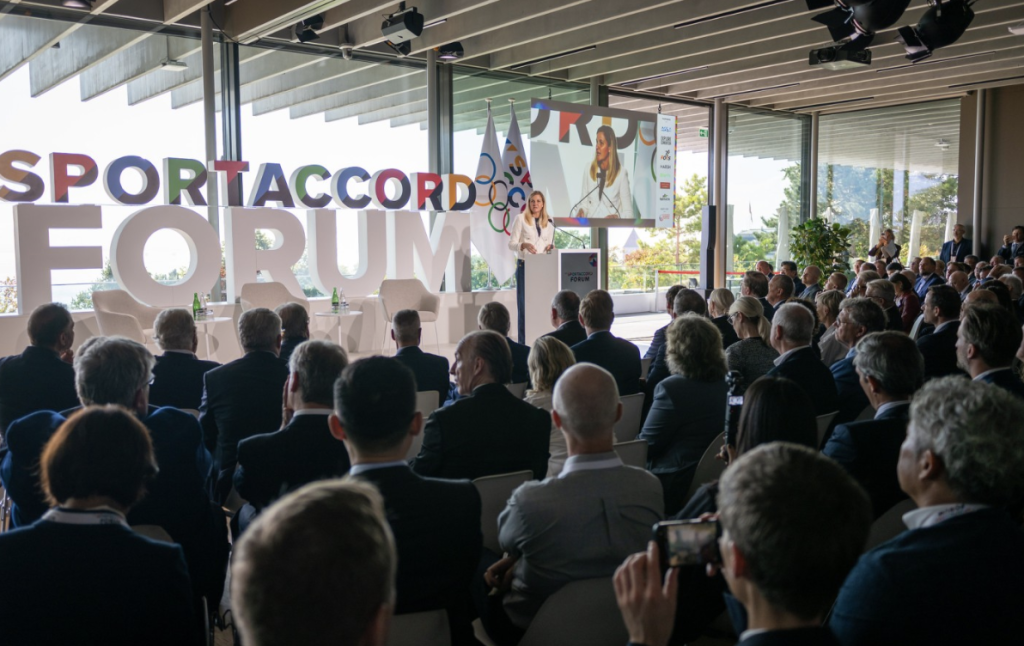
Speaking to Global Sustainable Sport following his presentation at the SportAccord IF Forum in Switzerland, Richard Tolley, Managing Director of Marsh reinforced the report’s central message: climate change is no longer simply an environmental concern but an increasingly important commercial, operational and governance issue for sport.
A trillion-dollar challenge
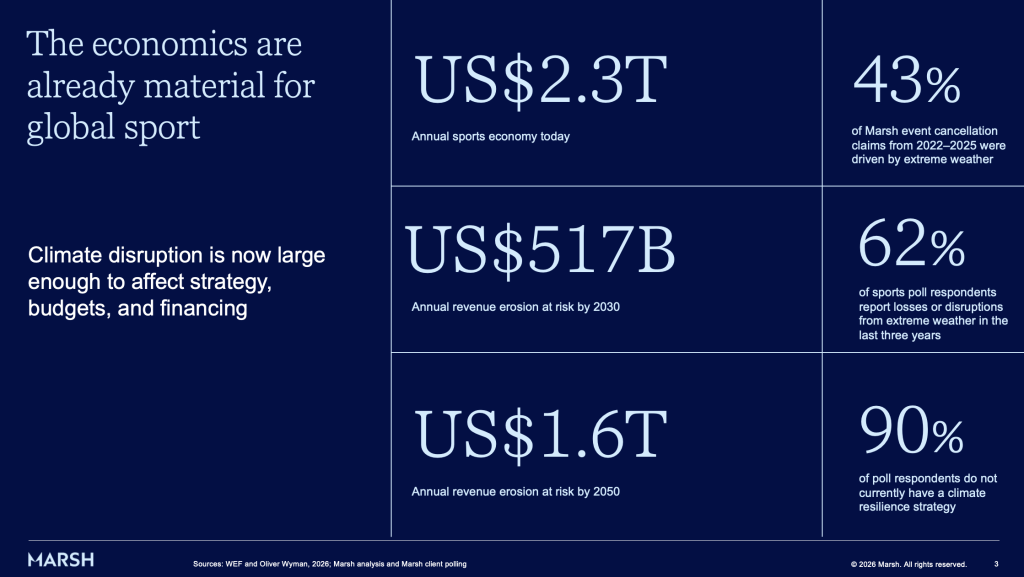
The scale of the challenge is substantial. Research from the World Economic Forum and Oliver Wyman (a Marsh company) estimates that the global sports economy currently generates approximately US$2.3 trillion annually, but faces potentially significant revenue losses as climate change, nature loss and physical inactivity threaten its future growth.
Marsh’s own research highlights how these risks are already materialising. Between 2022 and 2025, extreme weather accounted for 43% of Marsh’s event cancellation claims. Meanwhile, 62% of respondents to its sports industry poll reported losses or disruption from extreme weather over the previous three years.
Perhaps most concerning is the gap between awareness and action: 90% of respondents reported having no climate resilience strategy.
As Tolley’s presentation emphasised:
“What begins as weather quickly becomes a revenue, trust, and operating issue.”
For IFs responsible for international competition calendars, athlete welfare, event hosting and the development of their sports, these findings raise fundamental questions about how future competitions will be organised and financed.
"What begins as weather quickly becomes a revenue, trust, and operating issue."
Climate change is already reshaping sport
The report identifies numerous examples of climate-related disruption across the sporting landscape.
The 2026 FIFA World Cup in North America provided a major test of event resilience, with severe heat and thunderstorms disrupting matches and increasing pressure on organisers to protect players and spectators.
In Brazil, major stadiums have suffered significant flooding, while Hurricane Milton forced Florida’s Tropicana Field out of use, with repair costs approaching US$60 million.
Winter sports face particularly serious long-term challenges. Research cited by Marsh suggests that approximately half of former Winter Olympic host cities may no longer be climatically viable by 2050.
These examples demonstrate that climate change is already influencing competition schedules, venue investment, medical protocols and hosting decisions.
For IFs, the implications extend beyond individual events. Changing weather patterns could fundamentally alter where sports can be played, when competitions can take place and whether some traditional venues remain viable.
Four dimensions of climate risk
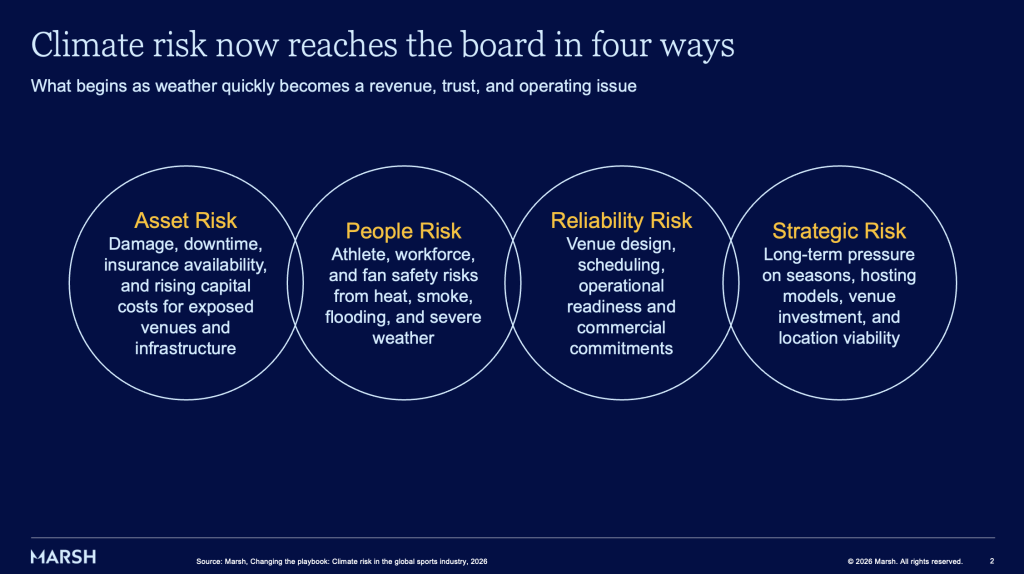
Marsh identifies four interconnected areas of exposure that should concern sports leaders.
Asset risk includes damage to venues and infrastructure, rising maintenance costs and insurance availability.
People risk concerns the safety of athletes, officials, employees and spectators exposed to extreme heat, flooding, smoke and severe weather.
Reliability risk reflects the growing challenge of delivering competitions consistently and safely.
Strategic risk encompasses the long-term viability of hosting models, competition calendars and investment decisions.
Together, these risks underline why climate resilience can no longer remain the responsibility of sustainability departments alone.
It must become a board-level priority, integrated into governance, financial planning and operational management.
From crisis management to resilience
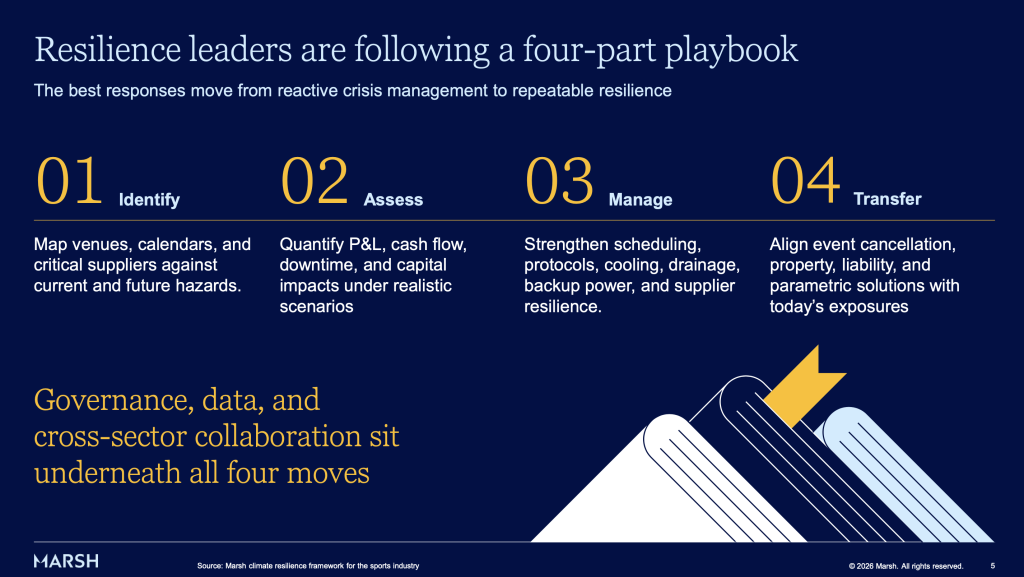
Marsh proposes a four-stage framework to help organisations respond: Identify, Assess, Manage and Transfer.
The first step involves mapping venues, events, competition calendars and critical suppliers against current and future climate hazards.
Organisations must then assess the potential financial consequences, including lost revenue, business interruption, infrastructure costs and reputational damage.
The third stage focuses on practical adaptation measures, including revised scheduling, improved cooling and drainage systems, emergency protocols and more resilient supply chains.
Finally, organisations should review insurance and other risk-transfer arrangements to ensure they reflect changing exposures.
For IFs, this framework offers a practical route towards building climate resilience into event bidding processes, host agreements, competition regulations and long-term development strategies.
Leadership must drive change
Tolley’s presentation concluded with five actions that sports organisations could implement within the next 12 months: appoint an executive owner and board sponsor, assess exposure across priority events and venues, quantify potential financial disruption, prioritise resilience investments and review insurance arrangements.
The underlying message from Tolley was clear:
“The leaders who act early will better protect people, revenues, and trust.”
For international federations, this requires collaboration with national federations, event organisers, host cities, venues, commercial partners and insurers.
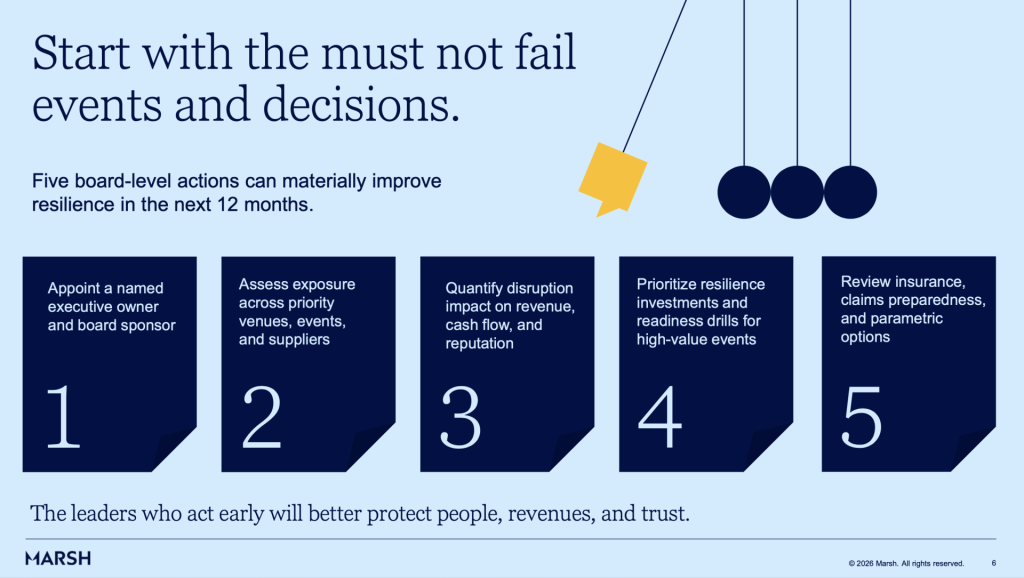
"The leaders who act early will better protect people, revenues, and trust."
It also means recognising that climate resilience is not simply about protecting major international competitions. The effects of extreme weather on grassroots facilities, participation and community sport could have profound consequences for the future development of individual sports.
A new responsibility for global sport
The Marsh findings highlight an important shift in the sustainability debate.
For many years, attention has focused on how sport contributes to climate change through travel, infrastructure, energy consumption and major events. Increasingly, the industry must also consider how climate change threatens sport itself.
Reducing environmental impact remains essential, but it must be accompanied by adaptation, financial resilience and stronger governance.
For IFs, climate resilience is becoming inseparable from their responsibility to protect athletes, safeguard competitions, support member federations and secure the long-term future of their sports.
The challenge is no longer simply to make sport more environmentally sustainable. It is to ensure that sport itself remains sustainable in a changing climate.
Read moreMarsh



















Join the GSS Alliance Partners programme today
Stay ahead of the game with our FREE weekly newsletter, delivering the latest sport and sustainability news from around the globe straight to your inbox



11th Hour Racing
Join the GSS Network programme today

15-16 October, 2026
Gtech Community Stadium,
London (UK)
The SPX Purpose League Summit is a working summit for decision-makers interested in activating sport in a purpose-led way. Attendees will leave with an aligned peer network, data-backed insights, and the strategic commercial toolkits to transform sponsorship from an outsourced marketing expense into the single greatest driver of value.



Register for GSS Workshops today
Join the GSS Education programme today