
To access our unique news archive of over 1,400 articles with insights on over 500+ sustainable sports organisations, join the GSS Network today.
Login here if you are a registered network subscriber.
News article
Top storyDoes rugby need a new commercial model? £366m debt crisis raises questions about the future of Premiership Rugby
English professional rugby is entering a new era of investment and structural reform, but rising losses, mounting debt and declining revenues continue to raise fundamental questions about its financial sustainability. Could a broader commercial model, recognising the social, environmental and community value of rugby, offer another opportunity for growth?

The Leonard Curtis Rugby Finance Report 2026, launched at The Berkeley Hotel in London on 3 November, reveals that Premiership Rugby’s ten clubs recorded combined losses of £36.5 million in 2024/25, with total debts reaching £366.1 million.
Despite growing investor interest and the transition towards a franchise-style competition, the report highlights the continuing challenges facing English professional rugby.
Presenting the findings, Professor Rob Wilson, co-author of the report and Provost at the University Campus of Football Business (UCFB), warned that investment alone would not resolve the sport’s financial difficulties.
“New capital is encouraging, but access to investment should not be confused with financial sustainability,” he said.
“The real test is whether clubs can convert that investment into stronger revenues, wider audiences and viable long-term business models.”
"New capital is encouraging, but access to investment should not be confused with financial sustainability ... the real test is whether clubs can convert that investment into stronger revenues, wider audiences and viable long-term business models."
Rising losses and mounting debt
The third annual Leonard Curtis report provides a detailed assessment of the financial performance of English professional rugby over the past decade.
Combined club revenues declined from £182.2 million in 2023/24 to £178.9 million in 2024/25, while total wage expenditure increased from £125.9 million to £129.8 million.
The average wage-to-revenue ratio rose from 75% to 80%, marking the third consecutive annual increase.
Meanwhile, combined losses increased from £34 million to £36.5 million, equivalent to approximately £3.7 million per club annually.
Six of the ten Premiership clubs remain balance sheet insolvent.
Alex Cadwallader, Leonard Curtis director and former England Under-21 rugby international, acknowledged the scale of the challenge.
“The figures show Prem Rugby sides have continued to make a combined loss of over £30m each year and highlight the significant challenges that remain within the game,” he said.
“Without any deep structural or governance changes, why would we expect the results to be any different?”
However, the financial figures largely predate the latest structural changes, meaning their impact has yet to be reflected in the accounts.
"The figures show Prem Rugby sides have continued to make a combined loss of over £30m each year and highlight the significant challenges that remain within the game ... without any deep structural or governance changes, why would we expect the results to be any different?"
Franchising offers a new beginning
Prem Rugby’s transition towards a franchise-style competition represents one of the most significant structural changes in English professional rugby.
By removing automatic relegation, the new model provides greater financial certainty for investors and creates opportunities for longer-term commercial planning.
The changes have coincided with significant investment from organisations and individuals including Red Bull, Sir James Dyson and Black Knight Sports and Entertainment.
Leonard Curtis estimates that a more centralised franchise structure could generate annual savings of between £1.1 million and £1.9 million for a club with £20 million in turnover.
Simon Danielli, former Scotland international and now head of investor relations and operations at private equity firm Agathos, believes the changes could transform rugby’s investment prospects.
“A closed league gives investors something rugby has never offered before: visibility of revenue and security of earnings,” he said.
"A closed league gives investors something rugby has never offered before: visibility of revenue and security of earnings,"
However, the panel acknowledged that franchising alone would not guarantee commercial success.
Greater coordination between clubs, shared services, improved governance and a more integrated commercial strategy will be essential.
Rugby has a revenue problem
One of the strongest messages emerging from the launch discussion was that rugby’s financial challenges cannot be resolved through cost reductions alone.
Danielli argued that the sport needs to focus on expanding its commercial opportunities.
“I don’t think wages are the problem. I think revenue is,” he said.
"I don't think wages are the problem. I think revenue is,"
Professor Wilson reinforced that argument, suggesting that rugby needs to develop stronger revenue streams through broadcasting, sponsorship diversification and new commercial partnerships.
The report’s new Digital Footprint Index highlights one opportunity.
Harlequins lead the digital rankings, demonstrating the potential for clubs to develop stronger relationships with supporters through social media, digital content and player engagement.
However, the panel also identified challenges associated with fragmented broadcasting schedules, limited audience growth and the difficulty of attracting younger supporters.
The report examines competitive balance, revealing that despite six different Premiership champions in six consecutive seasons, the 2025/26 competition recorded its greatest imbalance between clubs for more than a decade.
Dr Ellie Nesbitt, senior lecturer at Nottingham Trent University, highlighted the importance of maintaining competitive opportunities across the league.
The report also identifies opportunities within women’s rugby, where competitive balance has improved, although significant disparities remain between clubs.
More than a commercial asset
An important theme emerging from the discussion was the tension between rugby’s commercial ambitions and its historical position within British society.
Cadwallader described the challenge of transforming established sporting institutions into commercially sustainable businesses.
“We are trying to take cultural institutions and treat them as commercial assets,” he explained.
Unlike American professional leagues, which were largely established as commercial enterprises, English rugby clubs have developed through generations of participation, community involvement and sporting tradition.
"We are trying to take cultural institutions and treat them as commercial assets,"
Wilson reinforced the importance of recognising that heritage, describing rugby as part of the historical and cultural fabric of society.
This raises an important question about the future commercial model.
While broadcasting, sponsorship, ticketing and sporting performance remain essential revenue drivers, rugby also creates substantial value through participation, education, health, inclusion and community engagement.
The report acknowledges this wider contribution, highlighting the partnership between kitround and the London Irish Foundation.
The initiative has avoided more than 2,400 kg of CO₂e, diverted over 200 kg of sports kit from landfill and generated £10,000 for youth initiatives.
Such programmes demonstrate how environmental responsibility and community engagement can create measurable benefits beyond the professional game.
The SPI Index reveals an opportunity for rugby
The discussion also raised the question of whether Premiership Rugby could benefit from the growing emphasis on sustainability and purpose across the wider sports industry.
The GSS SPI Index independently assesses sporting organisations against more than 150 indicators across the Seven Sustainable Pillars of Sport, examining how organisations demonstrate awareness, activity and impact.
More than 70 UK sporting organisations have reached the GSS SPI Purpose Podiums, achieving ratings of C or above.
The contrast between professional rugby and other major UK sports is striking.
In English football, 14 of the 20 Premier League clubs have reached the Purpose Podiums, alongside the Premier League itself.
In cricket, eight of the ten County Championship organisations examined have achieved podium recognition along with the ECB.
Among 38 UK national sports federations, 14 have reached the Purpose Podiums.
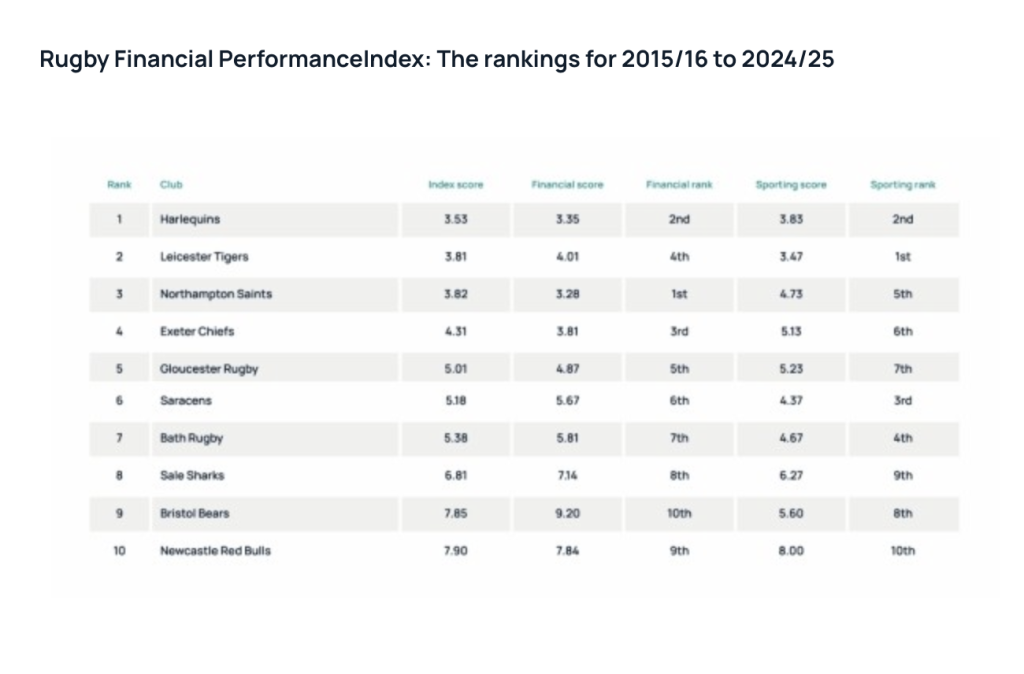
However, only one of the ten Premiership Rugby clubs has achieved podium recognition: Northampton Saints, currently ranked within the Global Top 100 and ranked number 1 in the Financial Index of the Leonard Curtis report.
Premiership Rugby itself has not reached the Purpose Podiums although the RFU has.
These findings do not suggest that rugby clubs are failing to deliver valuable community or environmental programmes. Rather, they indicate that the sport has considerable scope to strengthen how it demonstrates, measures and communicates its wider contribution.
The Leonard Curtis report provides another indication of this opportunity, identifying just two Premiership clubs that have signed up to the UN sustainability framework examined in its club profiles.
Does rugby need a new commercial model?
Speaking at the report launch, Global Sustainable Sport raised the possibility that Premiership Rugby’s new franchise structure could provide an opportunity to rethink its commercial approach.
Across the sports industry, organisations are increasingly exploring partnerships that recognise the value of year-round participation, community engagement, social impact and environmental responsibility, rather than relying exclusively on traditional media exposure.
UEFA’s evolving commercial approach provides one example of how major sporting organisations are beginning to recognise the broader value of their activities throughout the year.
Responding to the question, Cadwallader welcomed the opportunity to develop a more coordinated approach.
He acknowledged the significant health, social and community benefits generated by sport and suggested that longer-term planning and collective initiatives could help bring these opportunities into greater focus.
“There’s so much more to sport, and that’s why we’re passionate about it,” he said.
"There's so much more to sport, and that's why we're passionate about it,"
For Premiership Rugby, the opportunity may not be to replace its existing commercial model, but to expand it.
Rugby already possesses a powerful combination of sporting tradition, community engagement, participation and deeply embedded social values.
The challenge is to recognise that broader contribution, measure its impact and develop commercial partnerships that reflect the value being created.
The Leonard Curtis report demonstrates why English professional rugby needs stronger financial foundations. The transition towards franchising offers an opportunity to establish them.
But as the wider sports industry increasingly recognises the commercial value of sustainability and purpose, Premiership Rugby has an opportunity to develop a business model that reflects not only the value of the professional game, but the contribution rugby makes to society throughout the year.
Perhaps the future of rugby’s commercial sustainability lies not simply in generating more revenue from what it already sells, but in recognising the full value of what it already delivers.
Read moreLeonard Curtis



















Join the GSS Alliance Partners programme today
Stay ahead of the game with our FREE weekly newsletter, delivering the latest sport and sustainability news from around the globe straight to your inbox




11th Hour Racing
Join the GSS Network programme today





Register for GSS Workshops today
Join the GSS Education programme today