
To access our unique news archive of over 1,400 articles with insights on over 500+ sustainable sports organisations, join the GSS Network today.
Login here if you are a registered network subscriber.
News article
Top story200+ Purpose Podiums: How sustainability and purpose are creating new commercial opportunities across global sport
Global Sustainable Sport has reached a significant milestone, with over 200 sporting organisations now recognised on its SPI Purpose Podiums, representing 35 sports across 30 nations. The findings highlight the growing importance of sustainability and purpose, not simply as organisational responsibilities, but as drivers of strategic development and commercial opportunity across global sport.
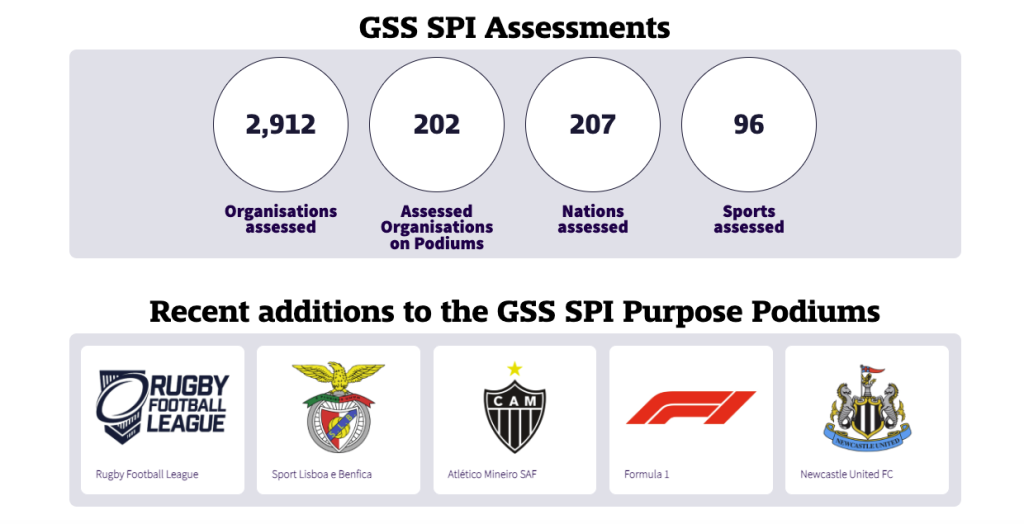
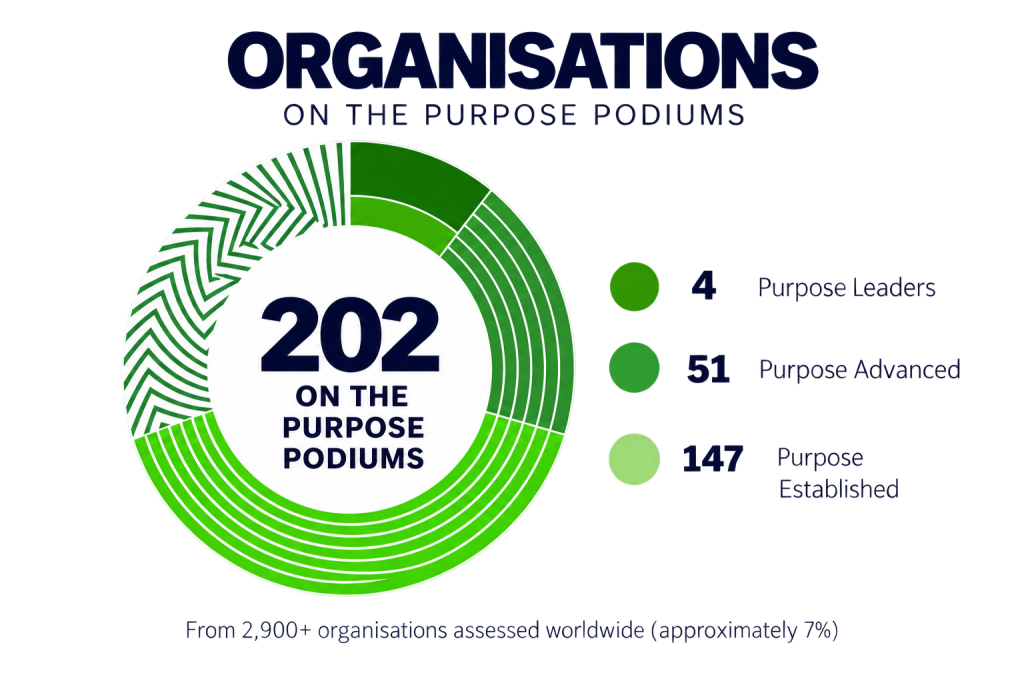
The latest results from the Global Sustainable Sport (GSS) Sustainable, Purposeful and Impactful (SPI) Index reveal both the progress being made and the considerable challenges ahead. Of more than 2,900 organisations assessed worldwide, only around 7% have achieved the level of publicly demonstrable sustainability performance required to reach the Purpose Podiums. But those 202 that have reached the podiums are demonstrating what can be achieved and helping to show the way forward for the wider global sports industry.
The significance of this milestone extends beyond recognition and rankings. As sporting organisations increasingly seek to attract commercial partners, engage communities and demonstrate their wider contribution to society, sustainability and purpose are becoming important elements of their commercial proposition. The ability to demonstrate meaningful activity and measurable impact is increasingly valuable.
From 5,000 organisations to 200 Purpose Podiums
The SPI programme began with an ambitious objective: to develop a comprehensive, independent assessment of sustainability across the global sports industry.
GSS initially identified more than 5,000 sporting organisations worldwide. However, over 2,000 had no accessible website or sufficient online presence to enable a meaningful assessment, highlighting an important challenge around transparency and accessibility.
Of the remaining organisations, just over 2,900 have now been analysed, covering a wide variety of sports, nations and organisational structures.
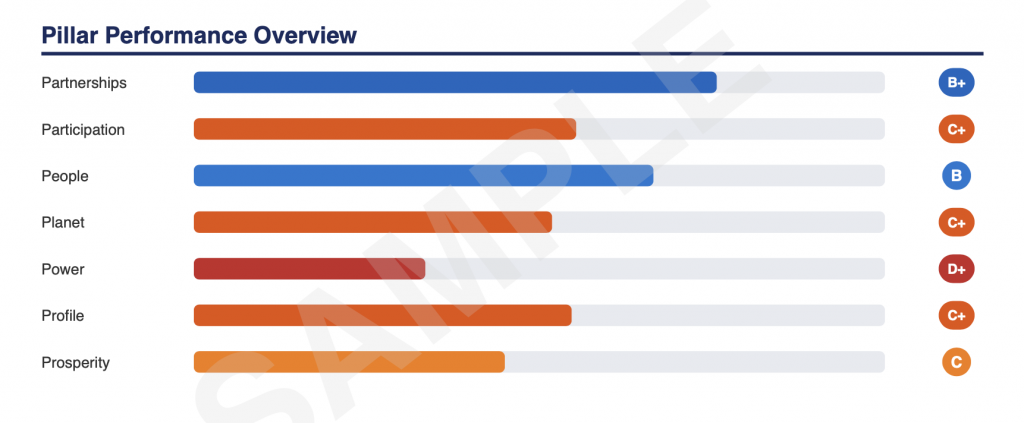
Using agentic AI combined with human expertise, GSS evaluates publicly available evidence against more than 150 criteria, examining performance across its Seven Sustainable Pillars of Sport: Partnerships, Participation, People, Planet, Power, Profile and Prosperity.
The Index is designed not simply to recognise sustainability leadership, but to help organisations understand their performance, identify opportunities and progress from awareness through activity to measurable impact.
Football leads, but the landscape is changing
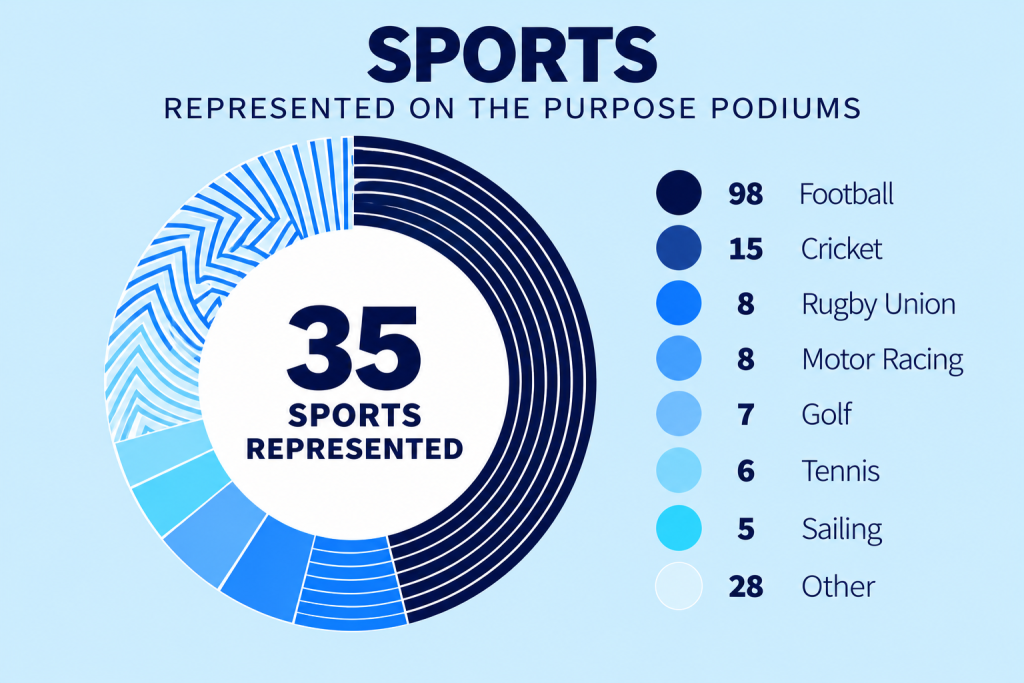
Football remains the largest contributor to the Purpose Podiums, with 98 organisations represented.
European football is particularly prominent, with clubs from the Premier League, Bundesliga, La Liga, Serie A and Ligue 1 demonstrating increasingly sophisticated approaches to sustainability.
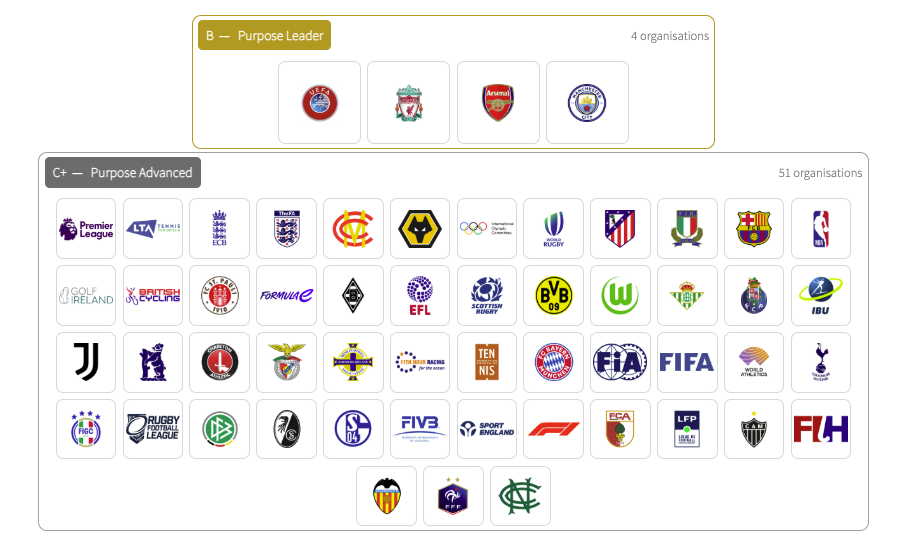
UEFA, Liverpool, Arsenal and Manchester City have all achieved a B rating, placing them among the highest-performing organisations assessed through the SPI Index. Their performance reflects the growing integration of sustainability, purpose and impact into the strategies and operations of major football organisations.
Importantly, 18 European national football federations have also reached the Purpose Podiums, making them one of the largest identifiable groups within the SPI Index. Their representation highlights the growing commitment to embedding sustainability throughout European football, from national governance and grassroots participation to professional competitions and community engagement.
However, football accounts for fewer than half of the organisations on the Purpose Podiums.
The remaining 104 organisations represent a broad range of sports, highlighting how sustainability leadership is spreading beyond football’s considerable commercial and institutional resources.
Cricket has 15 organisations represented, followed by rugby union and motor racing with eight each, golf and Olympic organisations with seven each, and tennis with six.
Athletics and sailing also feature prominently, alongside basketball, cycling, volleyball and numerous other sports.
This diversity demonstrates that meaningful progress is possible across different sporting structures, financial models and organisational sizes.
A global picture of sustainability leadership
The geographical distribution of the Purpose Podiums provides another revealing perspective.
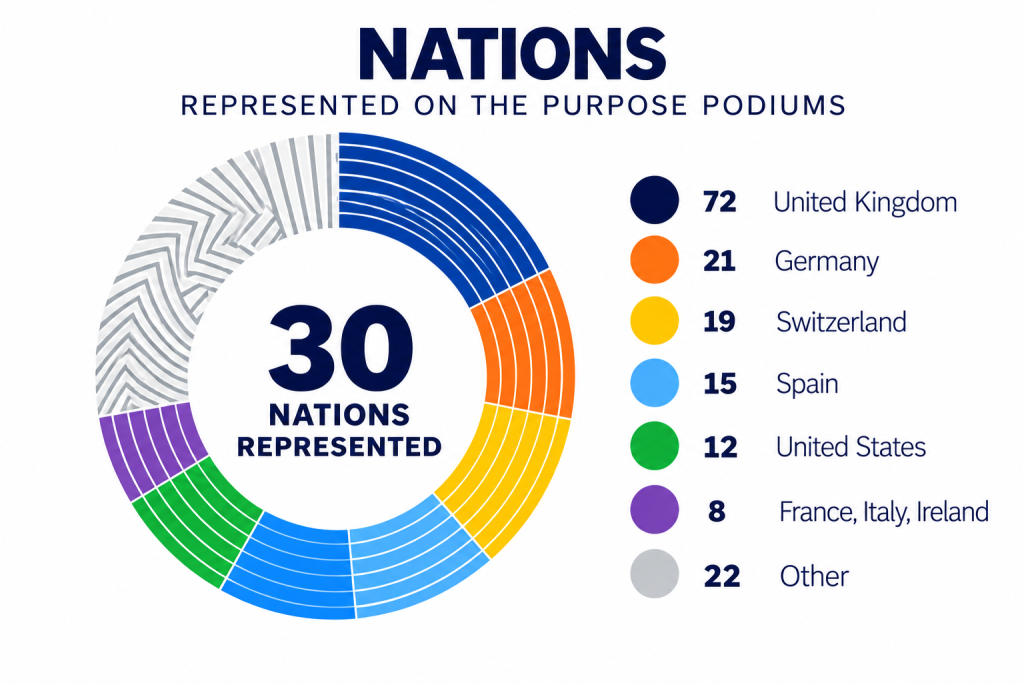
The United Kingdom currently has the largest representation, with 72 organisations, followed by Germany with 21, Switzerland with 19, Spain with 15 and the United States with 12.
France, Italy and Ireland also have strong representation, while organisations from Australia, New Zealand, Brazil, Canada, South Africa, Japan and Malaysia demonstrate the international reach of the programme.
In total, 30 nations are represented on the Purpose Podiums, reflecting the increasingly global nature of sustainability leadership.
Europe’s prominence partly reflects the maturity of sustainability reporting and governance expectations across the region, alongside the substantial concentration of international sporting institutions.
However, the emergence of organisations from other continents illustrates how sustainability is becoming an increasingly global consideration.
The challenge now is to ensure that leadership is not determined simply by geography, resources or access to specialist expertise.
Leadership across the sporting ecosystem
One of the most interesting findings is the diversity of organisations appearing towards the top of the Index.
Alongside leading football organisations are the Lawn Tennis Association, England and Wales Cricket Board, International Olympic Committee, World Rugby, NBA, Golf Ireland, British Cycling, Formula E and International Biathlon Union.
And sustainability leadership is not confined to the largest international federations, professional leagues or commercially successful clubs. Smaller organisations, including Desert Vipers from Dubai, Munster Rugby from Ireland and BSC Young Boys from Switzerland, are also demonstrating how sustainability and purpose can become integral to their operations and wider engagement with communities.
These organisations operate in very different environments, with contrasting governance structures, commercial models and stakeholder responsibilities.
Yet each is demonstrating publicly identifiable progress towards embedding sustainability within its operations.
The presence of international federations is particularly important. Unlike individual clubs or teams, federations have the opportunity to influence entire sporting ecosystems through their relationships with national associations, athletes, event organisers and commercial partners.
Similarly, professional leagues can establish common expectations, share knowledge and support clubs that may lack the resources to develop comprehensive sustainability programmes independently.
This potential multiplier effect, combined with the commitment of smaller organisations to demonstrate what is possible, represents one of sport’s greatest opportunities.
Recognising progress, not just excellence
The SPI Purpose Podiums recognise organisations achieving an overall score of 4.00 or above.
The latest results include four organisations classified as Purpose Leaders, 51 as Purpose Advanced and 147 as Purpose Established.
While a relatively small number have reached the highest levels of performance, a much larger group is establishing the foundations for sustained progress.
For GSS, this distinction is fundamental.
Sustainability should not be regarded as a competition in which only the highest-ranked organisations are recognised.
Instead, the Index provides a framework for understanding progress, identifying opportunities and encouraging continuous improvement.
Organisations currently outside the Purpose Podiums may already be undertaking valuable initiatives but have yet to demonstrate sufficient evidence across the Seven Pillars.
Others may have well-developed sustainability strategies but limited public reporting of their outcomes.
In both cases, greater transparency can help organisations communicate their contribution more effectively.

From external perception to commercial opportunity
The SPI Index is deliberately based on publicly available information, examining what a fan, participant, sponsor, commercial partner or other stakeholder can discover about an organisation’s sustainability activities and impact.
This external perspective is becoming increasingly important, not simply for transparency and accountability, but also for commercial development.
Organisations that can demonstrate a clear purpose, supported by credible evidence of activity and impact, are potentially better positioned to attract commercial partners, engage audiences, strengthen stakeholder relationships and develop new revenue opportunities.
This changing relationship between purpose and commercial performance was a central theme at the recent SPX Purpose League Summit, held at Brentford FC in London, where GSS was a media partner.
Guillaume Sabran, UEFA’s Chief of Sponsorship and Licensing, described how commercial partners are increasingly seeking relationships that extend beyond traditional sponsorship arrangements.
“Purpose is not separate from business, but it’s actually a catalyst for better business,” he explained.
“Purpose is not separate from business, but it's actually a catalyst for better business,”
Richard Ames, Head of Commercial Acquisitions at The FA, reinforced the importance of integrating purpose within an organisation’s commercial proposition.
“Focus on the three Ps: Purpose, Positioning, Platform,” he told delegates, emphasising that purpose should inform how organisations position themselves commercially rather than simply being added to existing sponsorship packages.
The discussions demonstrated how sustainability and purpose are increasingly becoming commercial differentiators, helping organisations develop partnerships that deliver financial, social and environmental value.
“Focus on the three Ps: Purpose, Positioning, Platform,”
For GSS, this reinforces the importance of examining sustainability holistically, particularly through the interconnected Partnerships, Profile and Prosperity Pillars.
An organisation’s ability to demonstrate its purpose externally can influence not only how it is perceived, but also the commercial opportunities available to it.
From 200 Purpose Podiums to a more sustainable sporting future
Reaching 202 organisations represents an important milestone for Global Sustainable Sport and the wider sports industry, but it is also a reminder of the scale of the opportunity ahead.
The global sports industry encompasses thousands of governing bodies, federations, leagues, clubs, teams, venues, event organisers and commercial organisations. Every one of these has the potential to contribute to a more sustainable, purposeful and impactful sporting ecosystem.
The next stage of the SPI programme will focus on expanding its global coverage, deepening its assessments and helping organisations translate sustainability awareness into meaningful activity and measurable impact.
With just over two months remaining in 2026, GSS is encouraging sporting organisations to discover where they stand on the SPI Index and explore what they can do to strengthen their sustainability performance. Could the Purpose Podiums reach 300 organisations by the end of 2026?
For organisations already assessed, this provides an opportunity to understand their current rating, identify areas for improvement and demonstrate more effectively the sustainability activities and impact they are creating.
For those not yet assessed, the SPI programme offers an independent, evidence-based perspective on their sustainability performance and the opportunity to work towards recognition on the Purpose Podiums.
As sustainability and purpose become increasingly important to commercial partners, stakeholders and communities, the ability to demonstrate credible progress will become an ever more valuable organisational asset.
The first 200 organisations on the SPI Purpose Podiums demonstrate what is already being achieved. With two months remaining in 2026, the question for sporting organisations is simple: how sustainable, purposeful and impactful is your organisation?
Discover the GSS SPI Purpose Podiums and contact Global Sustainable Sport to learn more about the SPI Assessment Programme.
Read moreGlobal Sustainable Sport












Join the GSS Alliance Partners programme today
Stay ahead of the game with our FREE weekly newsletter, delivering the latest sport and sustainability news from around the globe straight to your inbox


11th Hour Racing
Join the GSS Network programme today

15-16 October, 2026
Gtech Community Stadium,
London (UK)
The SPX Purpose League Summit is a working summit for decision-makers interested in activating sport in a purpose-led way. Attendees will leave with an aligned peer network, data-backed insights, and the strategic commercial toolkits to transform sponsorship from an outsourced marketing expense into the single greatest driver of value.




Register for GSS Workshops today
Join the GSS Education programme today