
To access our unique news archive of over 1,400 articles with insights on over 500+ sustainable sports organisations, join the GSS Network today.
Login here if you are a registered network subscriber.
News article
Beyond the Running Boom: What Comes Next for the World’s Most Accessible Sport?
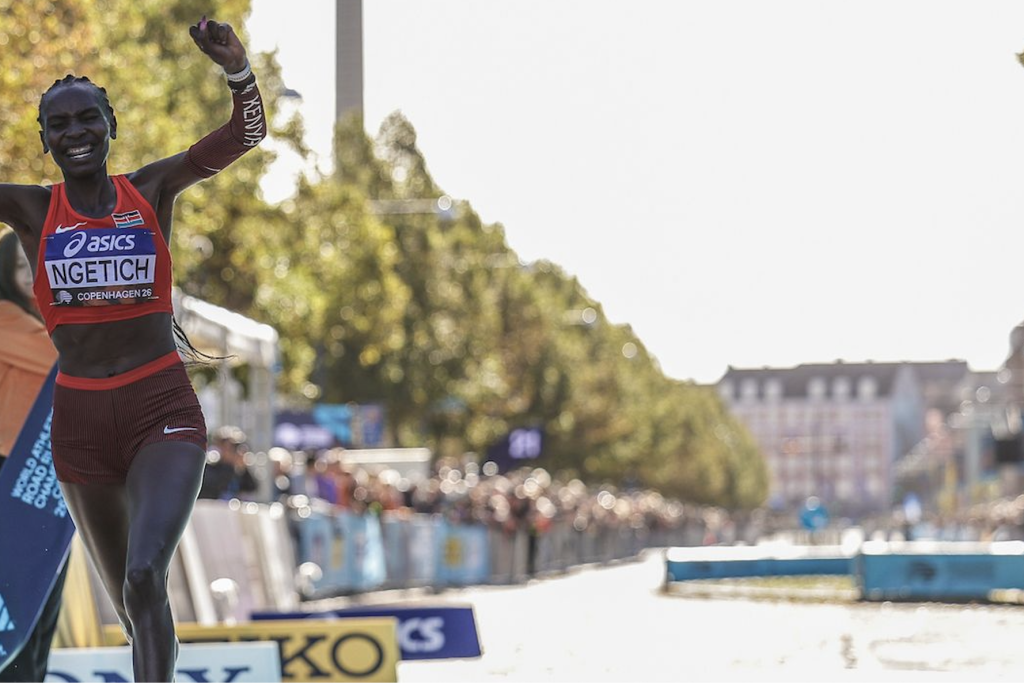
Running is booming. Participation is growing, major races are selling out, younger generations are entering the sport and cities around the world are embracing mass participation events. But in Copenhagen last week, the conversation was less about celebrating that growth than understanding what should come next.
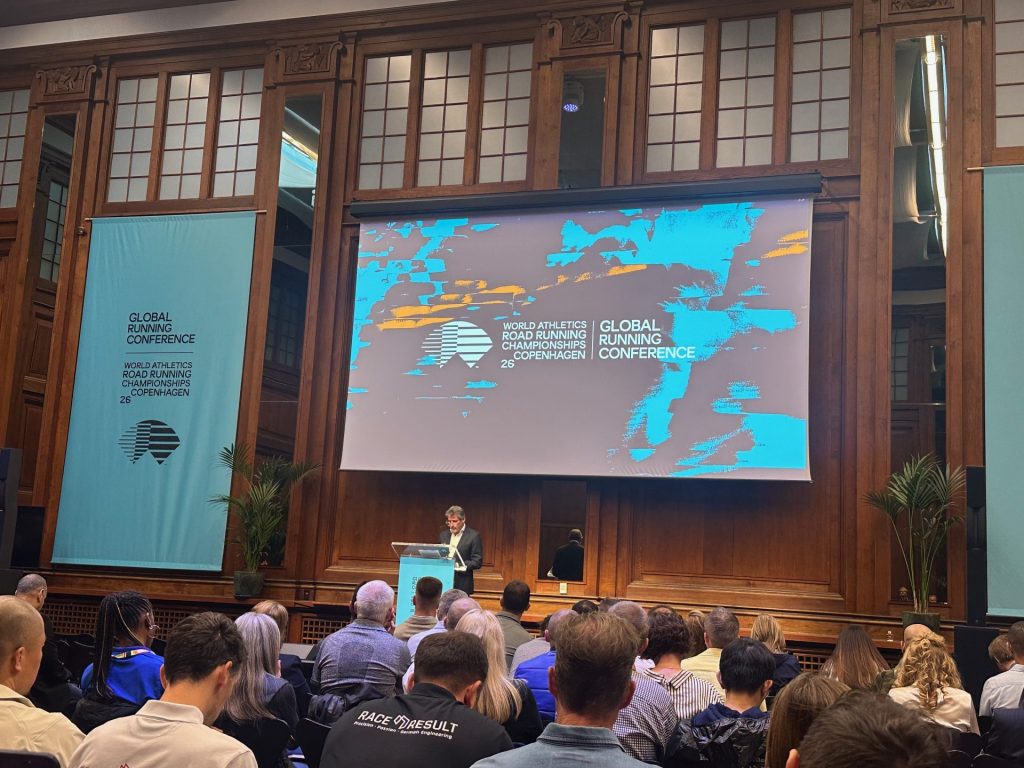
Staged alongside the World Athletics Road Running Championships, the Global Running Conference brought together organisers, federations, cities and commercial partners to explore how road running can remain relevant, resilient and socially valuable in a rapidly changing world.
Across the conference, the conversation moved well beyond organising races. Speakers explored how running can improve public health, strengthen communities, support cities, create economic value and provide platforms for environmental and social impact. At the same time, technology, artificial intelligence, changing demographics and new commercial models are beginning to reshape how the sport operates.
The running boom is real. But Copenhagen raised a bigger question: what can running do with it?
Coe sets the challenge
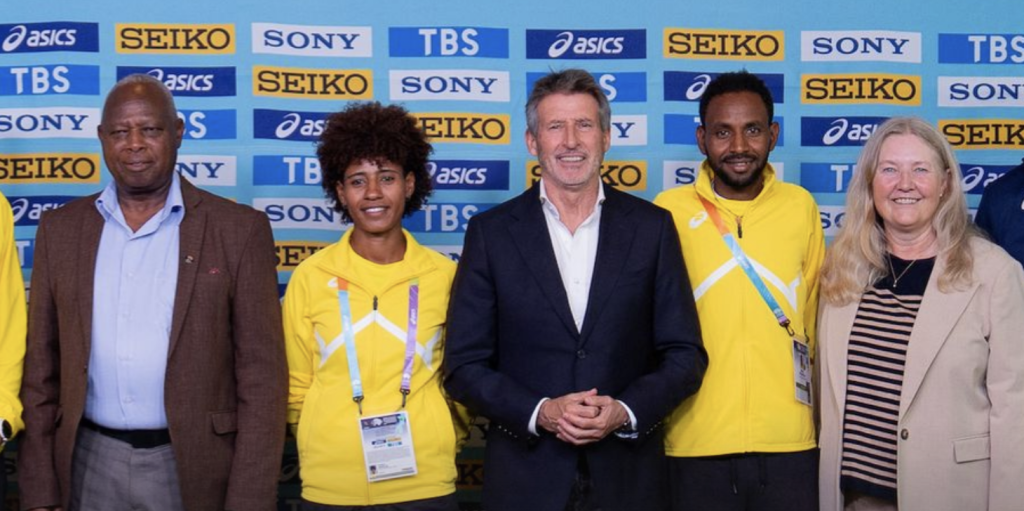
World Athletics President Sebastian Coe opened the day by placing running within a much wider period of global change.
Climate pressures, shifting economies, geopolitical tensions, artificial intelligence and digitalisation are transforming the environment in which sport operates. Against that increasingly fragmented backdrop, Coe argued that running possesses something unusually powerful.
“A strong sports policy is the strongest of education policies. It’s the strongest of health policies. It is a bridgehead to social cohesion and an economic driver.”
For Coe, that gives running a role extending far beyond competition into public health, mental wellbeing, youth engagement, social cohesion and economic development.
Physical inactivity represents perhaps the greatest challenge. Coe warned that by 2030 half of the global population could be deemed physically inactive and argued that sport needs to make its case to governments much more forcefully.
Running therefore finds itself in a race of its own: to remain relevant to younger generations, demonstrate its value to governments, respond to climate change and embrace innovation while retaining the ability to deliver.
Those themes would resonate throughout the rest of the conference.
“A strong sports policy is the strongest of education policies. It's the strongest of health policies. It is a bridgehead to social cohesion and an economic driver.”
A running boom – but a changing runner
Andreas Moll, Vice President of Categories at ASICS EMEA, took a deeper look at The State of Running: Who, Why, Where, and What’s Next, exploring whether the current surge represents another temporary running boom or something more fundamental.
The evidence presented suggests the latter.
Running has expanded through successive waves, from the recreational fitness movement of the 1970s and 1980s through commercialisation and globalisation to wearables and, since 2021, a new socially driven running culture.
Global participation has increased approximately two-and-a-half times since 2000, with estimated annual growth of 4–5%, while race participation grew by around 10% annually between 2024 and 2026. The underlying research covered more than 7,000 road runners internationally.
Health remains the primary motivation, but mental wellbeing, escaping everyday pressures, being outdoors and enjoying the experience are increasingly important.
Moll’s central conclusion was that the current growth should not simply be regarded as another short-lived boom:
“We see this more as organic growth rather than a boom.”
Perhaps most interesting is the changing participant. Race participation among 16–31-year-olds increased strongly, although growth is not confined to the young, with runners aged 60–69 also performing above average.
The opportunity is enormous. Coe estimated that around one billion people globally now run.
The challenge is understanding what this increasingly diverse population wants from running – and how organised sport builds a meaningful relationship with it.
“We see this more as organic growth rather than a boom.”
From race day to year-round engagement
That changing relationship with running also raises an important question for event organisers: why should their engagement with a runner revolve around one race on one day?
Hisham Shehab, Chief Operating Officer at N3xt Sport, explored how better use of data and artificial intelligence could help running organisations move beyond the traditional event model and build a much longer relationship with participants.
“The shift that is possible today is one that is made possible because of AI. Today we have tools that we did not have a few years ago.”
Shehab outlined the potential for a more integrated runner record capturing interests, behaviours and preferences, while AI could support everything from personalised communications and volunteer coordination to operational planning and race-day management.
The opportunity is to shift towards data-first, AI-enabled operations capable of engaging runners throughout the year rather than concentrating attention and commercial value around a single event.
That could fundamentally change the economics of mass participation. The race would remain the emotional focal point, but become one moment within a broader relationship encompassing training, community, travel, health, entertainment and commerce.
For an industry enjoying significant participation growth, the next step may therefore be less about simply creating more races and more about creating greater value – for runners, organisers, partners and communities – from the relationships that already exist.
“The shift that is possible today is one that is made possible because of AI. Today we have tools that we did not have a few years ago.”
Events for cities, not simply in cities
Perhaps the strongest theme to emerge from Copenhagen was the potential for running events to create value far beyond the event itself.
Kevin Pereira, Senior Vice President, Business & Running at Procam International, illustrated that potential through the extraordinary development of running in India.
When the Mumbai Marathon was created in the early 2000s, Pereira recalled that organised running barely existed.
“There were three things that we did primarily. Number one was shock and awe. Number two was ownership, and number three was inclusion.”
Elite athletes and live television created visibility, but mass participation was equally important. The Dream Run, Citizens Run and other accessible formats provided different entry points, including opportunities for people with disabilities and senior citizens.
The result was not simply a successful marathon but an ecosystem. India now has nearly 900 timed events, 890 running clubs across 137 towns and cities and approximately 2.8 million registered runners.
“There were three things that we did primarily. Number one was shock and awe. Number two was ownership, and number three was inclusion.”
Copenhagen is approaching the relationship between events and communities from another direction.
Henrik Nygaard, Development Consultant with the City of Copenhagen, and Sofie Andersen, Running Project Manager with Sparta and Danish Athletics, explained how the World Road Running Championships had been used to engage children and young people.
Their programme set a target of reaching 50,000 young people through schools, clubs and community organisations. But their experience also exposed one of sport’s perennial challenges: turning the excitement generated by a major event into lasting behaviour.
Their conclusion was that lasting change depends not simply on creating opportunities but on building relationships, structures and an ecosystem capable of surviving beyond individual projects and events.
It shifts the legacy conversation from how many people participated? to what changed because the event happened?
From participation to sustainable impact
Professor Vassil Girginov of Brunel University took that argument further, positioning running events as platforms capable of generating sustainable impact.
His starting point was strikingly human. Running, he argued, supports two fundamental needs: connection with nature and social cohesion. Events provide the physical and organisational infrastructure through which those relationships can develop.
An international study involving more than 4,650 participants examined physical, emotional, social, ecological and other dimensions of wellbeing. Physical wellbeing emerged strongly, while social connection and engagement with the local environment offered greater room for improvement.
But Girginov also cautioned against assuming that simply staging an event automatically creates impact.
“We have to leverage the opportunities created by the event and the potential of the event to mobilise different resources.”
Impact also needs to recognise negatives as well as positives – including disruption, pollution and injuries – rather than assuming that more participation automatically equals greater social value.
Pereira reinforced the importance of measurement, explaining that Procam independently assesses the social, health, sustainability and economic impact of its events in Mumbai and Delhi through studies involving thousands of respondents.
It represents an important shift: from claiming impact to demonstrating it.
For governments and cities being asked to invest in running, that distinction will become increasingly important.
“We have to leverage the opportunities created by the event and the potential of the event to mobilise different resources.”
Sustainability becomes operational
The same movement from ambition to measurement was evident in the environmental discussion.
Lauren Proshan, Chief of Race Operations and Production at the Boston Athletic Association, used the Boston Marathon to demonstrate how sustainability is becoming embedded into event operations.
Using 2023 as its baseline, the organisation has established a roadmap towards 2030. Its 2025 Marathon achieved 70% waste diversion, collected 19 tonnes of clothing and sent 10 fewer tonnes of waste to landfill, alongside more than $52 million in charitable impact and more than $509 million in economic activity.
But Proshan’s most revealing observation was not about any individual target.
“Sustainability isn’t something where we cross the finish line and say, ‘Okay, we’re done.’”
Instead, she used the marathon itself as an analogy: establish a baseline, understand where you are, set goals and checkpoints, measure progress, identify what is and is not working and adjust accordingly.
Responding to a question from Global Sustainable Sport about communications and stakeholder engagement, Proshan was equally open about the challenge of embedding sustainability throughout the organisation.
Some teams still need reminding to consider sustainability when making decisions, while conversations with commercial partners can sometimes come too late to influence packaging, materials or delivery.
Her objective is ultimately to make thinking and talking about sustainability part of the organisation’s “muscle memory”.
It is a challenge that extends far beyond Boston.
“Sustainability isn't something where we cross the finish line and say, ‘Okay, we're done.’”
Growth also requires trust
There is another essential requirement if road running is to capitalise on its global growth: integrity.
Brett Clothier, Head of the Athletics Integrity Unit examined the continuing challenge of protecting elite road running from doping.
Since the AIU’s establishment in 2017, testing coverage has expanded significantly. Kenya’s national anti-doping pool, for example, has increased from around 30 athletes to more than 300.
Yet the nature of the challenge is becoming increasingly sophisticated.
Microdosing and masking can reduce detection windows to between six and 48 hours, while conventional testing might reach an athlete only six or seven times annually.
The discussion therefore explored a much higher-assurance model, involving more frequent targeted testing of leading athletes, comprehensive analysis and the storage of samples for five years.
As the Clothier made clear:
“There is a cat-and-mouse dynamic.”
The challenge is cost. Increasing testing to the levels required to provide substantially greater assurance across leading road runners would require significant additional investment.
But as the commercial value and global visibility of road running increase, so does the value of confidence in the performances being produced.
Growth without trust is ultimately fragile.
“There is a cat-and-mouse dynamic.”
Beyond the running boom
Copenhagen demonstrated that the future of running will not be determined by participation numbers alone.
The bigger opportunity lies in what can be built around them.
Can one billion runners contribute to healthier societies? Can major events strengthen communities rather than simply pass through them? Can cities use races to create lasting participation? Can technology turn a one-day transaction into a year-round relationship? Can running grow commercially while improving its environmental performance and protecting sporting integrity?
These are increasingly interconnected questions.
Running possesses a quality few other sports can replicate. World champions, recreational runners and first-time participants can compete on the same streets. Cities become sporting venues. Spectators can become participants. An elite sporting event can simultaneously become a public-health intervention, tourism driver and community platform.
The challenge now is to convert that extraordinary reach into measurable and lasting impact.
For World Athletics, that means its role increasingly extends beyond governing elite competition towards helping shape the ecosystem in which running operates.
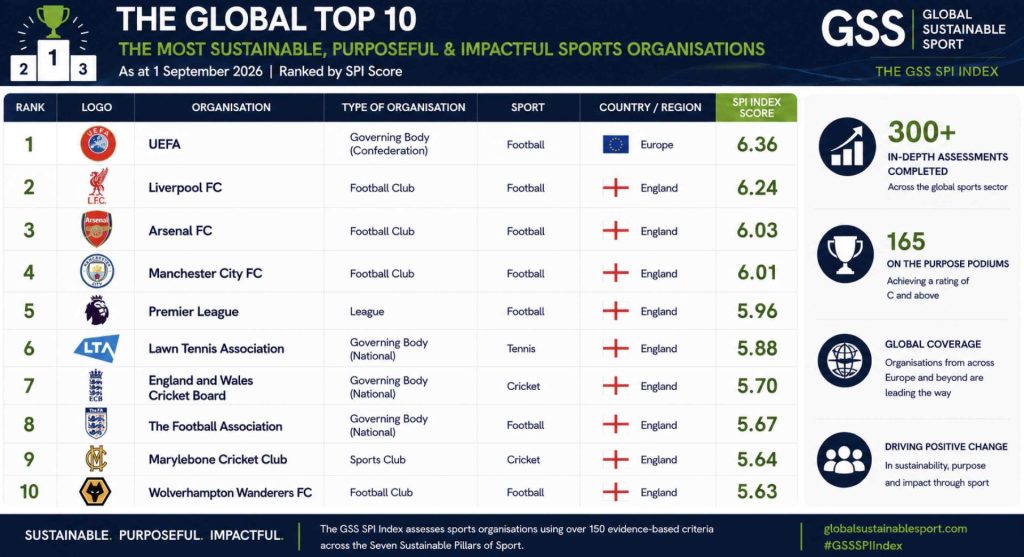
That broader approach is also reflected in the Global Sustainable Sport SPI Index, where World Athletics is currently ranked inside the Global Top 50, achieving a C+ – Purpose Advanced rating.
Copenhagen suggested that the running boom is only the starting point.
The real measure of its success will be what happens beyond the finish line.
Read moreWorld Athletics





Join the GSS Alliance Partners programme today
Stay ahead of the game with our FREE weekly newsletter, delivering the latest sport and sustainability news from around the globe straight to your inbox
11th Hour Racing
Join the GSS Network programme today
15-16 October, 2026
Gtech Community Stadium,
London (UK)
The SPX Purpose League Summit is a working summit for decision-makers interested in activating sport in a purpose-led way. Attendees will leave with an aligned peer network, data-backed insights, and the strategic commercial toolkits to transform sponsorship from an outsourced marketing expense into the single greatest driver of value.

Register for GSS Workshops today
Join the GSS Education programme today