
To access our unique news archive of over 1,400 articles with insights on over 500+ sustainable sports organisations, join the GSS Network today.
Login here if you are a registered network subscriber.
News article
FIS confronts financial sustainability as climate action delivers measurable results
The International Ski and Snowboard Federation (FIS) has used its Autumn Meetings in Geneva to confront two very different dimensions of sustainability: the financial resilience of the federation itself and the environmental impact of the sports it governs.

While a new leadership team revealed the scale of the financial challenge facing FIS, its second Climate Action Awards provided evidence of increasingly sophisticated environmental action across athletes, organisers and national associations. Together, the developments highlight a broader reality for international sport: sustainability must ultimately encompass both the organisation and the ecosystem around it.
A financial challenge comes into focus
FIS President Alexander Ospelt and Secretary General Urs Lehmann presented National Ski Associations with what FIS described as a “comprehensive and transparent” assessment of its finances.
FIS remains solvent and debt-free, but the figures revealed a significant deterioration in its financial position. Between 2021 and 2025, equity fell by 47%, from CHF81 million to CHF43 million. The federation says the financial trajectory inherited from its previous leadership is unsustainable, with plans now being developed to reduce costs and generate additional revenues.
Ospelt said:
“FIS is at a critical moment that requires immediate and decisive action. The FIS Council endorsed all the necessary structural and financial measures, which are now being developed and implemented together with the NSAs and other partners. The objectives are clear: to restore financial discipline, rebuild financial sustainability, and protect the long-term future of FIS and of the global snow sports ecosystem.”
“FIS is at a critical moment that requires immediate and decisive action. The FIS Council endorsed all the necessary structural and financial measures, which are now being developed and implemented together with the NSAs and other partners. The objectives are clear: to restore financial discipline, rebuild financial sustainability, and protect the long-term future of FIS and of the global snow sports ecosystem.”
That language is significant. Financial sustainability is sometimes separated from sport’s environmental and social agenda, but strong institutions require all three. An international federation cannot deliver long-term environmental or social programmes without resilient finances and effective governance.
Climate action moves towards measurement
Elsewhere in Geneva, the Climate Action Awards demonstrated how FIS is attempting to move environmental sustainability from commitments towards measurable outcomes.
Five awards went to five different countries, recognising work by Local Organising Committees, National Ski Associations and athletes.
FIS Sustainability Director Susanna Sieff said:
“Reducing snow sports’ carbon footprint takes work, and these awards recognize those doing it consistently: measuring emissions, finding ways to cut them, and following through.”
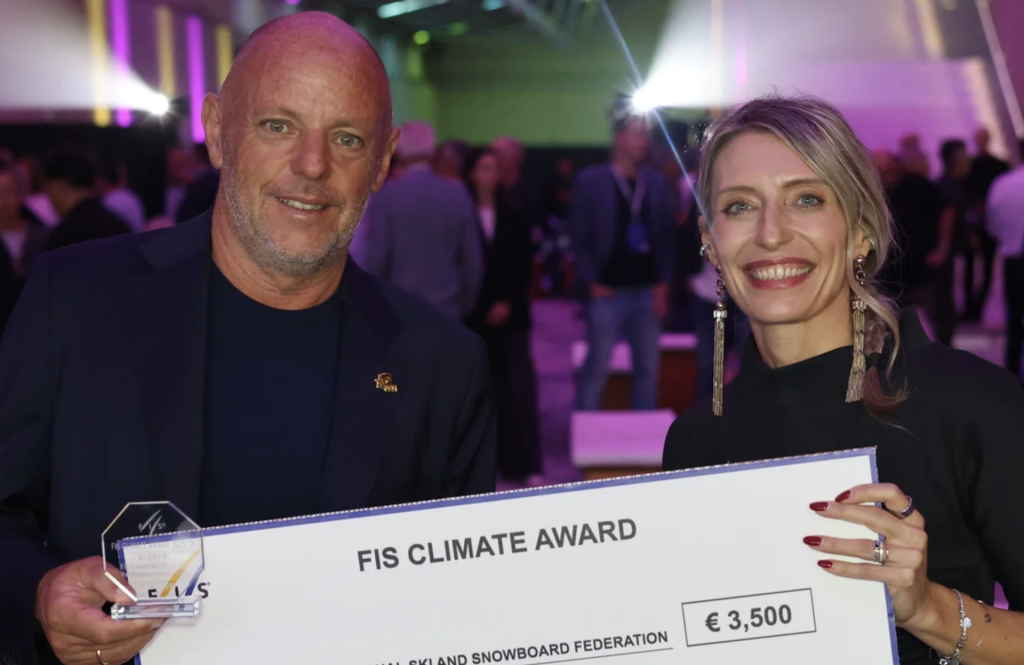
“Reducing snow sports’ carbon footprint takes work, and these awards recognize those doing it consistently: measuring emissions, finding ways to cut them, and following through.”
That emphasis on measurement is important. Winter sport is particularly exposed to climate change, making credible evidence of reductions increasingly important alongside targets and commitments.
Val Gardena in Italy won the Best Local Organising Committee award after reducing total emissions by 21.6% year-on-year and emissions per spectator by 39.1%. Canadian aerial skier Marion Thénault won Best Athlete after reducing her personal footprint from 27.8 to 16.5 tonnes of CO₂e. Her analysis of the Aerials World Cup calendar also identified potential savings of 3,971 kilometres of travel and 73 tonnes of CO₂e.
From federations to grassroots
France received the Best National Ski Association award, with its FIS CO₂ Calculator data independently double-verified and its emissions reduction programme extending through regional committees and clubs.
Sweden was also recognised after measuring its emissions annually since 2020. Emissions have fallen 15% from its 2021/22 baseline, with a further 38% reduction targeted by 2029/30.
The awards therefore reveal something more significant than a collection of individual initiatives. They suggest the beginnings of a common measurement infrastructure across snow sport – from the international federation through national bodies and event organisers to individual athletes.
As Ospelt told the awards ceremony:
“Sustainability is a joint effort – there are no two ways about it. It is work that only makes a true difference when carried out collectively, by everyone.”
“Sustainability is a joint effort – there are no two ways about it. It is work that only makes a true difference when carried out collectively, by everyone.”
Sustainability on and off the snow
The Geneva meetings also demonstrated the difficult balance facing FIS. Its Council rejected an additional World Championships in 2028 after a feasibility study concluded that the shortened timeline risked both execution quality and value creation, although the concept remains under consideration from 2032.
That decision, the financial review and the Climate Action Awards may appear separate. In reality, they are connected.
Sustainable sport requires environmental responsibility, but it also requires organisations capable of making disciplined decisions, measuring outcomes and remaining financially viable enough to deliver them.
In the GSS SPI Index, FIS currently sits outside the Purpose Podiums with a D+: Sustainability Developing rating. The developments in Geneva provide evidence of progress, particularly around climate measurement and transparency, but also underline the scale of the journey still ahead.
For FIS, the challenge now is to demonstrate that the measurement, accountability and action increasingly evident in its climate programme can be embedded consistently across the federation, turning individual examples of progress into a more sustainable organisation and a more sustainable future for snow sport.
Images: @ FIS / Pierre Teyssot
Read moreFIS

















Join the GSS Alliance Partners programme today
Stay ahead of the game with our FREE weekly newsletter, delivering the latest sport and sustainability news from around the globe straight to your inbox



11th Hour Racing
Join the GSS Network programme today

15-16 October, 2026
Gtech Community Stadium,
London (UK)
The SPX Purpose League Summit is a working summit for decision-makers interested in activating sport in a purpose-led way. Attendees will leave with an aligned peer network, data-backed insights, and the strategic commercial toolkits to transform sponsorship from an outsourced marketing expense into the single greatest driver of value.






Register for GSS Workshops today
Join the GSS Education programme today