
To access our unique news archive of over 1,400 articles with insights on over 500+ sustainable sports organisations, join the GSS Network today.
Login here if you are a registered network subscriber.
News article
Global Giants to Grassroots: GSS Launches the SPI Assessment Programme with 118 Organisations Already on the 2026 Purpose Podiums
Global Sustainable Sport (GSS) today launches the GSS SPI Assessment Programme and reveals the 118 organisations that have currently earned a place on the inaugural GSS SPI Purpose Podiums. They represent just 2% of the more than 5,000 organisations reviewed over three years — a group that includes some of the most recognisable names in world sport sitting alongside clubs, federations and teams operating far below the global spotlight.
Three Years. Five Thousand Organisations. One Question.
How sustainable, purposeful and impactful is sport, really? To answer it, GSS spent three years reviewing more than 5,000 organisations across 200+ countries and 150+ sports — analysing thousands of reports, strategies, policies and public disclosures. More than 3,000 received a detailed assessment across the 7 Sustainable Pillars of Sport and 150+ weighted indicators. Around 1,500 are yet to publish enough evidence to be scored at all — a reminder of how early the journey still is for much of sport. In simple terms, fewer than one in forty organisations reviewed has currently achieved a place on the Purpose Podiums.
“When we started, we expected the usual giants at the top. What we found was far more interesting — a non-league club sharing the podiums with UEFA, and a members’ cricket club ranking ahead of FC Barcelona and the International Olympic Committee. Purpose, it turns out, has very little to do with how big you are. It’s about what you choose to do.”
The 2%: Meet the Purpose Podiums
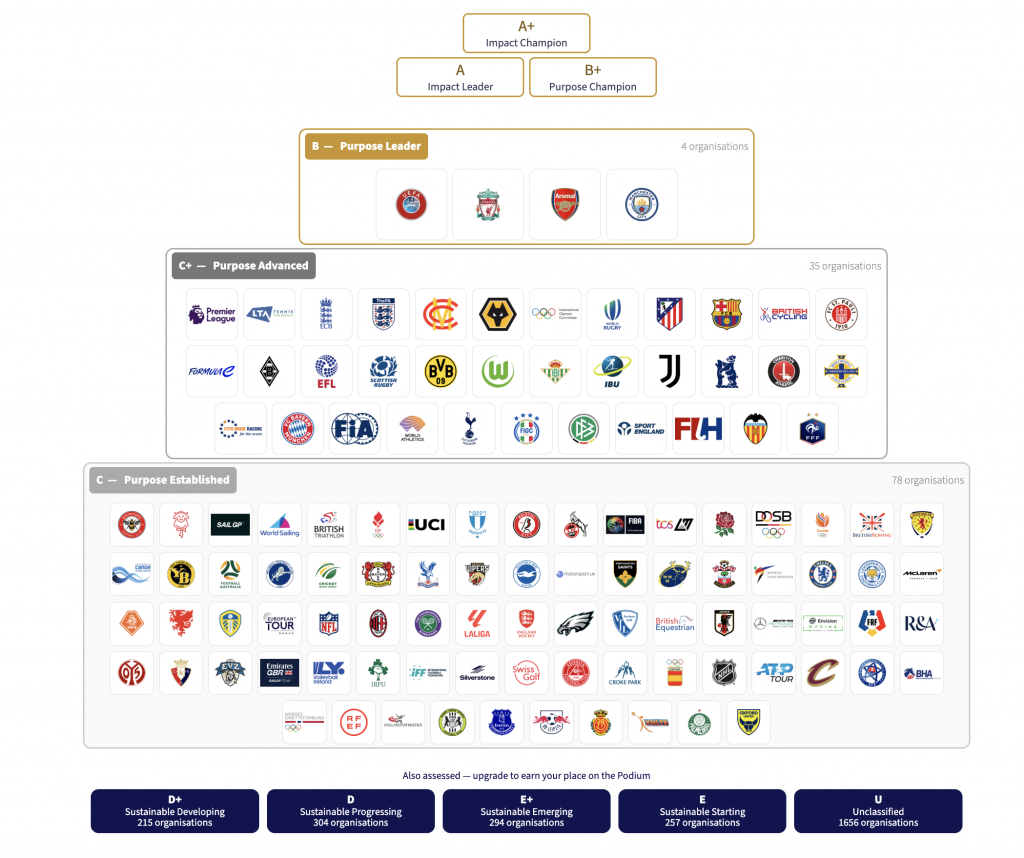
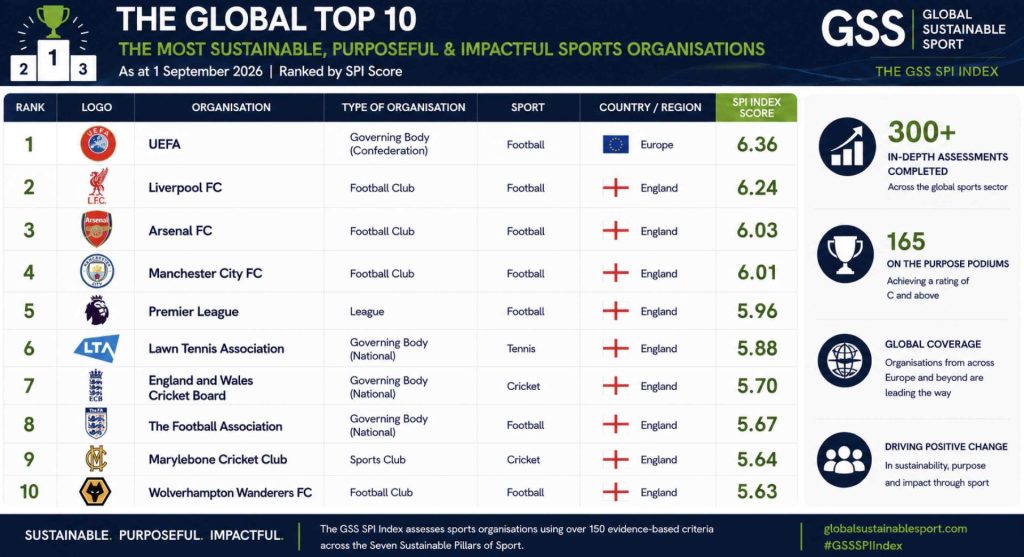
Just 118 organisations have reached the Purpose Podiums so far — the C, C+ and B tiers of the SPI Index. At the summit sit four Purpose Leaders (B Rating): UEFA, Liverpool FC, Arsenal FC and Manchester City FC. Behind them, a further 36 organisations have achieved Purpose Advanced (C+) status and 78 have reached Purpose Established (C) status. No organisation has yet reached Purpose Champion (B+), Impact Leader (A) or Impact Champion (A+) — the very top of sustainable sport remains open.
Global Giants to Grassroots
The most striking finding isn’t who leads — it’s who they lead alongside. The Marylebone Cricket Club, the LTA and the ECB rank ahead of the International Olympic Committee, FC Barcelona and the NBA. FC St Pauli, Charlton Athletic and 11th Hour Racing share the C+ podium with World Rugby, the International Biathlon Union and World Athletics. Football clubs like Lincoln City, BSC Young Boys, and Malmo FF, sit alongside other clubs like ice hockey’s EV Zug and rugby’s Munster Rugby Club, Teams like motor racing’s McLaren Racing and Envision Racing nestle alongside British national federations from cycling, triathlon, rugby and rowing and national Olympic committees from Denmark, Germany, the Netherlands, Spain and Norway. Of the 118, 58 are individual clubs and teams rather than governing bodies whilst some are world series like SailGP and Formula E and others are venues like Croke Park in Ireland.
The common thread is not scale or revenue. It is evidence of sustainability, purpose and impact.
Sustainability leadership in sport, the data shows, is no longer the preserve of the biggest or the richest. A community-owned club with a clear sense of purpose can stand shoulder to shoulder with a global federation — and, on this measure, sometimes ahead of it.
A Global Picture
The 118 come from 23 countries across six continents. Europe leads — the United Kingdom alone accounts for a significant proportion — but the podiums stretch far wider: Palmeiras in Brazil, Cricket South Africa, the Japan Football Association, World Taekwondo in South Korea, the Philadelphia Eagles and the Cleveland Cavaliers from the USA, the Desert Vipers in the UAE, and Football Australia all feature. The podiums reveal sustainability leadership emerging across very different sporting cultures and operating environments.
The wider research goes further still, covering organisations in more than 200 countries and 150+ sports. The forthcoming editions of the Podiums in 2026 are expected to broaden that map considerably, with stronger representation from Asia, North America, Oceania and Africa.
How the SPI Programme Works
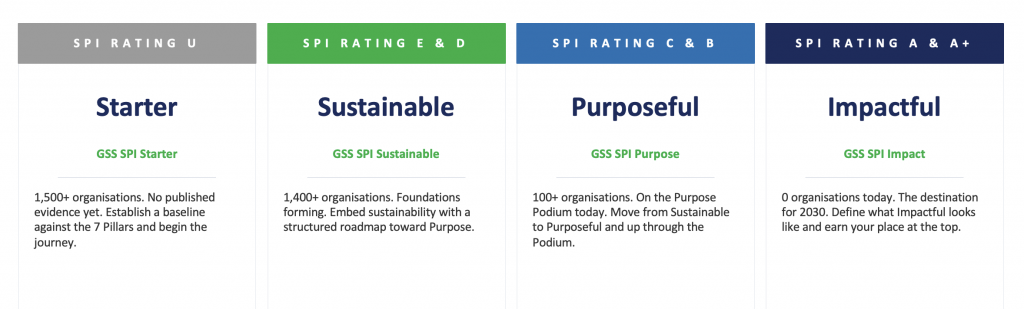
The GSS SPI Assessment Programme gives every organisation an independent SPI Rating — from U (Unclassified) to A+ (Impact Champion) — and a practical roadmap for improvement. Built on Agentic AI and expert review, it assesses organisations across the 7 Sustainable Pillars of Sport and 150+ weighted indicators, with no staff time required. Each organisation is placed on a four-stage journey — Starter, Sustainable, Purposeful, Impactful — and re-assessed annually to track progress towards 2030.
Built on Agentic AI — Designed for Consistency and Scale
The programme is powered by an Agentic AI platform that GSS has built over the past nine months using the Google, OpenAI and Anthropic AI platforms. Assessing with AI removes individual human bias from the scoring: every organisation is measured against the same 150+ weighted indicators, in the same way, with no judgement about size, reputation or profile. A score reflects one thing — the quality and accessibility of the sustainability evidence an organisation makes publicly available, primarily on its own website. And before any evidence is scored, it is sense-checked by GSS’s human experts as a quality-control step, so the AI works from a sound and accurate evidence base.
The result is one of the few assessment frameworks in sport capable of evaluating thousands of organisations consistently and at scale.
A Race Against Time, Not Each Other
For GSS, the Podiums are not a league table. SPI is a race against time, not against each other — a collective push against climate change, obesity, inactivity and a 2030 deadline the whole world shares. Every organisation that becomes more SPI, the programme argues, is a win for sport and for society.
“The 118 organisations on today’s Purpose Podiums are showing what is possible. Some are global leaders, some are local changemakers, but together they demonstrate that sustainability leadership is not defined by size. It is defined by action.” “Sport reaches more than five billion fans around the world. If we can help organisations become more sustainable, more purposeful and more impactful, the influence of sport could be extraordinary. That is the opportunity in front of us all.”
Register for Your SPI Rating
Organisations can register now to receive their SPI Rating and join the GSS SPI Assessment Programme for 2026 at globalsustainablesport.com. The first full edition of the SPI Ratings, SPI Index and GSS Purpose Podiums will be published at the end of 2026, with regular updates during the course of the year.
The race to 2030 has begun.
Start your SPI journey now. Register Here
About Global Sustainable Sport
Global Sustainable Sport (GSS) helps sports organisations measure, benchmark and communicate sustainability, purpose and impact through the GSS SPI Assessment Programme, built on the 7 Sustainable Pillars of Sport.
Read moreGlobal Sustainable Sport










Join the GSS Alliance Partners programme today
Stay ahead of the game with our FREE weekly newsletter, delivering the latest sport and sustainability news from around the globe straight to your inbox

11th Hour Racing
Join the GSS Network programme today

15-16 October, 2026
Gtech Community Stadium,
London (UK)
The SPX Purpose League Summit is a working summit for decision-makers interested in activating sport in a purpose-led way. Attendees will leave with an aligned peer network, data-backed insights, and the strategic commercial toolkits to transform sponsorship from an outsourced marketing expense into the single greatest driver of value.



Register for GSS Workshops today
Join the GSS Education programme today