
To access our unique news archive of over 1,400 articles with insights on over 500+ sustainable sports organisations, join the GSS Network today.
Login here if you are a registered network subscriber.
News article
From Commitment to Impact: World Athletics Moves from Strategy to Delivery
Five years after launching its Sustainability Strategy 2020–2030, World Athletics has published a detailed midway review that offers more than a progress update. From Commitment to Impact demonstrates how sustainability has evolved from a standalone initiative into an increasingly integrated part of governance, event delivery, athlete welfare and long-term planning across the sport.
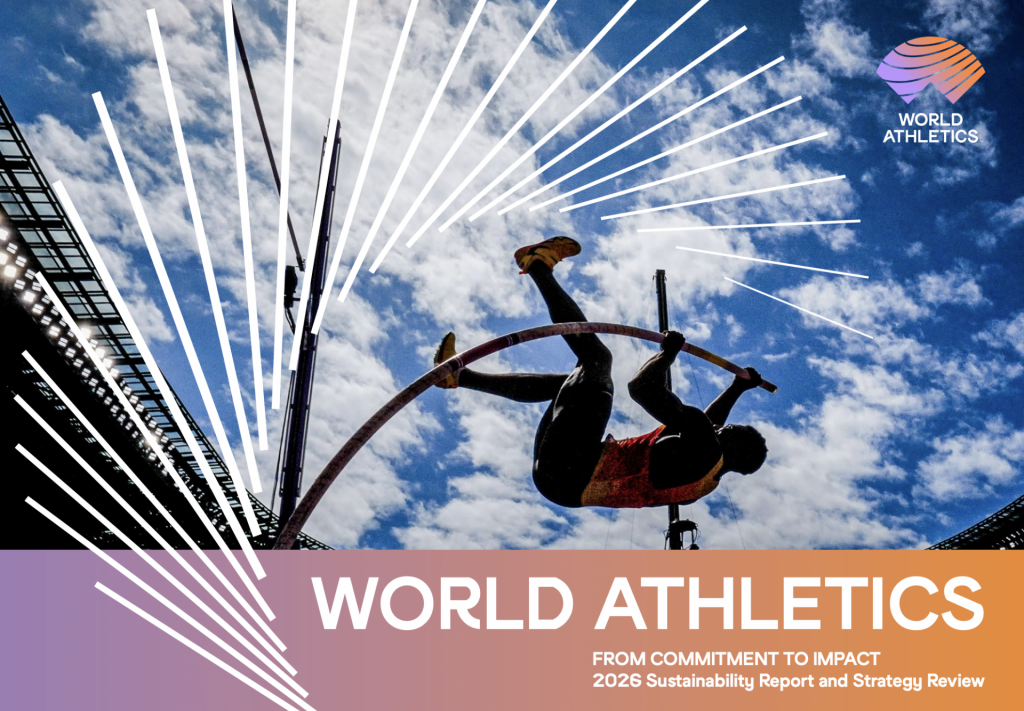
At a time when climate change, athlete welfare, safeguarding and social inclusion are rising rapidly up the sporting agenda, the report reflects a federation moving beyond commitments and towards measurable implementation. It is a journey that mirrors a wider shift taking place across sport, as organisations are increasingly judged not by the promises they make, but by the evidence they can provide.
As World Athletics President Sebastian Coe writes:
“Sustainability has moved from being a standalone commitment to becoming a more embedded part of how we plan events, support our Member Federations, work with partners and safeguard athletes.”
“Sustainability has moved from being a standalone commitment to becoming a more embedded part of how we plan events, support our Member Federations, work with partners and safeguard athletes.”
Climate Change Moves Centre Stage
The report is clear that sustainability is no longer simply about reducing environmental impacts. Increasingly, it is about protecting the future viability of athletics itself.
World Athletics describes climate change as an “existential threat” to sport, highlighting the growing risks posed by extreme heat, poor air quality, flooding and infrastructure disruption. These challenges are already affecting training environments, competition schedules and athlete safety around the world.
Coe does not understate the challenge:
“For athletics, that threat is not theoretical. It affects training environments, competition conditions, event planning and, above all, athlete safety.”
In response, World Athletics has developed a Climate Transition Plan alongside its first climate risk and opportunity assessment, examining the potential impacts of climate change through to 2050. The focus extends beyond carbon reduction to include adaptation, resilience and the long-term sustainability of the athletics ecosystem.
This reflects an important evolution in sport sustainability. Rather than treating climate action solely as an emissions challenge, World Athletics is increasingly framing it as a risk management and athlete welfare issue that sits at the heart of future decision-making.
“For athletics, that threat is not theoretical. It affects training environments, competition conditions, event planning and, above all, athlete safety.”
Building Systems That Drive Change
One of the strongest themes running through the report is the importance of systems and standards.
The Athletics for a Better World (ABW) Standard has become the cornerstone of World Athletics’ approach, providing a structured framework to evaluate and improve sustainability performance across events. More than 100 events are now reporting against the standard annually, with achievement levels ranging from Bronze to Platinum.
The programme is also moving beyond voluntary participation. From 2026, selected World Athletics Series events will be contractually required to meet minimum sustainability thresholds, embedding sustainability directly into event delivery expectations.
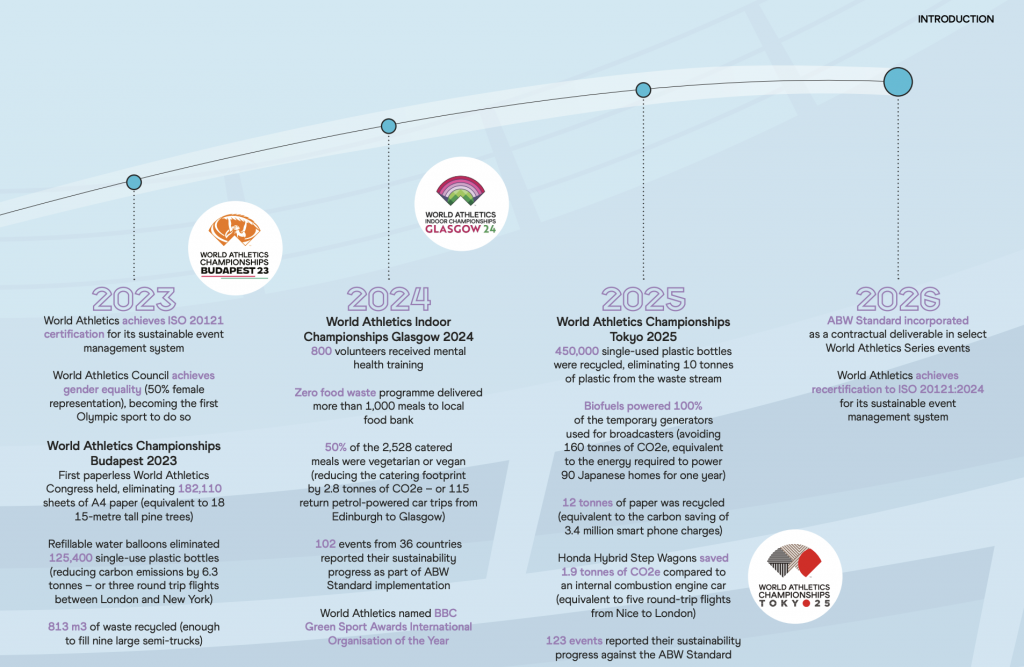
Importantly, the report demonstrates how those systems are now translating into measurable outcomes. The number of events reporting against the ABW Standard increased from 102 in 2024 to 123 in 2025, reflecting growing adoption across the global athletics community.
Tokyo 2025 Shows What Impact Looks Like
If the early years of the strategy were about building frameworks and standards, the World Athletics Championships Tokyo 2025 demonstrated how those principles can be applied at scale.
The Championships delivered some of the strongest evidence of impact contained within the report. More than 450,000 single-use plastic bottles were recycled, removing 10 tonnes of plastic from the waste stream. Temporary generators used by broadcasters operated entirely on biofuels, avoiding an estimated 160 tonnes of CO₂e emissions, while 12 tonnes of paper were recycled and hybrid transport solutions helped further reduce the event’s carbon footprint.
These figures may appear operational in nature, but they illustrate a broader point. Sustainability is increasingly becoming embedded within the practical delivery of major events rather than sitting alongside them as a separate programme.
Earlier, the World Athletics Indoor Championships Glasgow 2024 became the first event to achieve Platinum recognition under the ABW Standard, providing an important proof of concept. Tokyo 2025 showed how those principles can be delivered at scale across one of the sport’s flagship global events.
Air Quality, Athlete Health and Sporting Leadership
The report also highlights one of World Athletics’ most distinctive sustainability programmes: its work on air quality.
What began in 2018 as a research initiative has evolved into a global programme combining scientific monitoring, athlete education and public engagement. By deploying sensors in stadiums and along road race routes, World Athletics has generated valuable evidence on the impact of pollution on athlete health and performance.
The programme has since expanded through partnerships with organisations such as the Clean Air Fund, helping connect sport with wider conversations around urban health and environmental policy.
As Jane Burston, CEO and Founder of the Clean Air Fund, explains:
“Sport demonstrates that communities truly care about the air they breathe and that, with support and the right data, they can make a positive difference.”
The work is particularly significant because it moves beyond awareness and into practical action, providing organisers and athletes with tools to reduce exposure and make informed decisions.
“Sport demonstrates that communities truly care about the air they breathe and that, with support and the right data, they can make a positive difference.”
From Awareness to Impact
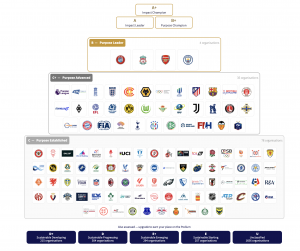
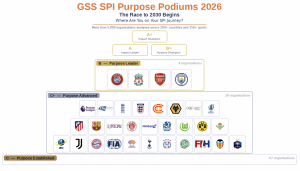
The findings also reflect a wider trend identified through the GSS SPI Assessment Programme, launched recently. While many sports organisations have developed sustainability strategies, far fewer are able to demonstrate consistent evidence of activity and measurable outcomes.
One of the foundations of the SPI assessment framework is the concept of Double AI – Awareness, Activity and Impact. The strongest-performing organisations are those that not only recognise sustainability challenges, but can demonstrate clear action and measurable results.
World Athletics provides evidence across all three areas. Awareness is reflected through its long-term strategy, climate transition planning and research programmes. Activity can be seen in the implementation of the ABW Standard, ISO 20121-certified event management systems and extensive support for member federations. Impact is demonstrated through measurable outcomes, from Platinum-rated events and gender parity on the World Athletics Council to mental health training, waste reduction initiatives and growing participation in sustainability reporting.
It is this breadth of evidence that has helped place World Athletics currently among the Top 50 most purposeful sports organisations in the GSS SPI Index.
The Next Five Years
The midway review makes clear that the foundations have largely been put in place. The challenge now is scale.
The next phase of the strategy will focus on consistency, strengthening implementation across the global athletics community and ensuring that sustainability standards translate into measurable outcomes across every level of the sport.
For many sports organisations, the sustainability conversation remains focused on ambition. World Athletics’ midway review suggests the federation is entering a different phase—one where success is increasingly measured through evidence, accountability and impact. The next challenge will be ensuring that the systems, standards and partnerships developed over the past five years continue to drive meaningful change across the global athletics community and help the sport adapt to an increasingly uncertain future.
Read moreWorld Athletics

















Join the GSS Alliance Partners programme today
Stay ahead of the game with our FREE weekly newsletter, delivering the latest sport and sustainability news from around the globe straight to your inbox



11th Hour Racing
Join the GSS Network programme today



Register for GSS Workshops today
Join the GSS Education programme today