
To access our unique news archive of over 1,400 articles with insights on over 500+ sustainable sports organisations, join the GSS Network today.
Login here if you are a registered network subscriber.
News article
The State of Sustainable Sport: New SPI Index Reveals Progress, Gaps and a Growing Climate Challenge
As London Climate Action Week prepares to bring together more than 75,000 people across hundreds of events throughout the capital, climate action will once again move to the centre of the global conversation. Over nine days, policymakers, businesses, investors and civil society organisations will gather to discuss how sectors can accelerate their response to the climate crisis and demonstrate measurable progress. Sport will be part of that discussion.
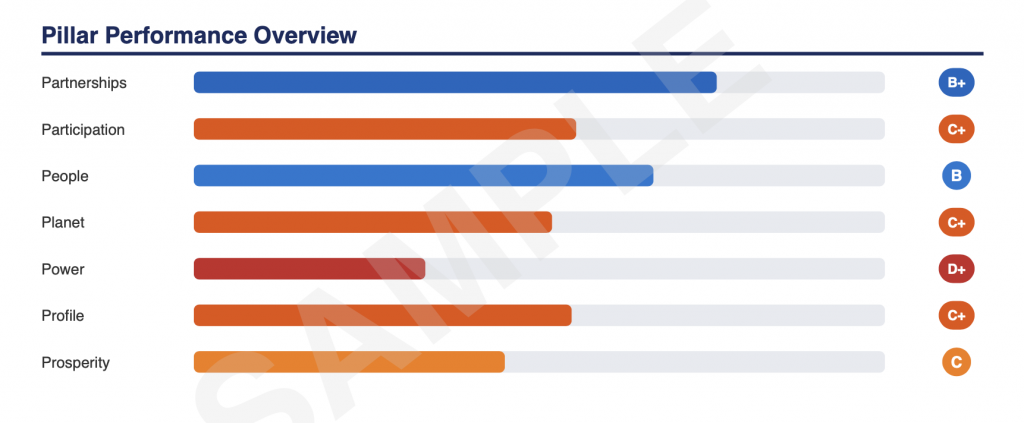
Yet new findings from the inaugural Global Sustainable Sport (GSS) SPI Index suggest that while sport has made important strides in sustainability, the sector still faces significant challenges in translating ambition into evidence, impact and accountability.
Drawing on assessments of more than 3,000 sports organisations worldwide, the preliminary findings provide one of the most comprehensive snapshots yet of sustainability performance across sport. The analysis examines organisations through the lens of the seven Sustainable Pillars of Sport: Partnerships, Participation, People, Planet, Power, Profile and Prosperity.
Perhaps the most striking finding is that sustainability in sport remains an emerging discipline. Across more than 10,000 individual pillar scores within the validated dataset, only a handful currently exceed 8 out of 10, underlining both the scale of the challenge and the opportunity ahead.
An Industry Still in the Early Stages
The headline finding is clear: sustainability in sport remains at an early stage of maturity.
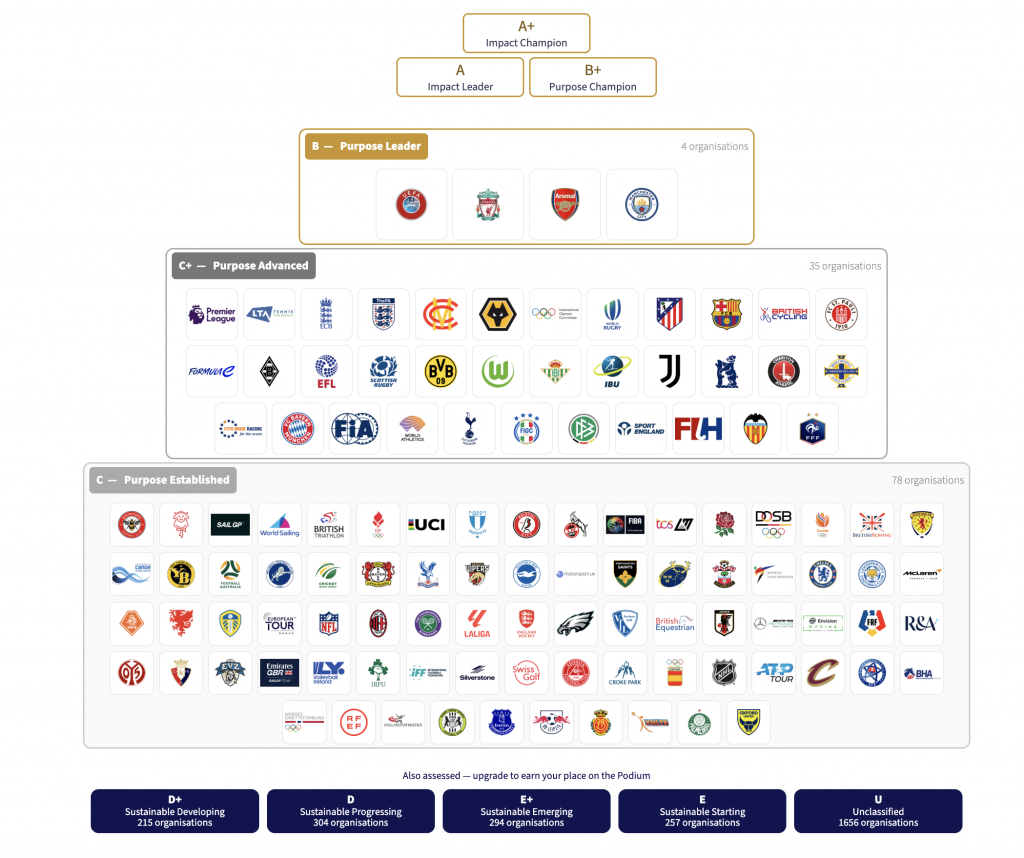
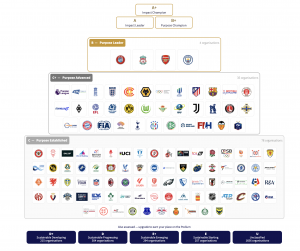
Across the validated dataset, no pillar averages above 3.5 out of 10, while no organisation has yet achieved the highest SPI ratings. The strongest performers currently sit within the SPI Index’s B category, led by UEFA, Liverpool FC, Arsenal FC and Manchester City FC.
While sustainability has become an increasingly prominent topic across sport, the findings suggest that many organisations remain at the beginning of their journey rather than approaching maturity.
Mike Laflin, Founder and CEO of Global Sustainable Sport, believes the results should be viewed as a positive challenge rather than a criticism of the sector.
“What we are seeing is a sector that is moving in the right direction but still has considerable ground to cover. The encouraging aspect is that sustainability is now firmly on the agenda across sport. The challenge is turning good intentions into measurable action and evidence.”
The data also highlights that size alone does not determine success. Alongside major governing bodies and global clubs, organisations such as Marylebone Cricket Club feature prominently within the early rankings, demonstrating that commitment, transparency and consistency can be as important as scale.
"What we are seeing is a sector that is moving in the right direction but still has considerable ground to cover. The encouraging aspect is that sustainability is now firmly on the agenda across sport. The challenge is turning good intentions into measurable action and evidence."
Partnerships Lead the Way
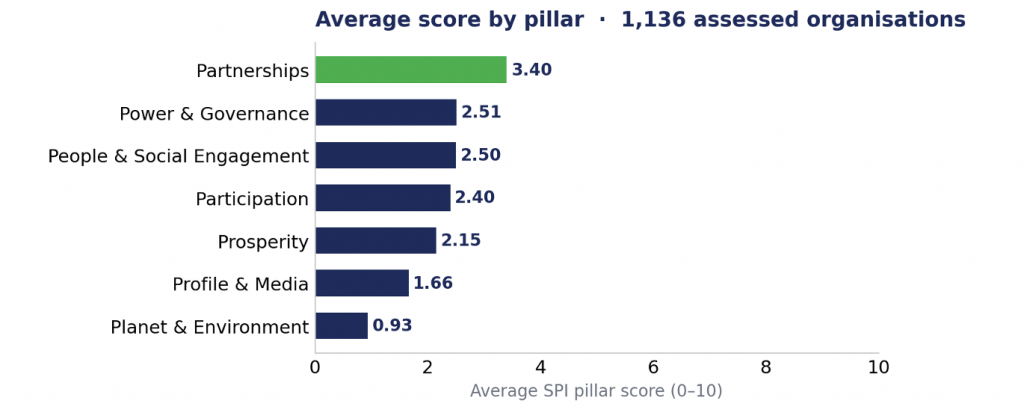
Of the seven pillars assessed, Partnerships emerged as the strongest area of performance, achieving an average score of 3.40 out of 10.
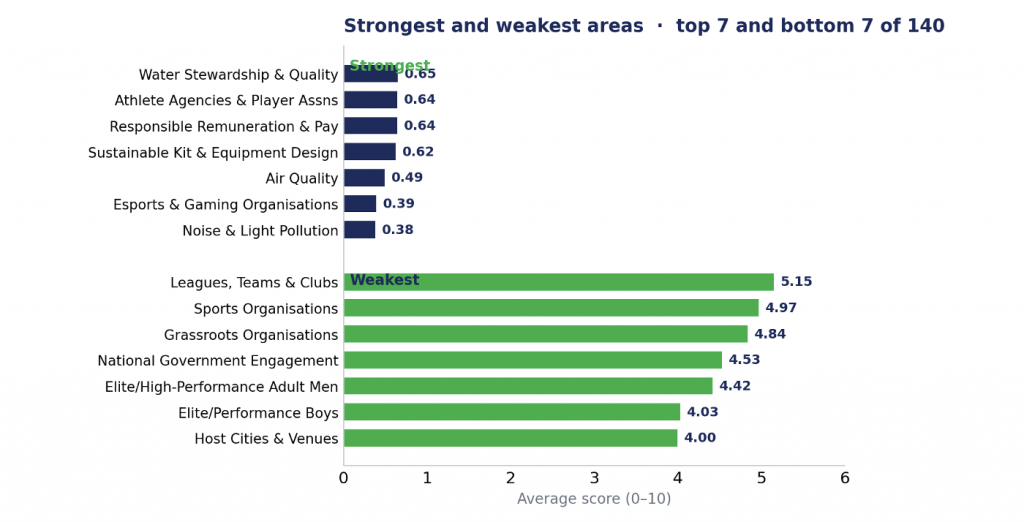
Sports organisations generally perform well when it comes to demonstrating relationships with governing bodies, leagues, clubs, sponsors, governments and community organisations. The highest-performing areas within the entire assessment framework relate to collaboration and institutional engagement, with Leagues, Teams and Clubs scoring 5.15, Sports Organisations 4.97, Grassroots Organisations 4.84 and Government Engagement 4.53.
These are among the highest scores in the entire SPI framework.
The strength of Partnerships reflects one of the clearest findings from the index. Organisations are generally good at identifying key stakeholders and establishing collaborative relationships. Awareness and activity are both relatively strong. The challenge, as elsewhere in the dataset, is often demonstrating the long-term outcomes and impact of those partnerships.
Governance, social engagement and participation also show relatively encouraging results, suggesting that many organisations have established foundations for responsible management and stakeholder engagement.
The Environmental Gap
If Partnerships represents sport’s greatest strength, environmental sustainability remains its most significant weakness.
The Planet pillar recorded by far the lowest average score across the entire framework, achieving just 0.93 out of 10. Areas such as water stewardship (0.65), air quality (0.49), sustainable equipment design (0.62) and noise and light pollution (0.38) consistently ranked among the weakest-performing indicators.
Perhaps most strikingly, around three in ten organisations assessed showed no measurable environmental activity through publicly available evidence.
The findings suggest that awareness of climate issues is growing rapidly across sport. However, the low scores indicate that awareness is not yet consistently translating into structured activity, comprehensive measurement or demonstrated impact. Even greenhouse-gas measurement, the highest-scoring environmental indicator, averages only 1.24 out of 10.
At a time when climate change is increasingly affecting sporting calendars, infrastructure, athlete welfare and fan experience, the findings suggest environmental action has yet to become embedded across large parts of the sector.
This issue is likely to feature prominently during London Climate Action Week, where discussions will focus not only on climate commitments but also on implementation, transparency and accountability. The same themes are becoming increasingly relevant for sport.
From Storytelling to Evidence
A second trend runs throughout the SPI findings and may ultimately prove even more significant than any individual sustainability topic.
Across almost every pillar, organisations perform better when describing activities than when measuring their impact.
Whether examining environmental initiatives, social programmes, governance practices or economic contributions, the pattern is remarkably consistent. Sports organisations are increasingly communicating sustainability commitments and sharing positive stories, but fewer are publishing robust evidence demonstrating outcomes and long-term impact.
In many cases this reflects a wider challenge facing organisations globally. Measuring impact requires systems, resources, data collection and reporting processes that remain underdeveloped in many organisations.
The finding aligns closely with the assessment philosophy underpinning the SPI Index itself. The programme is built around what Global Sustainable Sport describes as its Double AI approach: Awareness, Activity and Impact.
Awareness asks whether an organisation recognises and publicly acknowledges a sustainability issue. Has it identified the challenge? Has it developed policies, commitments, strategies or public statements?
Activity examines what an organisation is actually doing. Has it launched programmes, partnerships, campaigns, investments or operational initiatives designed to address the issue?
Impact looks for evidence that actions are producing measurable outcomes. Has the organisation established targets, collected data, monitored progress and reported results?
The progression is intentional. Awareness without activity achieves little. Activity without measurement makes learning difficult. Impact is where sustainability becomes demonstrable.
"One of the biggest lessons from the SPI Index is that evidence matters. Many organisations may be doing excellent work behind the scenes, but if that information isn't publicly available, consistently reported or easily discoverable, it becomes difficult to assess, benchmark and learn from. Sustainability increasingly requires transparency as well as action."
Across the preliminary dataset, many organisations perform reasonably well in the first two stages. They are increasingly aware of sustainability issues and are taking visible action. However, far fewer are consistently evidencing the difference those actions are making.
“One of the biggest lessons from the SPI Index is that evidence matters,” says Laflin. “Many organisations may be doing excellent work behind the scenes, but if that information isn’t publicly available, consistently reported or easily discoverable, it becomes difficult to assess, benchmark and learn from. Sustainability increasingly requires transparency as well as action.”
Laflin believes the sector is now entering a new phase of sustainability maturity.
“The first decade of sustainability in sport was largely about raising awareness. The next decade must be about demonstrating impact. The organisations that can clearly show outcomes, rather than simply intentions, will be the ones that emerge as genuine leaders.”
Athletes and Fans Hold Untapped Potential
The findings also reveal significant opportunities around engagement.
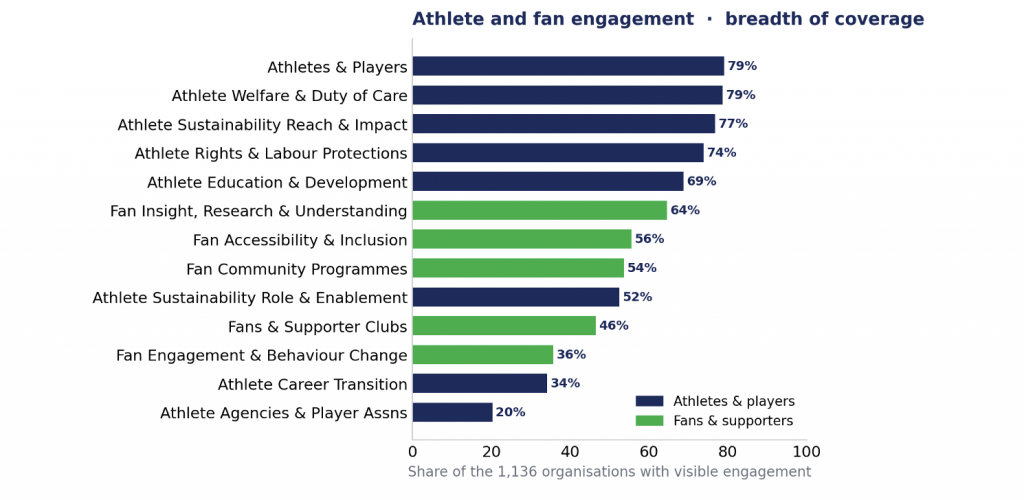
Athletes are widely engaged across sport. Athlete welfare and duty of care is addressed by 79% of organisations, athlete rights by 74%, and athlete education and development by 69%. In total, 77% of organisations reference athletes within a sustainability context.
These figures suggest that awareness of the athlete’s role in sustainability and social impact is now widespread across sport.
However, the picture changes when the assessment moves beyond awareness and examines activity and impact.
While 77% of organisations reference athletes within a sustainability context, the specific indicator measuring athlete sustainability reach and impact scores less than 1 out of 10 on average. In other words, many organisations talk about athletes as ambassadors or advocates, but far fewer provide evidence of structured programmes, measurable outcomes or meaningful athlete-led sustainability initiatives.
The same pattern appears in fan engagement.
More than half of organisations operate fan community programmes, while 56% address accessibility and inclusion for supporters. Yet only 36% actively engage fans in sustainability or behaviour-change initiatives.
This is one of the clearest examples of the SPI Index’s Double AI framework in action. Awareness is high. Activity is present but less widespread. Impact remains difficult to evidence.
The opportunity is significant. Sport reaches billions of people through its athletes and supporters. If organisations can move beyond awareness campaigns towards programmes that genuinely influence behaviour and demonstrate measurable outcomes, athletes and fans could become two of sport’s most powerful drivers of sustainability progress.
Inclusion Beyond Elite Pathways
The participation findings reveal another important trend.
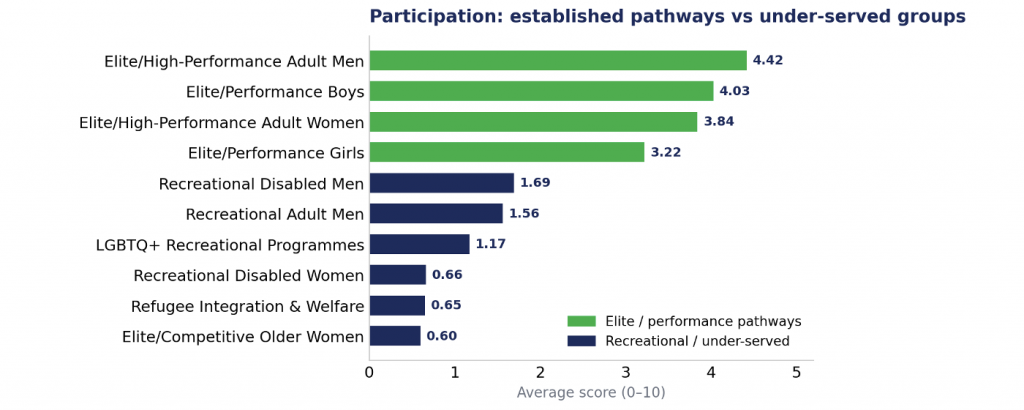
Elite and high-performance pathways generally score strongly across the dataset, reflecting significant investment in talent development and competitive structures. High-performance adult men score 4.42, boys 4.03, women 3.84 and girls 3.22.
However, participation scores decline substantially among recreational, disabled and under-served communities. Recreational disabled women score 0.66, refugee integration and welfare 0.65, and competitive older women just 0.60.
The data suggests that sport has developed strong awareness and activity around elite participation pathways. However, evidence becomes significantly weaker when assessing programmes focused on recreational, disabled, refugee and other under-served communities.
Whether this reflects a genuine activity gap or a reporting gap remains an important question for future phases of the SPI Index. Either way, it points to a significant opportunity for organisations to better evidence the broader social impact of sport beyond elite competition.
Building a Benchmark for the Future
The preliminary findings should not be viewed as a definitive ranking of global sport. Rather, they provide an early benchmark and a starting point for deeper analysis.
Importantly, a low score does not necessarily mean an organisation is inactive. In some cases, activities may not be publicly reported. In others, information may be fragmented across different websites, reports and platforms or difficult to locate. For some organisations, sustainability data and reporting processes are still evolving.
The SPI Index therefore measures what can be evidenced through publicly available information rather than claiming to capture every activity taking place behind the scenes.
That distinction matters. Organisations that undertake valuable work but do not publish it cannot easily be benchmarked, while organisations that communicate clearly, measure consistently and report transparently create opportunities for learning across the wider sector.
"The first decade of sustainability in sport was largely about raising awareness. The next decade must be about demonstrating impact. The organisations that can clearly show outcomes, rather than simply intentions, will be the ones that emerge as genuine leaders."
The SPI Index is designed to assess three distinct stages of sustainability maturity: awareness, activity and impact. The preliminary findings suggest that much of sport has successfully navigated the first stage and is making progress on the second. The greatest opportunity now lies in the third stage — demonstrating measurable outcomes and evidencing the difference sustainability initiatives are making.
Ahead of London Climate Action Week, the message is clear. Sport has established important foundations through partnerships, governance and social engagement. But significant opportunities remain around environmental action, impact measurement, transparency and the mobilisation of athletes and fans.
The sector’s sustainability journey is underway. The next challenge is demonstrating not simply what sport intends to achieve, but what it is actually delivering.
For Global Sustainable Sport, that is ultimately the purpose of the SPI Index: helping organisations move from awareness, to activity, to measurable impact.
Read moreGlobal Sustainable Sport


















Join the GSS Alliance Partners programme today
Stay ahead of the game with our FREE weekly newsletter, delivering the latest sport and sustainability news from around the globe straight to your inbox


11th Hour Racing
Join the GSS Network programme today




Register for GSS Workshops today
Join the GSS Education programme today