
To access our unique news archive of over 1,400 articles with insights on over 500+ sustainable sports organisations, join the GSS Network today.
Login here if you are a registered network subscriber.
News article
The Hoofprint: Equestrian community unites to build a more sustainable and resilient future
The equestrian industry has come together to launch The Hoofprint, a new digital platform designed to help the sector address the growing challenges of climate change, protect horse welfare and build a more environmentally and economically resilient future.
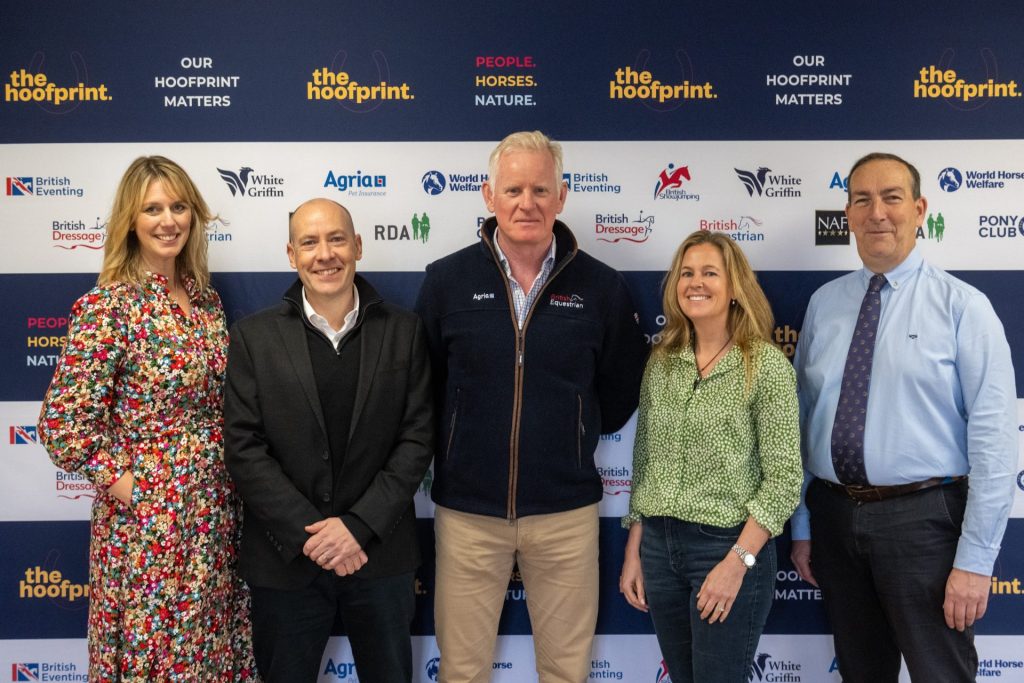
Launched on Monday (23 November) at the British Showjumping National Training Centre in Leicestershire, the free online resource is the culmination of four years of research, development and collaboration between sporting bodies, commercial organisations, welfare charities and sustainability specialists.
Developed by White Griffin, the initiative brings together British Equestrian, British Showjumping, British Dressage, British Eventing, The Pony Club, World Horse Welfare and Riding for the Disabled Association (RDA), alongside commercial partners Agria and NAF, demonstrating what can be achieved when a sporting community works collectively to address shared challenges.
From environmental sustainability to environmental resilience
Opening the event, Ruth Dancer, Director of White Griffin, highlighted the ability of the sporting community to drive change, irrespective of progress at an international political level.
“We can actually shape our own futures and our families and our industries and the welfare of our horses,” said Dancer.
“We can actually shape our own futures and our families and our industries and the welfare of our horses,”
Jim Eyre, Chief Executive of British Equestrian, highlighted how extreme weather conditions were increasingly affecting the sport, with events being cancelled or rescheduled because of excessive heat, hard ground and changing environmental conditions.
“We’re shifting now from environmental sustainability to environmental resilience,” said Eyre. “How are we going to adapt and how we’re going to mitigate the threats of this ever-changing climate?”
“We’re shifting now from environmental sustainability to environmental resilience ... How are we going to adapt and how we’re going to mitigate the threats of this ever-changing climate?”
Climate change hits the equestrian supply chain
The event heard from three industry representatives who highlighted the very real challenges that changing weather patterns are already presenting to equestrian businesses.
Jess Vickers, Commercial Operations Director at horse bedding supplier UniBed, explained how excessive rainfall in 2023 and excessively dry conditions this year had both affected straw production, creating challenges around availability, quality and horse welfare.
“Despite all of these efforts, farming is still ultimately beholden to weather, a force none of us can control,” she said.
“I think it’s all about collaboration, and that’s the key thing that we’re all coming together for today.”
“Despite all of these efforts, farming is still ultimately beholden to weather, a force none of us can control ... I think it’s all about collaboration, and that’s the key thing that we’re all coming together for today.”
Making the commercial case for sustainability
Dan Hassall, owner and Managing Director of temporary stabling and marquee supplier Woodhouse, highlighted the financial implications of climate change, particularly for grassroots events, whilst demonstrating how sustainable business practices could deliver significant commercial returns.
The company’s sustainability journey began as a supplier to the London 2012 Olympic Games and has subsequently driven innovation across its manufacturing, product design and logistics operations.
By refurbishing existing stables, Woodhouse has saved nearly 4,000 square metres of plastic and £63,000 in material costs. Improved transport logistics have also delivered significant financial and environmental savings, with one initiative saving nearly 20,000 miles and 25 tonnes of carbon dioxide emissions.
“Challenges create opportunities, and those opportunities enable us to drive innovation,” he said.
“For me, sustainability has to have a commercial underpinning.”
“Challenges create opportunities, and those opportunities enable us to drive innovation .... For me, sustainability has to have a commercial underpinning.”
Protecting horse welfare in a changing climate
Jenny Fernando, Director of Finance and Administration from World Horse Welfare highlighted the growing impact of extreme weather on equine welfare and the charity’s operations.
Its Somerset farm experienced severe flooding in January 2025, damaging buildings and infrastructure, before experiencing 30 days of temperatures above 25°C this summer.
Extreme heat has affected rehabilitation programmes, visitor numbers, staff working patterns and the charity’s ability to generate commercial income.
“What we’ve seen over the last couple of years is that some of those situations are moving from precarious to unsustainable,” said Fernando.
World Horse Welfare is now incorporating climate change into its organisational risk register, whilst investing in drainage, water management and longer-term resilience measures.
“What we’ve seen over the last couple of years is that some of those situations are moving from precarious to unsustainable,”
Turning knowledge into action
Central to The Hoofprint is the ambition to make sustainability accessible and practical for everyone, from individual horse owners and grassroots participants to major event organisers and commercial businesses.
The platform features more than 50 video case studies filmed across the UK, alongside practical guides, carbon calculators, interactive sustainability checklists and guidance on biodiversity, water management, energy, waste and the circular economy.
A second-hand marketplace supports the ambition of making equestrianism a fully circular sport, whilst dedicated educational resources are being developed with The Pony Club, including a learning hub planned for 2027.
“I’ve always believed there should be no IP in sustainability,” said Dancer. “The more we all know, the more we all thrive.”
“I’ve always believed there should be no IP in sustainability ... The more we all know, the more we all thrive.”
A collective responsibility for the future of sport
British Equestrian currently sits just outside the Global Top 100 in the Global Sustainable Sport (GSS) SPI Assessment Programme, achieving a C: Purpose Established rating and securing a place on the GSS Purpose Podiums.
The launch of The Hoofprint represents another significant step in the federation’s sustainability journey, demonstrating the importance of partnerships, knowledge sharing and collective action in addressing challenges that extend far beyond individual sporting organisations.
For Dancer, the ambition is for equestrianism to become synonymous with environmental responsibility, with the industry working together to protect its horses, its people and the natural environment upon which it depends.
“This is bigger than one yard, one rider, one event. This is all of us.”
As the initiative’s launch video concludes: “This is bigger than one yard, one rider, one event. This is all of us.”
Read moreBritish Equestrian


















Join the GSS Alliance Partners programme today
Stay ahead of the game with our FREE weekly newsletter, delivering the latest sport and sustainability news from around the globe straight to your inbox

11th Hour Racing
Join the GSS Network programme today




Register for GSS Workshops today
Join the GSS Education programme today