
To access our unique news archive of over 1,400 articles with insights on over 500+ sustainable sports organisations, join the GSS Network today.
Login here if you are a registered network subscriber.
News article
Top storyReimagining the Games: How Glasgow 2026 is Building a New Model for Sustainable Sport
When Glasgow hosted the Commonwealth Games in 2014, it was widely regarded as one of the most successful editions in the event’s history. Twelve years later, the city is once again preparing to welcome the Commonwealth, but this time with a very different ambition.
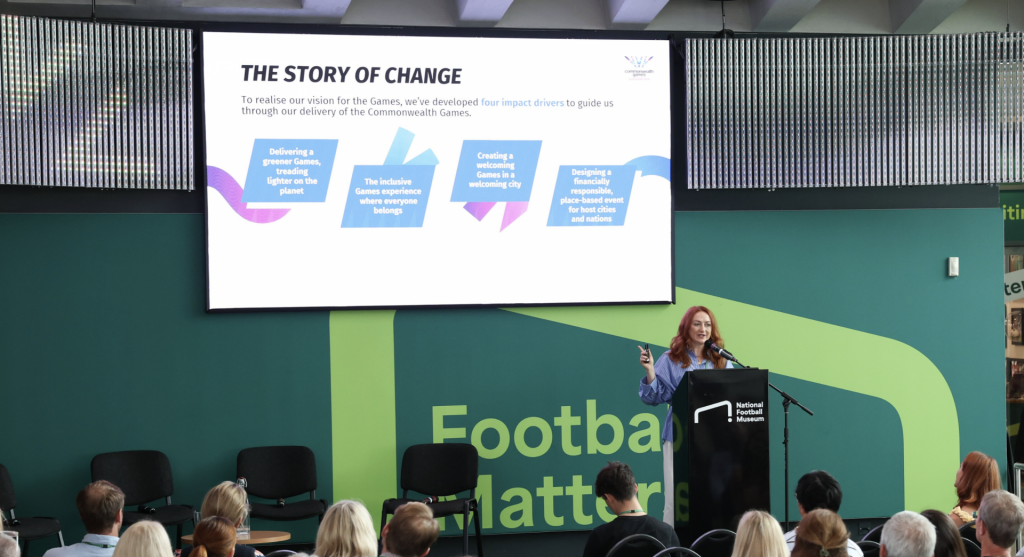
As Selina Donald, Glasgow 2026’s Lead for Sustainability and Accessibility, explained during her recent presentation at the BASIS Conference, Glasgow is no longer simply hosting another major event. It is attempting to prove that international multi-sport events can be delivered in a fundamentally different way.
The result is what organisers call the “Reimagined Games” – a model designed around financial responsibility, inclusion, accessibility and long-term impact rather than scale alone.
“We refer to it as the Reimagined Games,” Donald told delegates. “We’re trying to prove that major events can be handled with financial responsibility. Small and focused Games can still be a world-class event and be a viable model for future hosts.”
“We refer to it as the Reimagined Games. We’re trying to prove that major events can be handled with financial responsibility. Small and focused Games can still be a world-class event and be a viable model for future hosts.”
Doing More with Less
The contrast with traditional mega-events is striking.
According to Donald, Glasgow 2026 will be delivered with an estimated budget around 80 per cent smaller than recent editions, using existing venues, no new permanent construction and a compact footprint stretching across an eight-mile corridor through the city.
The model reflects a growing challenge facing international sport. Escalating costs have made hosting increasingly difficult, with Victoria’s withdrawal from the 2026 Games highlighting concerns around financial sustainability. Glasgow’s response has been to embrace simplicity rather than expansion.
The city will utilise four existing competition venues, temporary overlay instead of new infrastructure, and accommodation spread across local hotels rather than a purpose-built athletes’ village. The approach not only reduces costs but also significantly lowers the environmental footprint of the event.
Sustainability Built Into Operations
Environmental sustainability sits at the heart of the Games strategy.
Donald outlined ambitions to deliver a low-carbon Games through circular procurement, waste reduction and renewable energy. The organising committee is targeting zero waste to landfill, maximising reuse opportunities and embedding circular principles throughout event operations.
Many of those ambitions are already taking shape.
Glasgow 2026 has partnered with EDF to ensure key venues are powered by renewable electricity sourced from Scottish renewable generation. Three major venues will receive 100 per cent traceable renewable electricity, with the infrastructure and benefits extending beyond the Games themselves.
“As a Principal Partner, EDF is supporting our ambitions to host a greener Games, feeding into Scotland’s wider net-zero ambitions,” said Glasgow 2026 Chief Executive Phil Batty.
Other initiatives highlighted by Donald include the largest electric and hybrid vehicle fleet ever assembled for a Commonwealth Games, renewable energy across competition venues, reusable cup systems, recycled materials in branding and signage, and the reuse of competition infrastructure from previous events including Birmingham 2022.
“As a Principal Partner, EDF is supporting our ambitions to host a greener Games, feeding into Scotland’s wider net-zero ambitions,”
Putting People at the Centre
Yet Glasgow’s sustainability story extends far beyond carbon and waste.
One of the strongest themes emerging from both Donald’s presentation and recent announcements is the commitment to social sustainability.
The Games will feature the largest Para sport programme in Commonwealth Games history, reinforcing ambitions to create the most inclusive edition ever staged. Donald described inclusion as one of the defining characteristics of the event, with Para athletes more visible than ever before.
That commitment has also expanded into health and wellbeing.
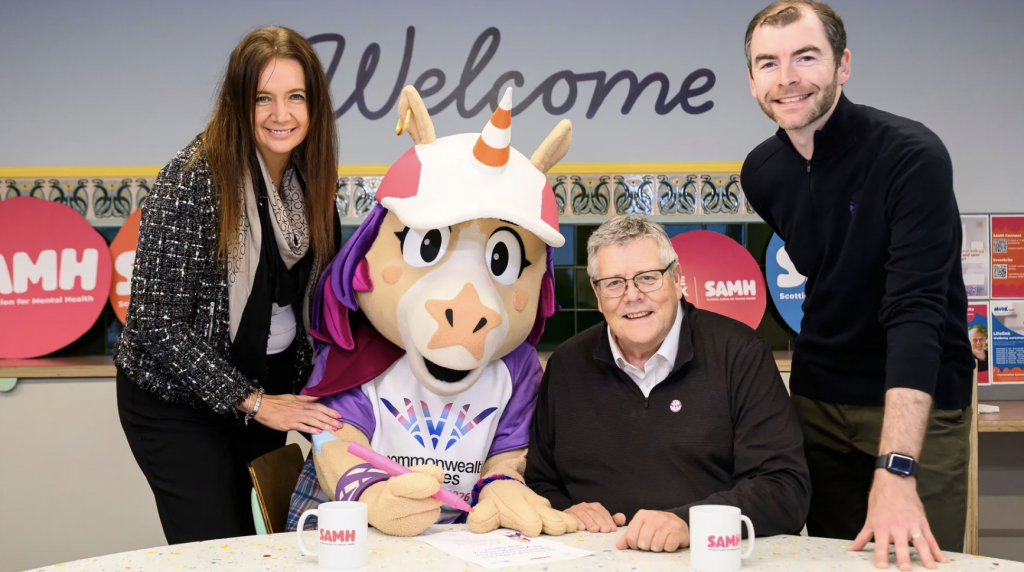
In June, Glasgow 2026 announced a landmark partnership with SAMH (Scottish Action for Mental Health), becoming the first major sporting event to sign Scotland’s Mental Health Charter for Physical Activity and Sport. The initiative will provide mental health support for staff, volunteers, athletes, coaches and families throughout the Games.
“Great sporting moments are powered by extraordinary people,” said Gayle Shepherd, Director of Executive Office and Social Impact at Glasgow 2026. “Looking after those people is fundamental to the success of the Games.”
The Games have also strengthened their commitment to safeguarding and human rights through the publication of a dedicated Human Rights Statement and a partnership with anti-trafficking charity It’s a Penalty. The campaign aims to raise awareness, strengthen prevention efforts and leave a lasting legacy beyond the event itself.
“Great sporting moments are powered by extraordinary people, Looking after those people is fundamental to the success of the Games.”
A Story of Change
Donald repeatedly returned to one phrase during her BASIS presentation: “Story of Change”. For Glasgow 2026, success will not simply be measured through medals won, tickets sold or broadcast audiences. Instead, organisers want to understand whether the event delivers meaningful change for the city, communities and future hosts.
“Success nowadays isn’t just measured by medals won or tickets sold,” she said. “It’s about the impact it has on the wider community. It’s about whether it actually delivers meaningful change.”
That philosophy aligns closely with the growing emphasis across sport on measuring awareness, activity and impact rather than simply announcing commitments.
“Success nowadays isn’t just measured by medals won or tickets sold. It’s about the impact it has on the wider community. It’s about whether it actually delivers meaningful change.”
Setting a New Standard
Perhaps the most important question facing Glasgow 2026 is whether its model can be replicated elsewhere.
With existing venues, reduced costs, stronger community integration, renewable energy partnerships, mental health programmes and human rights commitments, Glasgow is presenting an alternative vision for major events at a time when many traditional hosting models are under increasing scrutiny.
The city is effectively positioning itself as a test case for the future of international sport.
If successful, Glasgow 2026 may be remembered not simply for what happened on the field of play, but for demonstrating that major sporting events can be smaller, smarter and more sustainable while still delivering world-class competition and meaningful social impact.
Read moreGlasgow 2026










Join the GSS Alliance Partners programme today
Stay ahead of the game with our FREE weekly newsletter, delivering the latest sport and sustainability news from around the globe straight to your inbox

11th Hour Racing
Join the GSS Network programme today


Register for GSS Workshops today
Join the GSS Education programme today