
To access our unique news archive of over 1,400 articles with insights on over 500+ sustainable sports organisations, join the GSS Network today.
Login here if you are a registered network subscriber.
News article
The 1% Advantage: What Envision Racing Can Teach Business About AI
Artificial intelligence may be transforming almost every industry, but few environments demonstrate its potential quite as vividly as elite motorsport.

At London City Hall on 13 August, just two days before the final Formula E race weekend of the season, Envision Racing brought together technology, energy and business leaders for an AI Data Centre Summit examining how organisations are responding to one of the fastest-moving technological transformations of our time.
For Envision Racing, however, AI is already much more than a future opportunity. It is increasingly embedded within the way the Formula E team analyses data, develops strategy and searches for the marginal gains that can determine success or failure.
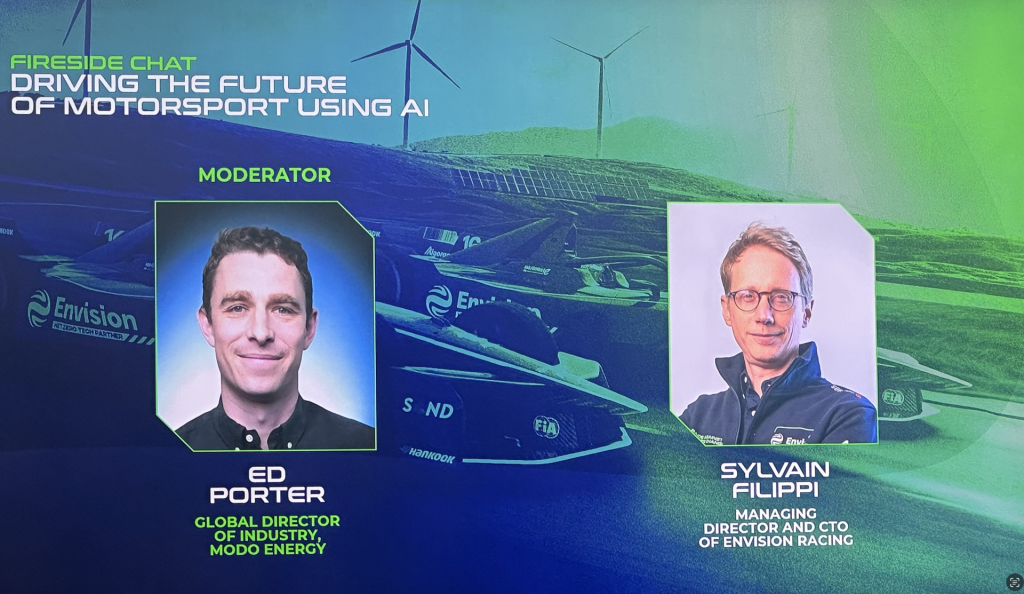
And according to Sylvain Filippi, Managing Director and CTO of Envision Racing, that makes motorsport an increasingly relevant testing ground for the wider business community.
“People are always very surprised that 90% of what we do is data,” he explained. “There are way more software and computers and laptops than there are spanners around the garage.”
That observation provides an important starting point. Modern motorsport might still be expressed through cars and drivers, but increasingly its competitive advantage is created through data, software and the speed at which organisations can turn information into decisions.
“People are always very surprised that 90% of what we do is data. There are way more software and computers and laptops than there are spanners around the garage.”
Purpose beyond performance
That combination of technology, performance and wider purpose has helped establish Envision Racing as one of the leading purposeful sports teams globally.
Perhaps even more significantly, the Formula E team is currently ranked number one in the GSS Global Profile Pillar Index, which assesses how effectively sports organisations communicate, engage and build awareness around their sustainability, purpose and impact.
That distinction is particularly relevant to the discussion around AI. Envision Racing is not simply exploring how technology can make a racing car faster. It is increasingly demonstrating how innovation, sustainability, data and communications can work together to create wider value – for the team, its partners, its fans and potentially businesses far beyond motorsport.
Turning data into competitive advantage
Envision Racing employs around 50 people, making efficiency fundamental to its operating model. Formula E compounds that challenge through compressed race weekends in which teams can have little more than an hour between sessions to analyse information and make changes.
This is where AI is beginning to deliver tangible benefits.
“If you can do an analysis job in half the time that you used to do it, it’s a massive step in performance,” said Filippi. “Every minute counts, and every second counts.”
“If you can do an analysis job in half the time that you used to do it, it’s a massive step in performance. Every minute counts, and every second counts.”
AI is now being deployed across performance analysis, driver comparisons, vehicle dynamics, weather forecasting and race strategy. Importantly, Envision starts with something many businesses still struggle to achieve: structured, high-quality data.
“Our data is so well organised because, by definition, that’s what we do,” Filippi said. “It’s a dream for AI developers, which means we can develop AI tools quite quickly because the quality of the data in the first place is very good.”
That lesson extends far beyond Formula E. AI cannot magically compensate for fragmented systems, inconsistent information or poor-quality data. Before organisations ask what AI can do for them, they may first need to ask whether their underlying data is capable of supporting it.
“Our data is so well organised because, by definition, that’s what we do. It’s a dream for AI developers, which means we can develop AI tools quite quickly because the quality of the data in the first place is very good.”
Five people – but no jobs lost
Perhaps the most interesting example from Envision Racing is not about replacing people, but freeing them to do something more valuable.
Filippi revealed that one AI strategy tool has become sufficiently reliable to remove a workload that previously required the equivalent of five people.
“Now you convert that to zero people with the same accuracy,” he explained. “These five people are still there to do something which is very useful.”
This distinction could prove fundamental to the next phase of corporate AI adoption.
“Now you convert that to zero people with the same accuracy. These five people are still there to do something which is very useful.”
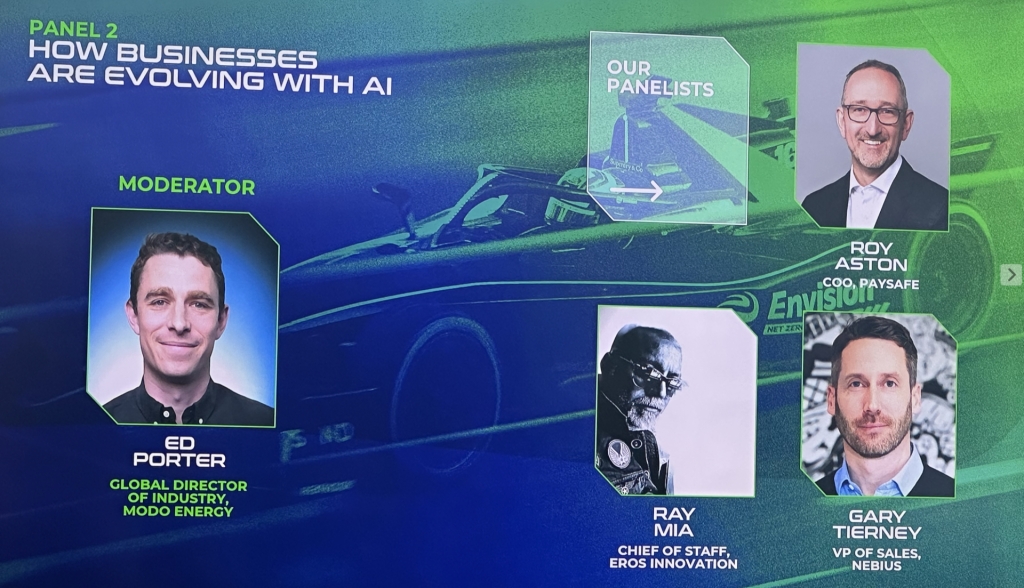
Gary Tierney, Vice President of Sales at Nebius, reinforced that point during a later panel.
“Rather than make people redundant, one view we should look at is: how do we make people more productive?” he said.
For businesses, therefore, the question may increasingly become not which jobs can AI replace?, but which activities can AI perform so people can create greater value?
“Rather than make people redundant, one view we should look at is: how do we make people more productive?”
When AI changes the race
Envision is already seeing that principle translate directly into sporting performance.
At the recent Tokyo E-Prix, the team used an AI-powered weather system combining multiple forecasting models to predict highly uncertain conditions.
Envision trusted the model and made a different set-up decision to much of the field.
“We absolutely nailed that decision,” Filippi said. “It looked like quite a brave move at the time, but we trusted the models.”
This is where AI becomes particularly interesting for business. The technology did not simply produce more information; it helped create confidence to make a better decision under pressure.
The same principle applies in almost every sector. Competitive advantage increasingly lies not in possessing data, but in converting enormous volumes of information into reliable insight quickly enough to act upon it.
“We absolutely nailed that decision. It looked like quite a brave move at the time, but we trusted the models.”
AI needs a business case
That does not mean adopting AI for its own sake.
Roy Aston, Chief Operating Officer of Paysafe, warned against organisations simply adding AI to existing processes without understanding the value they are trying to create.
“Lots of companies, and definitely big corporate companies, just talk about putting AI into the business,” he said. “We must do AI. Well, for what? What’s the value you’re trying to create?”
For Paysafe, there are already clear applications. AI is being used to strengthen cybersecurity, accelerate maintenance and patching and, crucially, analyse transactions in real time to identify fraud while reducing the risk of blocking legitimate customers.
“Lots of companies, and definitely big corporate companies, just talk about putting AI into the business. We must do AI. Well, for what? What’s the value you’re trying to create?”
“We’re using AI in ways that we could have never done before to detect patterns in data and transactions in real time,” Aston explained.
The connection between the two organisations became even more significant the following day when Paysafe announced that it would become Envision Racing’s new title partner, with the team becoming Paysafe Envision Racing as it enters Formula E’s Gen4 era.
The partnership is expected to extend across gaming, digital payments, esports, rewards and new forms of fan engagement, creating another potential environment in which technology and data can transform the relationship between sport and its audiences.
“We’re using AI in ways that we could have never done before to detect patterns in data and transactions in real time,”
From AI adoption to AI transformation
Aston also identified three recurring challenges for businesses: attempting to bolt AI onto existing processes rather than rethinking them; adopting technology without identifying the value it should create; and failing to address the quality and accessibility of underlying data.
Ray Mia, Chief of Staff at Eros Innovation, added another dimension: AI should enhance human capability rather than eliminate it.
“I’m seeing people needing to be upskilled,” he said, describing the emergence of “new toolkits that are required and embedded at every single level of the future”.
“I’m seeing people needing to be upskilled .. new toolkits that are required and embedded at every single level of the future”.
challenges alongside its opportunities.
Aston argued that organisations need “robust control testing”, while Tierney suggested businesses will require continuous agility because AI models and capabilities are developing so rapidly.
“AI isn’t a moment in time,” Tierney said. “It’s a thing that’s going to keep evolving.”
“AI isn’t a moment in time. It’s a thing that’s going to keep evolving.”
The race for the final 1%
Perhaps the most powerful business lesson from Envision Racing comes from the relentless pursuit of marginal improvement.
Motorsport operates at a level where achieving 98 or 99 per cent is relatively straightforward compared with finding the final percentage point. That final 1% consumes enormous amounts of engineering, analysis and human effort.
AI potentially changes that equation.
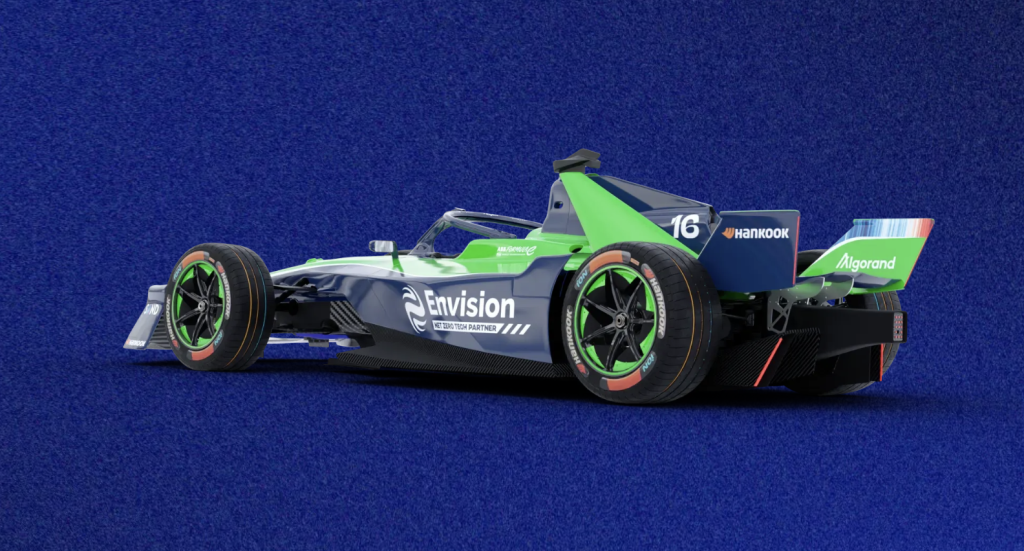
“Every time you gain 1% of efficiency, you go 1% faster,” Filippi said. “Every time AI is saving us 1% of effort or energy somewhere, we go 1% faster.”
“Every time you gain 1% of efficiency, you go 1% faster. Every time AI is saving us 1% of effort or energy somewhere, we go 1% faster.”
That could equally describe the opportunity facing businesses.
AI does not necessarily require organisations to reinvent everything overnight. Its greatest immediate value may lie in systematically identifying inefficiencies, accelerating analysis, improving decisions and releasing people to concentrate on activities where human judgement creates the greatest value.
For Envision Racing, that journey is only beginning. Filippi expects a significant proportion of the team’s preliminary data analysis to be undertaken by AI within the next two or three years, while engineers remain responsible for interpreting the information and making decisions.
As Formula E moves into its faster and more technologically advanced Gen4 era, the competition will increasingly extend beyond drivers and cars to the quality of the tools, models and data behind them.
For business leaders watching from outside the garage, there is an important message.
The AI race may ultimately not be about who has access to the most technology. It will be about who has the best data, asks the right questions and turns AI-generated insight into better human decisions.
And, as Envision Racing is demonstrating, sometimes a 1% advantage is all that is needed to move ahead of the competition.
Read moreEnvision Racing














Join the GSS Alliance Partners programme today
Stay ahead of the game with our FREE weekly newsletter, delivering the latest sport and sustainability news from around the globe straight to your inbox



11th Hour Racing
Join the GSS Network programme today




Register for GSS Workshops today
Join the GSS Education programme today