
To access our unique news archive of over 1,400 articles with insights on over 500+ sustainable sports organisations, join the GSS Network today.
Login here if you are a registered network subscriber.
News article
Glasgow 2026: How the Reimagined Commonwealth Games Could Transform the Future of Major Sporting Events
The Glasgow 2026 Commonwealth Games may prove to be a turning point in the future of major sporting events. Delivered at a fraction of the cost of previous editions, the Games demonstrated how a different approach to hosting could combine financial responsibility with environmental sustainability, inclusion and meaningful community engagement.
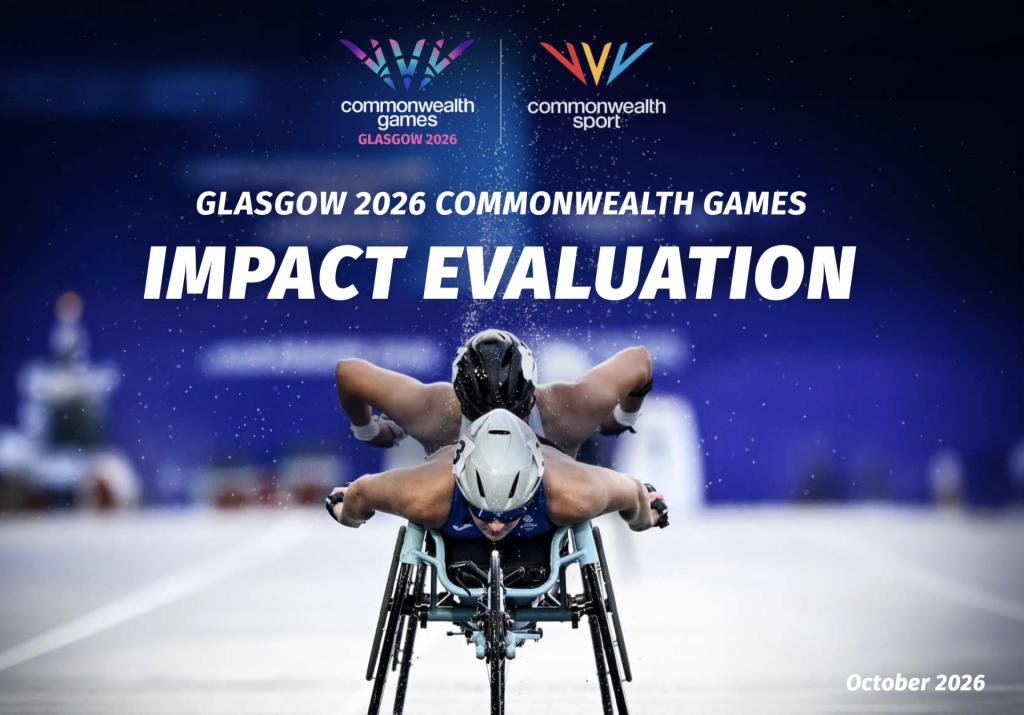
The recently published Glasgow 2026 Commonwealth Games Impact Evaluation reveals how the Games were delivered for just £159.6 million, approximately 85% less than the average cost of the previous three editions. But perhaps the most significant achievement was not simply reducing costs. It was demonstrating how sustainability, commercial partnerships and community impact could become integral to the delivery of a major international sporting event.
Speaking to Global Sustainable Sport, Selina Donald, Director of Sustainability at The Bulb (part of Trivandi Group), who worked in-house as Sustainability and Accessibility Lead for much of the Games, explained how this new approach challenged traditional event delivery models and created opportunities that could help reshape the future of international sport.
Reimagining the Games
When the Australian state of Victoria withdrew from hosting the 2026 Games in 2023, the future of the event was uncertain. Glasgow stepped forward with an alternative approach, building on existing facilities and the city’s experience of hosting the 2014 Commonwealth Games.
Rather than constructing new venues, Glasgow used four existing venue clusters within an eight-mile corridor. Hotels replaced the traditional athletes’ village, while a streamlined organising structure brought in experienced delivery specialists.
The Games featured 10 sports, 2,749 athletes from 74 nations and territories, and the largest integrated Para sport programme in Commonwealth Games history.
The event was organised around four impact drivers: delivering an inclusive Games, creating a greener Games, celebrating Glasgow as a welcoming city, and developing a financially responsible hosting model.
Donald believes the most important change was the willingness to challenge established practices.
“We were able to be a lot more agile, and we had to be,” she explained.

"We were able to be a lot more agile, and we had to be,"
However, she also emphasised that the accelerated delivery timetable came at a human cost. Although the Games had an 18-month operational planning period, many staff joined less than a year before the event.
Donald believes a two-year delivery period could provide a better balance between efficiency and the wellbeing of the workforce.
Sustainability as a Commercial Opportunity
One of Glasgow’s most significant innovations was the integration of sustainability into the commercial strategy.
Rather than securing sponsors and subsequently identifying sustainability initiatives, Donald worked with the commercial team to identify partners capable of delivering specific environmental objectives.
“For the first time ever that I’ve done this, I was really strategic in working with the commercial team on sustainability,” she explained.
“We set the sustainability strategy, and then we identified the partners we needed to be able to meet those goals.”
"For the first time ever that I've done this, I was really strategic in working with the commercial team on sustainability ... we set the sustainability strategy, and then we identified the partners we needed to be able to meet those goals."
This produced a series of practical partnerships.
EDF supported the transition of three competition venues to renewable electricity tariffs, with the arrangements extended beyond the Games until March 2027.
Zero Waste Scotland helped fund the replacement of conventional branding materials with recycled alternatives.
Scottish Water supported refill infrastructure, helping avoid an estimated 156,000 single-use plastic bottles.
Coca-Cola supplied drinks in bottles made from 100% recycled PET, while vehicle partnerships supported greater use of electric and hybrid transport.
Donald described the collaboration between sustainability and commercial teams as one of her proudest achievements.
“It meant that it was a win-win for everyone.”
This approach offers an important lesson for the wider sports industry: sustainability can become part of the commercial proposition rather than simply an operational expense.
"It meant that it was a win-win for everyone."
Measuring Environmental Performance
The Impact Evaluation records a total carbon footprint of 40,907 tonnes of CO₂ equivalent.
Existing venues, renewable electricity, lower-impact temporary infrastructure and circular procurement were central to reducing the environmental impact.
The Games achieved ISO 20121 certification, diverted all reported waste from landfill and introduced carbon labelling across food menus.
Donald highlighted another significant operational decision.
“We banned diesel across the board, and there was not one diesel generator, which I’m really proud of.”
"We banned diesel across the board, and there was not one diesel generator, which I'm really proud of."
Hydrotreated vegetable oil was used instead for temporary generators, a decision supported by the Games’ leadership even when it was expected to cost more.
Not every environmental target was achieved. Public and active transport accounted for 67% of surveyed spectator journeys, against an 80% ambition. Similarly, 53% of fresh food menu items were classified as Scottish, below the original 80% target.
Donald acknowledged that some targets had been overly ambitious, particularly given the diverse dietary requirements of athletes and visitors.
The willingness to report both achievements and shortcomings is an important part of the Glasgow model. Sustainability requires transparent measurement, not simply positive commitments.
Leadership Makes the Difference
Donald repeatedly emphasised the importance of leadership in embedding sustainability throughout the organisation.
Glasgow 2026 Chief Executive Phil Batty actively supported environmental ambitions and challenged operational teams to identify further improvements.
“He would challenge me to be more ambitious,” Donald explained, adding that he made clear to functional leads that sustainability was their responsibility too.
“These things are so hard that you need leadership behind you, or it just doesn’t work.”
The result was a more integrated approach, connecting governance, procurement, commercial partnerships, operations and environmental performance.
"He would challenge me to be more ambitious ... these things are so hard that you need leadership behind you, or it just doesn't work."
Inclusion and Community at the Heart of the Games
Glasgow also demonstrated how a smaller sporting event could generate significant community engagement.
The integrated Para sport programme placed accessibility at the centre of event planning. Donald’s team worked with disability organisations to undertake lived-experience audits of venues, accommodation and training facilities.
These identified practical improvements to ramps, signage, spectator routes and seating arrangements, including better provision for assistance dogs.
Beyond the venues, the Glasgow 2026 Festival supported 161 community organisations across every ward of the city, backed by £1.1 million in funding.
The innovative All In programme allowed schools, businesses and community organisations to use Games branding free of charge, attracting 755 participating organisations.
Donald explained that the objective was to build on existing initiatives rather than create programmes that would disappear once the Games ended.
“What was already existing that we could then use the Games as a platform to accelerate it further?”
"What was already existing that we could then use the Games as a platform to accelerate it further?"
This included supporting physical activity initiatives such as Together We Move, alongside community arts, cultural activities and local wellbeing projects.
The Games also created volunteering, skills and employment opportunities, demonstrating that major sporting events can contribute to wider social development.
A Different Economic Model
The evaluation estimates that Glasgow 2026 generated £117.3 million in Gross Value Added for Scotland, including £92.5 million for the Glasgow City Region.
With 99% of the £162.2 million budget funded from non-public sources, the Games also demonstrated a different relationship between sporting events and government.
Rather than acting as the principal financial underwriter, government could support the event through infrastructure, services and collaboration.
However, Glasgow benefited from an unusually strong foundation: existing venues, experienced event professionals and infrastructure developed through previous investment.
Donald recognised that this model cannot simply be transferred unchanged to every host city.
“Every city is going to take this model and do it differently.”
For future hosts, including Amdavad 2030, the challenge will be to adapt Glasgow’s principles to local circumstances, rather than reproduce its exact format.
"Every city is going to take this model and do it differently."
From Event Impact to Lasting Legacy
Perhaps the most important unresolved question concerns legacy.
The evaluation provides extensive evidence of immediate economic, environmental and social outcomes. However, Donald confirmed that it is an evaluation of the Games themselves, not an ongoing assessment of their long-term legacy.
The Glasgow 2026 Legacy Network will continue bringing stakeholders together, but sustained measurement of changes in physical activity, community wellbeing and environmental performance remains a wider challenge.
For Global Sustainable Sport, this reinforces the importance of evaluating sporting organisations and events across the Seven Sustainable Pillars of Sport: Partnerships, Participation, People, Planet, Power, Profile and Prosperity.
Glasgow demonstrates how these different dimensions can work together, particularly when commercial partnerships, environmental objectives and community outcomes are connected from the outset.
A Blueprint for the Future?
Glasgow 2026 has demonstrated that major sporting events do not necessarily need to become bigger, more expensive or more complex to be successful.
Its most significant achievement may be showing how existing infrastructure, experienced delivery teams, commercial partnerships and purposeful leadership can create a different hosting model.
The next challenge is to establish which elements can be replicated, how the model can evolve, and how its longer-term benefits can be measured.
The future of major sporting events may no longer be defined by how much hosts spend or how much they build, but by how effectively they use the resources they already have, and the lasting value they create for people, communities and the planet.
Read moreCommonwealth Sport













Join the GSS Alliance Partners programme today
Stay ahead of the game with our FREE weekly newsletter, delivering the latest sport and sustainability news from around the globe straight to your inbox
11th Hour Racing
Join the GSS Network programme today


Register for GSS Workshops today
Join the GSS Education programme today