
To access our unique news archive of over 1,400 articles with insights on over 500+ sustainable sports organisations, join the GSS Network today.
Login here if you are a registered network subscriber.
News article
Top storyWho Governs the Governors of Sport?
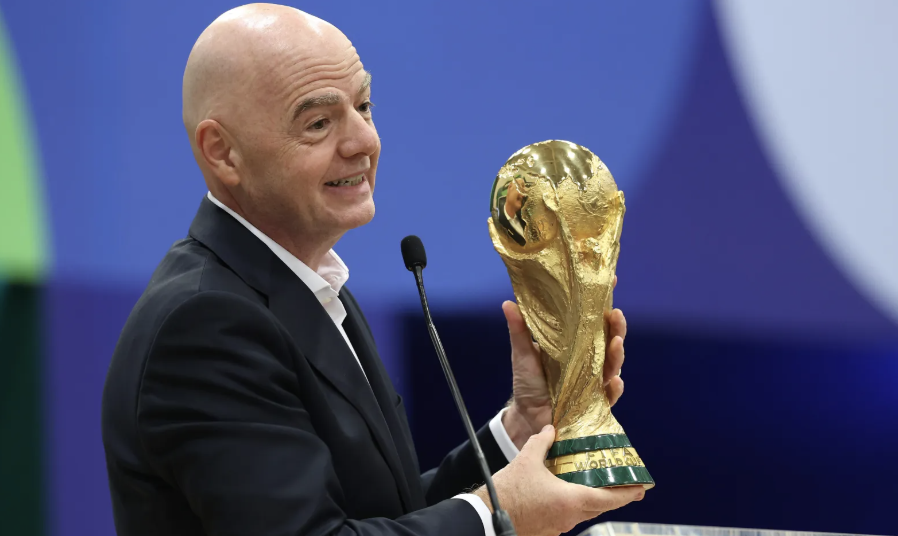
The growing crisis surrounding FIFA President Gianni Infantino has moved beyond one controversial commercial proposal. Questions over political neutrality, decision-making, accountability and independence are now testing whether FIFA’s governance structures can withstand scrutiny when concerns reach the very top of the organisation. For sport it raises a wider question: how should governance itself be tested when the rules come under pressure?
From commercial crisis to governance crisis
The controversy surrounding FIFA Forward Enterprise (FFE) initially appeared to be about money.
The proposal to attract billions of dollars of private investment into a new commercial structure controlling interests linked to the FIFA World Cup generated extraordinary opposition. Senior figures within FIFA distanced themselves from the project, with Arsène Wenger, FIFA’s Chief of Global Football Development and the former Arsenal manager, saying he had only learned about it through media reports.
“The decision to withdraw the project was absolutely necessary and beyond question,” Wenger said, adding that he believed “We need an independent FIFA that serves our game with commitment, transparency, and integrity.”
“The decision to withdraw the project was absolutely necessary and beyond question ... we need an independent FIFA that serves our game with commitment, transparency, and integrity.”
FIFA Secretary General Mattias Grafström described what had happened as a “sad and reproachable series of events”, while Chief Operating Officer Kevin Lamour reportedly described FFE as “the project of one person”.
The proposal was abandoned. But the governance questions did not disappear with it.
Instead, they have intensified.
A joint intervention from UEFA, the Asian Football Confederation (AFC) and Concacaf has moved the debate towards whether FIFA should independently investigate what happened. As sports lawyer Emad Hanayneh observed, the dispute is “no longer about a failed commercial project, but about trust, governance, and the unity of the football family”.
That distinction matters.
The question is no longer simply whether FFE represented a good or bad commercial proposition. It is whether the processes through which one of world sport’s most important organisations makes major strategic decisions operated as they were supposed to.
“no longer about a failed commercial project, but about trust, governance, and the unity of the football family”.
What do FIFA’s own rules say?
FIFA is not short of governance structures.
Its Statutes define responsibilities between the FIFA Congress, Council, President and administration, while its Code of Ethics sets standards around integrity, political neutrality and loyalty.
Article 34 gives the Council responsibility for defining FIFA’s mission, strategic direction, policies and values, while Article 35 defines the President’s role more narrowly around representing FIFA and ensuring that the direction established by the Council is protected and implemented. Article 36 provides that commercial contracts should be negotiated and executed according to standards, policies and procedures established by the Council.
That makes the current situation particularly interesting.
The publicly available evidence does not establish that Infantino has been found to have breached FIFA’s rules. Any serious assessment must maintain the distinction between allegations, governance concerns and proven violations.
But there is sufficient evidence to ask whether FIFA’s own governance mechanisms should now independently examine what happened.
FIFA itself has acknowledged that mistakes were made, that the Council and Member Associations felt excluded and that the FFE process “should have been handled differently”. At the same time, it maintains that everything was conducted in compliance with FIFA’s regulatory framework.
It is the tension between those two positions that an independent investigation could help resolve.
A test already under way
The FFE controversy is only part of the discussion.
The Norwegian Football Federation has formally supported a complaint by human rights organisation FairSquare asking FIFA’s Ethics Committee to examine whether Infantino’s presentation of a peace prize to US President Donald Trump and associated conduct breached FIFA’s political neutrality requirements.
Article 4.2 of the FIFA Statutes states that “FIFA remains neutral in matters of politics and religion”.
Norwegian FA President Lise Klaveness acknowledged the sensitivity of challenging FIFA from within.
“There is no doubt that the letter is perceived as problematic when it comes from a member association,” she said. “But it was a good meeting, and we had constructive discussions about why it is perceived as problematic, and why it is important for Norway to support FairSquare in this matter.”
Again, this is an allegation requiring investigation, not evidence of guilt.
But that is precisely where governance becomes important.
“There is no doubt that the letter is perceived as problematic when it comes from a member association. But it was a good meeting, and we had constructive discussions about why it is perceived as problematic, and why it is important for Norway to support FairSquare in this matter.”
Independence under pressure
FIFA has an Ethics Committee with investigatory and adjudicatory chambers alongside a Governance, Audit and Compliance Committee. Its statutes impose independence requirements on committee members and provide mechanisms through which potential breaches can be investigated.
The critical distinction, however, is between bodies that are independent within FIFA and an investigation that is independent of FIFA.
That distinction has become central to the current dispute.
UEFA, AFC and Concacaf are not simply asking FIFA to use its existing internal structures. Their joint intervention calls for a “fully independent third party”, excluding FIFA staff and football stakeholders from conducting the investigation.
Ebru Köksal, former FIFA and UEFA adviser and Chair of Women in Football, believes the crisis demonstrates the need for stronger independent voices within sports governance.
“The discussions had been going on for a while but the fact that it had not been confronted signals some lack of checks and balances and a genuine independent challenge,” she told the media.
Köksal has argued that international sport could benefit from genuinely independent non-executive directors bringing governance experience from outside sport.
“Imagine having the former CEO of a FTSE 100 company sitting on the board of FIFA or UEFA,” she said. “They would bring decades of experience in governance, strategy, risk management and organisational transformation. That doesn’t replace football expertise, it complements it.”
“The discussions had been going on for a while but the fact that it had not been confronted signals some lack of checks and balances and a genuine independent challenge. Imagine having the former CEO of a FTSE 100 company sitting on the board of FIFA or UEFA. They would bring decades of experience in governance, strategy, risk management and organisational transformation. That doesn’t replace football expertise, it complements it.”
Introducing the GSS Governance Stress Test
The current crisis also presents an opportunity to look differently at how governance in sport is assessed.
Governance is traditionally measured through structures: statutes, policies, committees, elections, term limits, reporting systems and codes of conduct. All are important. But having a governance framework and demonstrating that it works when placed under pressure are two very different things.
The GSS Governance Stress Test has therefore been developed to examine not simply whether governance structures exist, but whether they function effectively when an organisation faces a genuine governance challenge.
It asks five questions: are responsibilities and decision-making powers clearly defined; were established processes followed; is there a clear mechanism for investigating suspected breaches; can that investigation operate genuinely independently of those being investigated; and are sanctions, removal procedures and succession arrangements clearly established before a crisis occurs?
Applied illustratively to the current FIFA crisis, the results reveal an important distinction between governance on paper and governance under pressure.
FIFA scores strongly on Responsibility (8/10). Its Statutes clearly establish the respective roles of Congress, Council, President and administration.
The score falls sharply on Process (4/10). The development of FFE raises serious questions over whether established governance processes were followed, particularly given FIFA’s acknowledgement that key stakeholders felt excluded.
On Accountability (6/10), FIFA again has substantial structures in place. Its Ethics Committee can investigate potential breaches, while the Norwegian FA-backed complaint provides a real-world test of whether those mechanisms are prepared to scrutinise conduct at presidential level.
It is Independence (3/10) that emerges as the greatest weakness. FIFA’s oversight bodies may be constitutionally independent within the organisation, but they remain part of FIFA’s own governance architecture. That is fundamentally different from being independent of FIFA.
Finally, FIFA performs relatively strongly on Resolution (7/10). Its Statutes provide mechanisms for sanctions, presidential removal and succession. An Extraordinary Congress must be convened if one-fifth of FIFA’s 211 member associations request one – 43 associations – while succession procedures are established should a President become unable to perform the role.
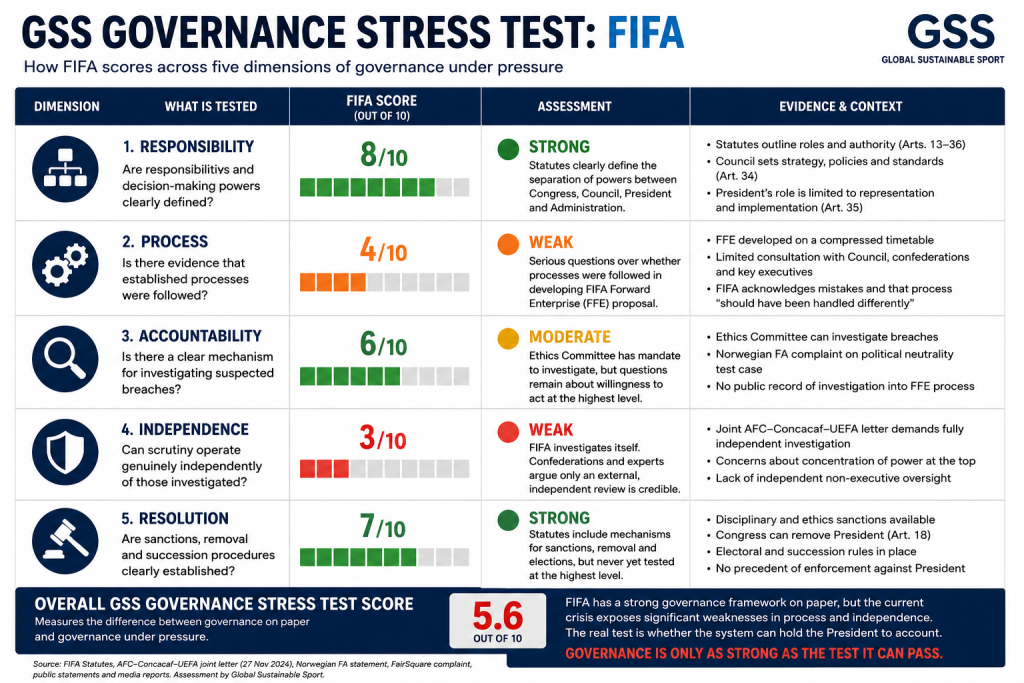
Taken together, the illustrative assessment gives FIFA an overall GSS Governance Stress Test score of 5.6 out of 10.
The score is not a formal FIFA SPI Rating, nor is it a judgement that any individual has breached FIFA’s rules. Instead, it highlights something more fundamental: FIFA has a comparatively sophisticated governance framework on paper, but the current crisis exposes significant weaknesses around process and, above all, independence when that framework comes under pressure.
The Stress Test also builds on three dimensions already central to the GSS assessment approach: Awareness, Activity and Outcome. FIFA demonstrates considerable Awareness through its statutes and codes, and considerable Activity through its ethics, audit and governance structures. The present controversy is testing the third and most important dimension: Outcome – do those structures actually work when they are needed?
The real governance test
This changes the nature of the debate surrounding FIFA.
The question is not simply whether Infantino should remain President. Nor should the existence of allegations be confused with evidence that FIFA’s rules have been breached.
The more important question is whether FIFA’s governance system is capable of determining that independently and credibility.
That matters because FIFA does have mechanisms for accountability. Its Statutes contemplate the dismissal of a President, provide for an Extraordinary Congress and establish succession arrangements. This is not an organisation without rules for dealing with a governance crisis.
The test is whether those mechanisms command sufficient confidence to be used when the individual under scrutiny occupies the most powerful position in the organisation.
Last week, GSS examined how international sport has repeatedly allowed presidential power to become concentrated over the past 50 years. From FIFA and athletics to boxing and biathlon, the underlying challenge has often been not simply the individual holding office, but the institutions that allow power to accumulate around them.
The current FIFA crisis takes that argument one step further.
Strong governance cannot prevent every controversy, poor decision or allegation of misconduct. What it can do is ensure that when a crisis occurs there is a clear process for establishing what happened, determining whether rules were breached and, where necessary, holding even the most senior people to account.
That is ultimately what the GSS Governance Stress Test seeks to measure.
FIFA has much of the necessary architecture. Its 5.6 score suggests the weakness is not principally an absence of governance, but uncertainty over how effectively that governance operates when placed under genuine pressure.
An independent investigation would therefore do more than determine what happened with FIFA Forward Enterprise. It would provide FIFA with an opportunity to demonstrate that its governance structures are stronger than the personalities operating within them.
Because the ultimate test of good governance is not how comprehensive the rulebook appears when everything is going well.
A governance framework is only as strong as the mechanism that applies it when the person accused of breaching it is the person at the top.
Read moreGlobal Sustainable Sport






Join the GSS Alliance Partners programme today
Stay ahead of the game with our FREE weekly newsletter, delivering the latest sport and sustainability news from around the globe straight to your inbox

11th Hour Racing
Join the GSS Network programme today


Register for GSS Workshops today
Join the GSS Education programme today