
To access our unique news archive of over 1,400 articles with insights on over 500+ sustainable sports organisations, join the GSS Network today.
Login here if you are a registered network subscriber.
News article
From Tournament to Transformation: The Lasting Impact of Women’s EURO 2025
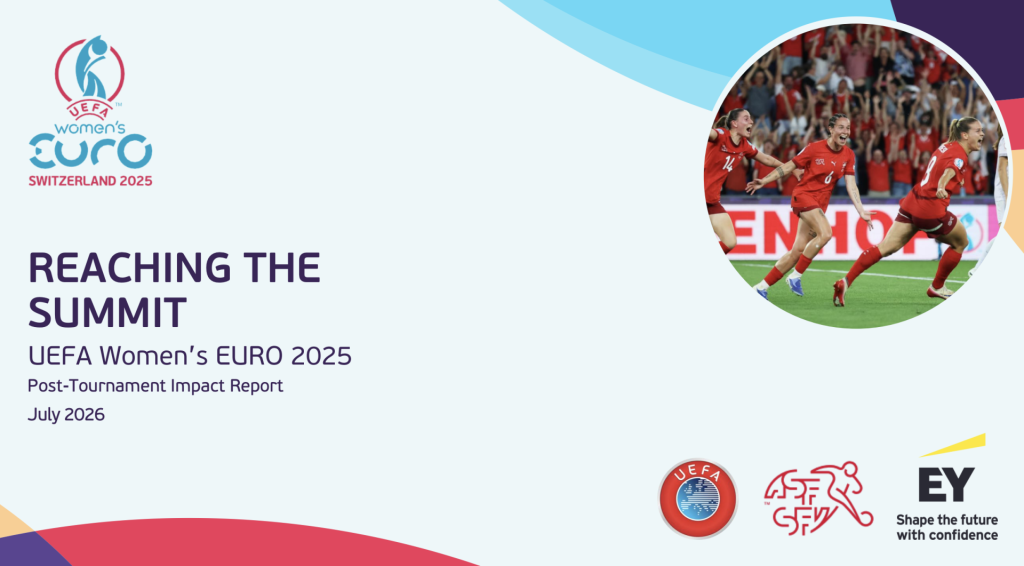
The true measure of a major sporting event is rarely found in the final score. Instead, it lies in what remains after the crowds have gone home. UEFA's newly published Women's EURO 2025 Post-Tournament Impact Report demonstrates that the championship in Switzerland has become far more than a record-breaking football tournament. It has become a blueprint for how major events can deliver lasting economic, social and environmental value alongside sporting success.
For many sports organisations, this is precisely where the conversation around sporting events is moving. Increasingly, the question is not simply whether an event was successful, but whether it leaves behind stronger communities, healthier participation pathways and a more sustainable sporting ecosystem.
That philosophy is reflected in UEFA’s broader sustainability ambitions. In the recently published GSS SPI Index, UEFA is ranked among the Top 10 most purposeful sports organisations in the world, achieving a Purpose Leader (B) SPI Rating—one of only four organisations currently to reach the highest level achieved in the Index.
Turning records into long-term impact
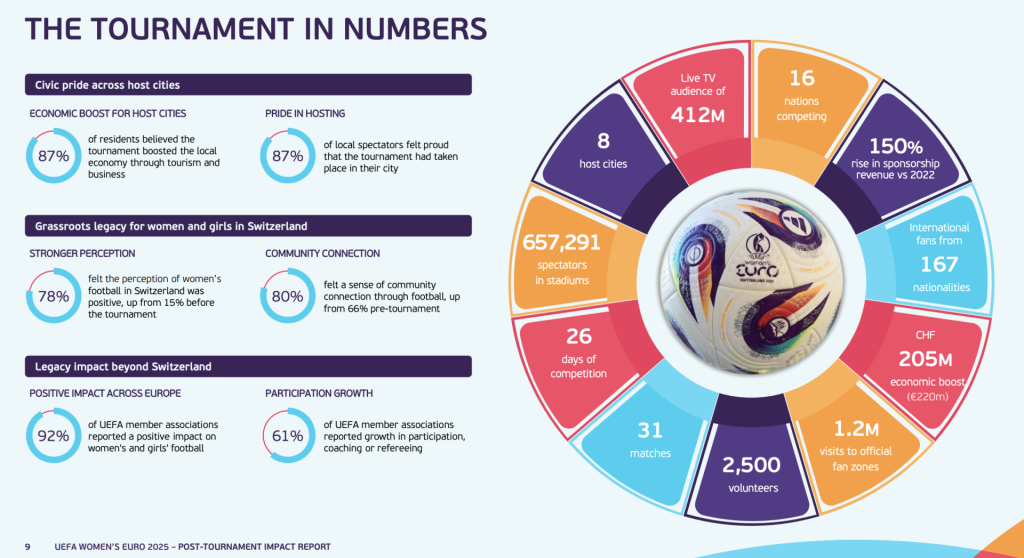
Women’s EURO 2025 undoubtedly set new benchmarks. The tournament attracted a record 657,291 spectators, sold out 29 of its 31 matches, welcomed fans from 167 nationalities, generated over 500 million global viewers, and recorded an extraordinary 1.9 billion digital interactions. Yet the report argues that these figures represent only the beginning of the story.
UEFA President Aleksander Čeferin captures the wider significance:
“The legacy of UEFA Women’s EURO 2025 is not a single achievement, fixed in time. It is something alive and tangible with every girl who joins a club, every coach who opens a new door, every referee who steps onto a pitch, and every fan who returns for more.”
That shift from measuring outputs to measuring outcomes is becoming one of the defining trends in sustainable sport.
"The legacy of UEFA Women's EURO 2025 is not a single achievement, fixed in time. It is something alive and tangible with every girl who joins a club, every coach who opens a new door, every referee who steps onto a pitch, and every fan who returns for more."
Legacy designed, not left to chance
Perhaps the most impressive aspect of the report is the evidence that legacy was intentionally planned rather than assumed.
Switzerland received an estimated CHF205 million (€220 million) economic boost, almost 2,300 full-time equivalent jobs were supported, while host cities reported strong increases in visitor spending and local business activity. More importantly, many of those benefits are continuing well beyond the tournament itself.
The Swiss Football Association’s ‘Here to Stay’ programme has already delivered record participation growth, with registered female players increasing from almost 40,000 to over 48,000 since 2023, alongside significant increases in female coaches and referees. Across UEFA’s 55 member associations, 92% reported a positive impact on women’s and girls’ football, while 61% linked the tournament to growth in participation, coaching or refereeing.
As UEFA Director of Women’s Football Nadine Kessler explains:
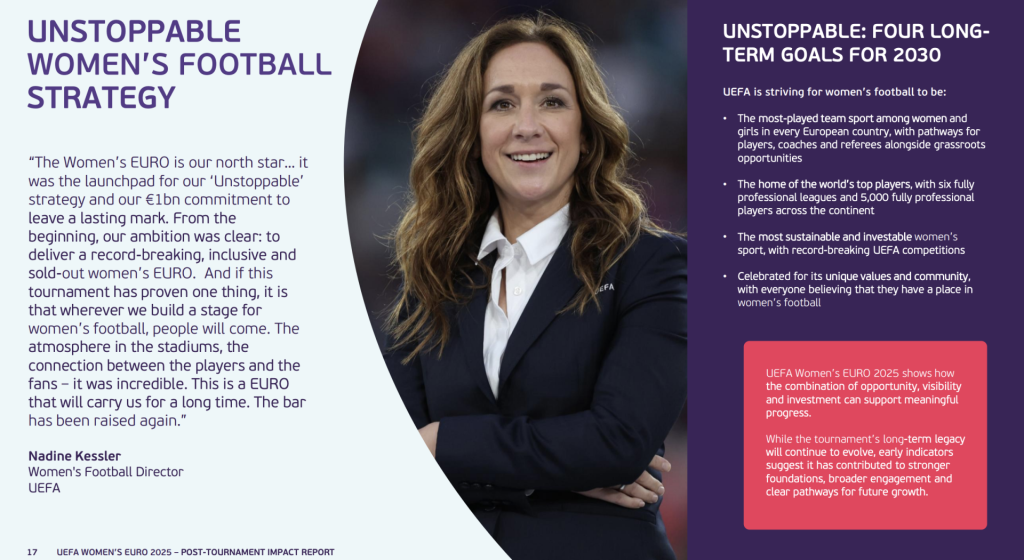
"The Women's EURO is our north star… it was the launchpad for our 'Unstoppable' strategy and our €1 billion commitment to leave a lasting mark."
Sustainability at the heart of delivery
The report also demonstrates that sustainability has become integral to tournament delivery rather than an add-on.
Among the standout achievements were 86% of spectators travelling by public transport, walking or cycling, 90% of staff commuting by train, five stadiums operating on 100% renewable energy, 70% of event signage being recycled or upcycled, and no tournament waste being sent to landfill. Accessibility also featured prominently, with affordable ticket pricing, comprehensive accessibility services and audio-descriptive commentary available throughout the competition.
These initiatives align closely with UEFA’s Football Sustainability Strategy 2030 and illustrate how environmental responsibility, inclusion and fan experience can reinforce one another.
Raising the bar for major events
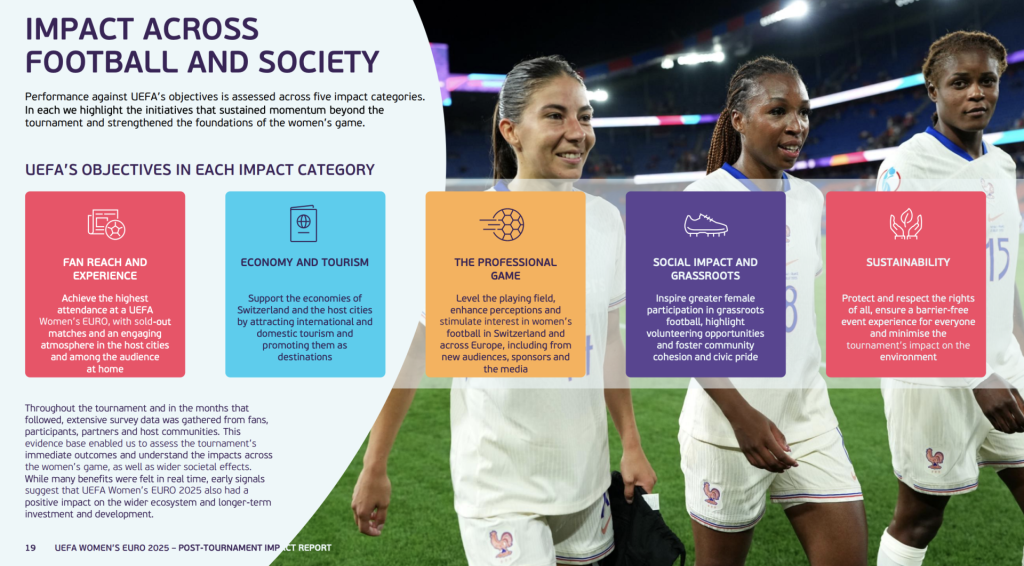
Women’s EURO 2025 demonstrates that success should no longer be measured solely in attendance records or television audiences. Its greatest achievement may be showing how elite sport can create lasting value through purposeful planning, measurable legacy and sustainable delivery.
As preparations begin for UEFA Women’s EURO 2029 in Germany, the challenge will no longer be simply to stage an even bigger tournament. It will be to build an even deeper legacy.
If Switzerland showed what is possible, the next generation of major sporting events now has a benchmark against which they will increasingly be judged.
To read the full report Click Here
Read moreUEFA










Join the GSS Alliance Partners programme today
Stay ahead of the game with our FREE weekly newsletter, delivering the latest sport and sustainability news from around the globe straight to your inbox
11th Hour Racing
Join the GSS Network programme today



Register for GSS Workshops today
Join the GSS Education programme today