
To access our unique news archive of over 1,400 articles with insights on over 500+ sustainable sports organisations, join the GSS Network today.
Login here if you are a registered network subscriber.
News article
The Climate Cost of the Beautiful Game
The FIFA World Cup 2026 has already secured its place in football history as the largest tournament ever staged. Yet, according to a new report from World Climate Athletes (WCA), it may also become the defining case study for the future sustainability of global sport. Rather than exposing the environmental cost of building stadiums, the tournament has highlighted a far greater challenge: the carbon impact of moving millions of people across continents.

The findings should resonate well beyond football. As sporting events continue to expand in scale and ambition, organisers face a new reality. The sustainability challenge is no longer primarily about venues or infrastructure. It is about mobility, travel and the difficult decisions that accompany truly global competitions.
A tournament built on existing infrastructure
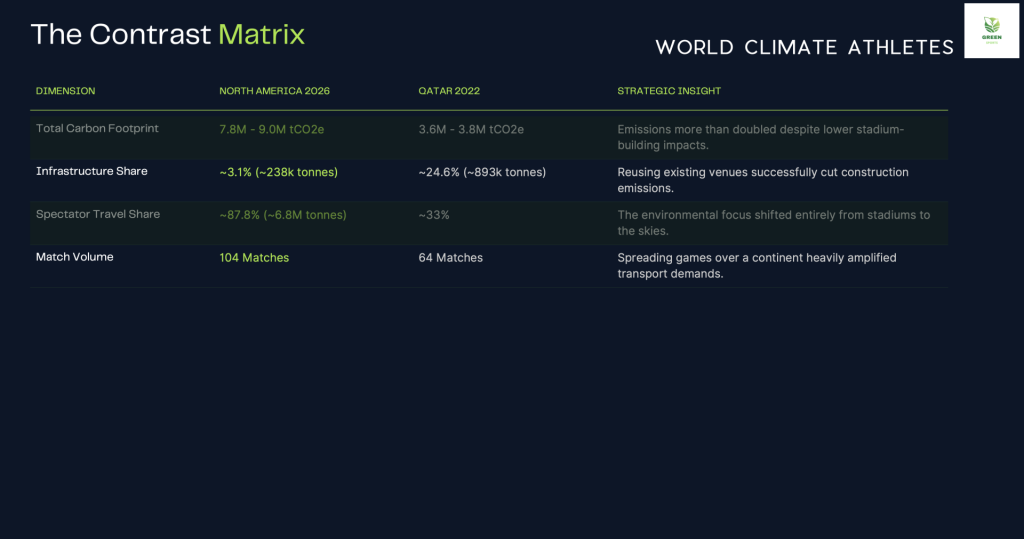
There is good news within the report. Unlike previous FIFA World Cups, the 2026 tournament relied almost entirely on existing stadiums across Canada, Mexico and the United States, meaning infrastructure accounted for only around 3.1% of the tournament’s estimated carbon footprint. The strategy demonstrated that reusing existing venues can dramatically reduce construction-related emissions and should become the benchmark for future mega-events.
However, these gains were overwhelmed by another factor.
With 48 teams, 104 matches and 16 host cities spread across North America, the tournament generated an estimated 7.8–9.0 million tonnes of CO₂e—more than double the reported footprint of Qatar 2022. Almost 88% of those emissions came from spectator travel, principally international aviation.
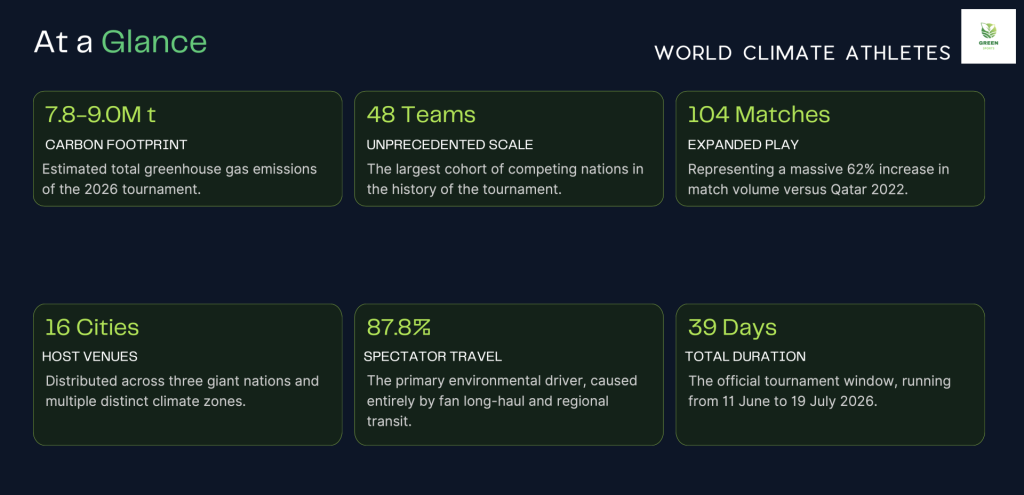
From stadiums to the skies
Perhaps the report’s most significant contribution is its argument that sport’s environmental debate has fundamentally shifted.
For many years, discussions around sustainable events centred on venue construction, waste management and renewable energy. WCA argues that these remain important but are no longer the dominant issue. Instead, aviation and fan mobility now represent the greatest climate challenge facing international sport.
The report also identifies a governance gap. Because international aviation emissions generally fall outside national climate accounting frameworks, much of the tournament’s carbon footprint is effectively absent from the host nations’ Nationally Determined Contributions (NDCs) under the Paris Agreement. This creates what WCA describes as an accountability loophole that future organisers and governments will need to address.

Climate adaptation becomes operational reality
The research also highlights another emerging trend that will become increasingly familiar to sports organisers: adaptation.
Extreme summer temperatures across several host cities meant eight stadiums required intensive cooling systems, while six venues experienced significant heat-related operational risks. Climate change is no longer simply an environmental issue—it is becoming a day-to-day operational challenge affecting athlete welfare, spectator experience and energy demand.
As competitions continue to be staged in hotter climates, investment in cooling, hydration and heat mitigation is likely to become a permanent feature of event planning.

Turning athletes into climate catalysts
Rather than presenting only problems, the report concludes with a call for a different model of leadership.
“The 2026 World Cup proved that mega-event sustainability is no longer about what we build, but how billions of people move,” said Kishan Changlani, CEO of World Climate Athletes. “By mobilising trusted athlete voices to drive grassroots fan action, we can convert this carbon liability into a catalyst for global change.”
"The 2026 World Cup proved that mega-event sustainability is no longer about what we build, but how billions of people move. By mobilising trusted athlete voices to drive grassroots fan action, we can convert this carbon liability into a catalyst for global change."
WCA recommends that future tournaments formally include spectator travel within official carbon accounting, improve reporting of aviation emissions and harness elite athletes to encourage lower-carbon travel choices among supporters.
The report reinforces an increasingly important message. Sustainable sport can no longer be measured solely by greener stadiums or recycled materials. As international calendars expand and competitions become ever more global, governing bodies must confront the emissions generated beyond the stadium gates. The next generation of sporting sustainability will be judged not only by how events are delivered, but by how intelligently they move people around the world.
To view the report Click Here:
Read moreWorld Climate Athletes














Join the GSS Alliance Partners programme today
Stay ahead of the game with our FREE weekly newsletter, delivering the latest sport and sustainability news from around the globe straight to your inbox



11th Hour Racing
Join the GSS Network programme today






Register for GSS Workshops today
Join the GSS Education programme today