
To access our unique news archive of over 1,400 articles with insights on over 500+ sustainable sports organisations, join the GSS Network today.
Login here if you are a registered network subscriber.
News article
Top storyHow Sustainable is Saudi Investment in Sport
Saudi Arabia’s investment in global sport has built over the past decade, accelerating dramatically since 2021 to reshape the scale of ambition. Backed by the Public Investment Fund (PIF), billions have been deployed across golf, football, motorsport and entertainment to position the Kingdom as a central force in the global sports economy.
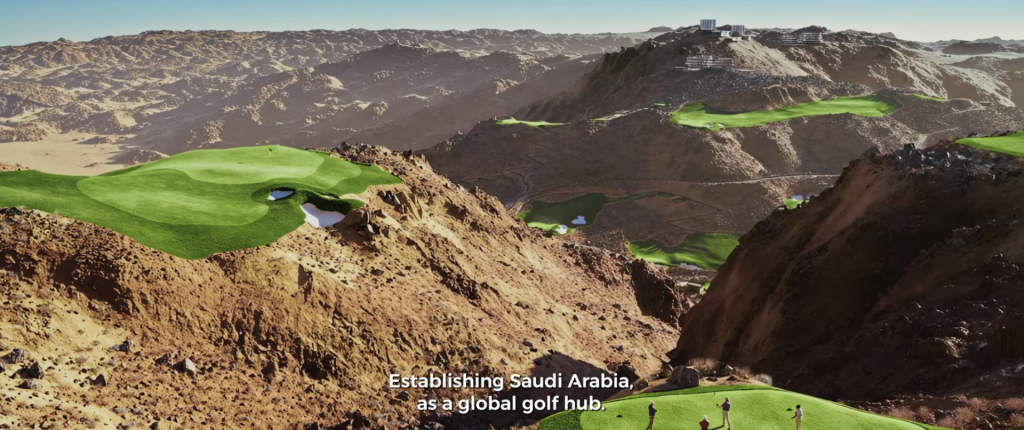
But in 2026, the narrative is shifting.
What was once framed as limitless capital is now being tested by financial realities, geopolitical instability and project delivery challenges. The emphasis has moved from expansion to what Saudi officials describe as “efficiency of investments” .
The implications for sport are significant.
LIV Golf: from disruption to doubt
No investment better captures this shift than LIV Golf.
Since its launch in 2022, the league has reportedly consumed close to $6 billion (£3.9 billion), offering unprecedented contracts and weekly prize purses of $33 million. While revenues have grown, the model remains heavily reliant on sovereign backing.
Now, with reports that PIF may step back, the future of the league is uncertain, with the possibility that funding will stop at the end of the season.
Players themselves appear unclear on what comes next. Sergio Garcia, the 2017 Masters champion and one of LIV Golf’s most recognisable players, admitted:
“Honestly, we haven’t heard anything other than what Yasir told us at the beginning of the year… you know how these rumours are.”
That lack of clarity reflects a wider structural issue: a competition built on financial speculation rather than commercial sustainability.
“Honestly, we haven’t heard anything other than what Yasir told us at the beginning of the year… you know how these rumours are.”
Three paths forward
If Saudi backing is reduced, LIV Golf faces three potential outcomes.
The first is reintegration, with players returning to the PGA Tour under evolving eligibility rules.
The second is external investment, with attempts to sell minority stakes in teams or attract private equity—although confidence in the model appears limited.
The third is contraction and localisation, with events in Saudi Arabia continuing while the global tour scales back.
Each scenario represents a dilution of the original vision—and a reminder that disruption alone does not guarantee durability.
Geopolitics hits sport directly
Alongside financial pressure, geopolitics is now playing a defining role.
The cancellation of the Bahrain and Saudi Arabian rounds of Formula 1 due to the conflict in the Middle East is one of the clearest examples. The decision, taken on safety grounds, will cost the sport well over £100 million in lost hosting fees.
Formula 1 CEO Stefano Domenicali acknowledged the reality:
“While this was a difficult decision… it is unfortunately the right one considering the current situation in the Middle East.”
The disruption extends beyond motorsport. A Saudi-backed Fanatics event fronted by Tom Brady was relocated to the United States, triggering a withdrawal of funding and exposing the fragility of international partnerships .
In this context, sport is no longer insulated from geopolitics—it is directly exposed to it.
“While this was a difficult decision… it is unfortunately the right one considering the current situation in the Middle East.”
NEOM and the limits of ambition
Perhaps the most telling signals, however, are emerging beyond sport itself.
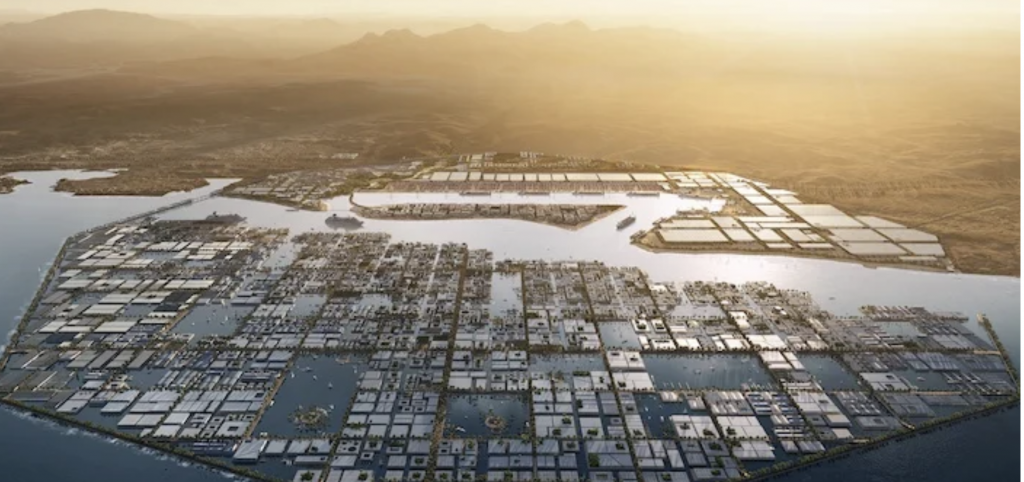
The postponement of the 2029 Asian Winter Games, planned for the futuristic NEOM development, highlights growing pressure on infrastructure delivery. The event, intended to showcase a $500 billion vision for a desert-based winter sports destination, has been delayed indefinitely amid financial and logistical challenges .
At the same time, multiple construction contracts linked to NEOM—including the Trojena ski resort and The Line—have been cancelled, with contractors citing delays and geopolitical disruption .
There are also increasing reports of suppliers facing delayed payments, raising questions about cash flow and project prioritisation across the wider Vision 2030 programme.
Taken together, these developments point to a system under strain.
From infinite capital to strategic constraint
For years, Saudi Arabia’s sporting strategy has been underpinned by the idea of effectively unlimited capital.
That perception is now changing.
The geopolitcal turmoil in the Middle East, rising domestic commitments and the cost of mega-projects—including the FIFA World Cup 2034—are forcing more disciplined capital allocation . Even flagship partnerships, such as those involving Aramco, may come under greater scrutiny.
As PIF governor Yasir al-Rumayyan noted:
“Of course the war would add more pressure to reposition some priorities.”
This is not a retreat—but it is a recalibration.
“Of course the war would add more pressure to reposition some priorities.”
A question of sustainability
For global sport, the implications are profound.
Saudi investment has accelerated growth, increased athlete earnings and opened new markets. But it has also introduced new dependencies—on a single source of capital, on geopolitical stability and on the successful delivery of vast infrastructure projects.
When those conditions shift, so too does the risk profile.
The postponement of events, the cancellation of contracts and the uncertainty surrounding flagship properties like LIV Golf all point to a more complex reality.
Sustainability, in this context, is no longer just about environmental or social impact. It is about financial resilience and systemic stability.
The moment of truth
Saudi Arabia remains a central player in the future of global sport. Its ambitions are undiminished, and its influence is undeniable.
But for the first time, the model is being tested.
What was once seen as a permanent transformation may, instead, prove to be a more fragile system—one that must now balance ambition with affordability, and global influence with domestic priorities.
For sport, the question is no longer what Saudi investment can deliver.
It is whether that delivery is sustainable.



Join the GSS Alliance Partners programme today
Stay ahead of the game with our FREE weekly newsletter, delivering the latest sport and sustainability news from around the globe straight to your inbox
11th Hour Racing
Join the GSS Network programme today

Register for GSS Workshops today
Join the GSS Education programme today