
To access our unique news archive of over 1,400 articles with insights on over 500+ sustainable sports organisations, join the GSS Network today.
Login here if you are a registered network subscriber.
News article
The Intergenerational Shift: Why Gen Z is Rewriting the Playbook for Sports Sustainability
The global sports industry is standing at a critical crossroads. For decades, its leaders have refined the commercial machinery of leagues, events and franchises. But a new force is emerging—from locker rooms, data teams and community programmes—that is reshaping not just how sport operates, but why.
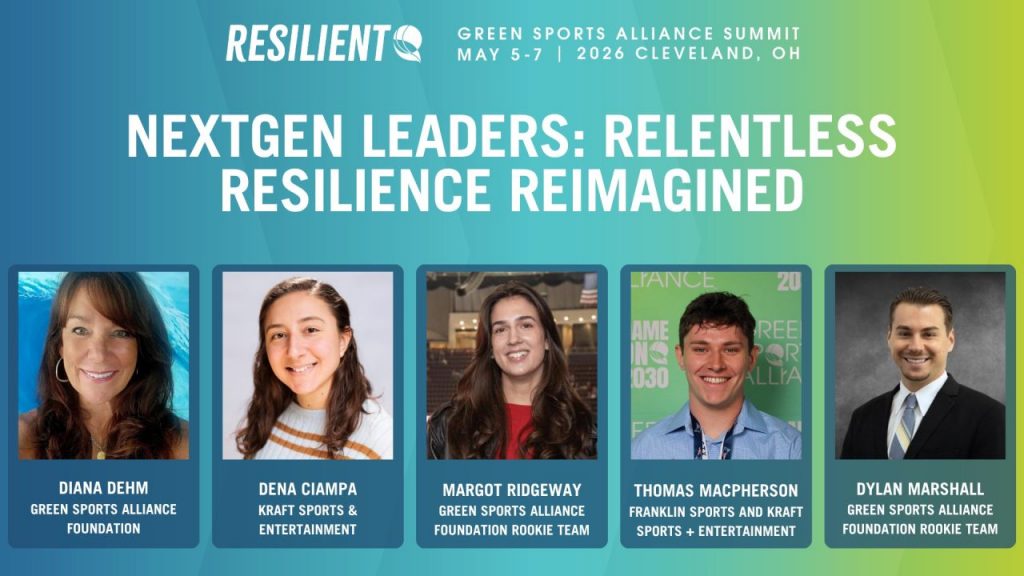
This is not simply a generational handover. It is a shift in values.
Talking with Global Sustainable Sport, it became clear that what has been dubbed the “Rookie Team” of next-generation leaders is no longer waiting for a seat at the table—they are beginning to build a new one.
The DNA of a Different Generation
For Diana Dehm, Director of Innovative Strategic Partnerships for Good at the Green Sports Alliance Foundation, the defining trait of this generation is clear.
“The secret sauce here is every single one of these Gen Z leaders—they already have sustainability built into their DNA.”
Unlike previous generations, which often treated sustainability as a bolt-on corporate responsibility function, Gen Z sees no separation between performance and purpose. For them, the “sports trail” and the “sustainability trail” are one and the same.
That shift carries real commercial implications. Research highlighted in the discussion suggests that sport risks a 42% drop in engagement among Gen Z and Gen Alpha if it fails to align with purpose-driven expectations.
This is not a future issue. It is a present-day market signal.
“The secret sauce here is every single one of these Gen Z leaders—they already have sustainability built into their DNA.”
Relentless Resilience as a Skillset
If sustainability is their mindset, resilience is their operating system.
Entering the workforce amid a global pandemic, economic uncertainty and rapid technological change has shaped a generation that is both pragmatic and persistent.
Dylan Marshall from the Rookie Team describes the experience bluntly:
“The job market is like a boxing match—you get knocked down, you reset, and you go again. You have to keep building yourself back up.”
Yet this pressure has created advantage. Growing up in the information age, Gen Z leaders are not only comfortable with technology—they are fluent in it. Tools like AI are not seen as threats, but as enablers.
Combined with a global perspective, this positions them uniquely to tackle the interconnected challenges facing sport—from climate risk to fan engagement and supply chain transformation.
“The job market is like a boxing match—you get knocked down, you reset, and you go again. You have to keep building yourself back up.”
From Strategy to Action
What distinguishes this generation further is its bias towards action.
At Gillette Stadium, Tommy MacPherson and Dena Ciampa have moved rapidly from learning to implementation. Within a year of attending the Green Sports Alliance Summit, they introduced composting systems, waste sorting processes and operational changes that simply did not exist before.
“A year ago, we weren’t sorting at all on site,” MacPherson reflected. “Now we have composting in concession stands and kitchens. That’s real change in a short time.”
“A year ago, we weren’t sorting at all on site. Now we have composting in concession stands and kitchens. That’s real change in a short time.”
For Ciampa, the shift is as much cultural as operational:
“Sustainability needs to be part of the infrastructure of a business—not a side project.”
This focus on embedding sustainability into decision-making—rather than treating it as an add-on—marks a critical evolution in how sport organisations must operate.
“Sustainability needs to be part of the infrastructure of a business—not a side project.”
Connecting Data, Business and Impact
Elsewhere, the next generation is bridging another long-standing gap: the divide between sustainability ambition and business reality.
Giulia Henshaw, a carbon management consultant, is working at the intersection of data, strategy and implementation.
“I was really interested in how you make the business case for sustainability—how you link environmental, social and economic value.”
From carbon accounting to merchandise supply chains, this generation is focused on measurable outcomes. It is not enough to act; organisations must demonstrate impact.
This aligns closely with a broader industry shift—moving from activity-based reporting to evidence-based performance.
“I was really interested in how you make the business case for sustainability—how you link environmental, social and economic value.
A Global Generation Driving Local Change
While much of the conversation remains US- and Europe-centric, the outlook of this cohort is inherently global.
Marshall highlights the demographic reality:
“In regions like Africa and the Middle East, the median age is much lower. The athletes and future leaders driving these conversations are young.”
“In regions like Africa and the Middle East, the median age is much lower. The athletes and future leaders driving these conversations are young.”
For Margot Ridgeway, a Community Relations officer at Syracuse Crunch, the opportunity lies not just in global reach, but in connection across generations:
“How do we create an intergenerational movement? Sport gives us that platform to unite people and push for a higher standard.”
Her work in community relations reflects a broader shift—using sport not just to engage fans, but to mobilise them around purpose.
“How do we create an intergenerational movement? Sport gives us that platform to unite people and push for a higher standard.”
Redefining Success: From Profit to Purpose
Perhaps the most significant shift lies in how success is measured.
Historically, sport has been driven by financial metrics. Revenue, sponsorship and growth have defined progress. But that model is being challenged.
As discussed in the conversation, the next phase of sport will require a different balance—where purpose sits alongside, and increasingly shapes, profit.
Ciampa’s perspective is clear:
“Sustainability can’t sit off to the side anymore—it has to be part of how the whole business operates.”
“Sustainability can’t sit off to the side anymore—it has to be part of how the whole business operates.”
This requires structural change. It means integrating sustainability into investment decisions, operations, fan engagement and governance.
It also requires a shift in leadership.
Read moreGreen Sports Alliance Foundation











Join the GSS Alliance Partners programme today
Stay ahead of the game with our FREE weekly newsletter, delivering the latest sport and sustainability news from around the globe straight to your inbox

11th Hour Racing
Join the GSS Network programme today




Register for GSS Workshops today
Join the GSS Education programme today