
To access our unique news archive of over 1,400 articles with insights on over 500+ sustainable sports organisations, join the GSS Network today.
Login here if you are a registered network subscriber.
News article
Top storyRacing Toward a Better Future: Formula E Makes History as the World’s First B Corp Certified Sport
Formula E has entered a new era of sports governance, becoming the world’s first sport to achieve B Corp certification. The milestone formalises the all-electric championship’s long-standing ambition to demonstrate that elite performance, commercial growth and sustainability leadership can be delivered together.
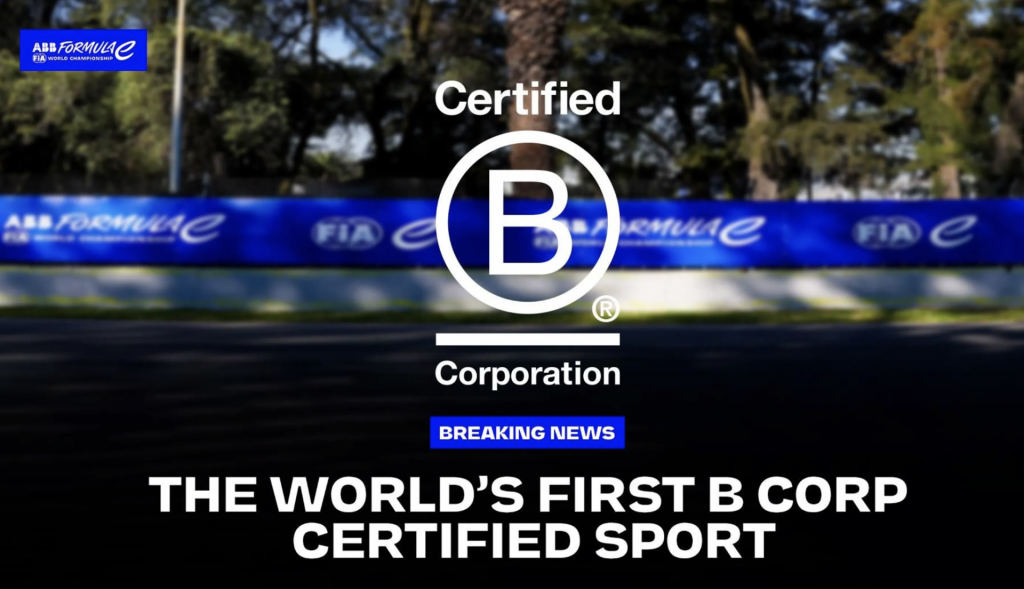
Since its launch in 2014, Formula E has positioned itself as a challenger to traditional sporting models. B Corp certification now embeds that mission into the organisation’s legal and operational framework, placing Formula E alongside purpose-driven global brands such as Patagonia and Ben & Jerry’s that are required to balance profit with people and planet.
A New Benchmark for Modern Sport
B Corp certification is a rigorous, independently verified process that assesses organisations across five impact areas: Governance, Workers, Community, Environment and Customers. Formula E Operations Limited achieved an overall B Impact Score of 89.6, just above the 80-point threshold required for certification and well ahead of the global median score for ordinary businesses of 50.9.
For Formula E, the certification is positioned as a statement of intent rather than an end point.
Jeff Dodds, CEO of Formula E, said the process reflects a deliberate effort to redefine what global sport can be:
“We didn’t set out to join a club; we set out to break the rules of what a global sport is allowed to be. B Corp Certification is the proof that elite performance and world-moving purpose belong in the same story.”
“We didn’t set out to join a club; we set out to break the rules of what a global sport is allowed to be. B Corp Certification is the proof that elite performance and world-moving purpose belong in the same story.”
Dodds added that sustainability, for Formula E, is designed to be visible and tangible rather than abstract:
“Most see sustainability as a seminar or a box to tick; we see it happening at 200mph around a corner in your city. This isn’t a milestone to celebrate standing still—it’s a licence to go even faster.”
Breaking Down the Score: Where Formula E Performs Strongly
The B Impact Assessment provides a detailed insight into how Formula E performs across its operations and value chain:
- Workers (28.8)
The strongest scoring category reflects Formula E’s approach to employee wellbeing, financial security, health and safety, and career development. The assessment recognises structured engagement processes and a commitment to inclusive workplace practices. - Environment (27.6)
Environmental performance is underpinned by Formula E’s certified net-zero pathway, its role as a testbed for low-carbon mobility innovation, and a 55% reduction in Scope 1 and 2 emissions since 2019. The championship’s race calendar is designed to group events by continent, reducing freight mileage and associated emissions. - Governance (17.5)
The governance score highlights transparency, ethical oversight and the formal integration of stakeholder considerations into decision-making. B Corp certification requires Formula E to protect its mission through its corporate structure, not simply through policy commitments. - Community (12.6)
This category reflects Formula E’s social impact programmes, diversity and inclusion initiatives, and engagement with host cities. Community investment is positioned as an integral part of event delivery rather than a peripheral activity. - Customers (2.9)
The customer score focuses on responsible marketing, data protection and service quality, reinforcing trust and accountability across Formula E’s growing global audience.
Julia Pallé, Vice President of Sustainability at Formula E, said the certification recognises a focus on delivery rather than rhetoric:
“Becoming B Corp certified is a powerful recognition that electric racing can do more than inspire—it can drive real, measurable change. Formula E has always focused on impact, not just pledges.”
She added that collaboration will be critical to deepening impact:
“By joining the B Corp community, we will collaborate, challenge each other and deepen our impact across sport and industry.”
“Becoming B Corp certified is a powerful recognition that electric racing can do more than inspire—it can drive real, measurable change. Formula E has always focused on impact, not just pledges. By joining the B Corp community, we will collaborate, challenge each other and deepen our impact across sport and industry.”
Part of a Growing Sports Movement
While Formula E is the first sport to achieve B Corp certification, it joins a growing ecosystem of 71 certified organisations operating across the sports sector. These range from manufacturers and apparel brands to event organisers and specialist consultancies, highlighting the breadth of sustainability activity emerging across sport.
Examples include companies developing circular sporting goods, brands prioritising durable and repairable equipment, and organisations redesigning events and operations to reduce environmental impact while strengthening community engagement.
Notably, sustainability consultancies such as bloomUp Sàrl—certified in 2025 with a B Impact Score of 125.9—are supporting sports organisations and events to translate sustainability frameworks into practical, measurable action. Together, these organisations demonstrate that B Corp certification is increasingly being used as a governance and accountability tool within sport, not simply a branding exercise.
Formula E’s certification arrives at a time when sport is under growing scrutiny for its environmental footprint, labour practices and social impact.
Chris Turner, CEO of B Lab UK, described Formula E’s certification as a defining moment for the sector:
“Welcoming Formula E to the B Corp community marks an exciting milestone for the entire sports industry. It shows that success and purpose are not mutually exclusive, and that positive impact is possible for organisations of any size and scale.”
“Welcoming Formula E to the B Corp community marks an exciting milestone for the entire sports industry. It shows that success and purpose are not mutually exclusive, and that positive impact is possible for organisations of any size and scale.”
Yet with more than 10,218 organisations globally now certified as B Corporations Formula E’s position as the first fully fledged sports organisation to meet the standard is as revealing as it is impressive. While sustainability strategies are now commonplace across leagues, federations and major events, progress has too often remained narrative-led rather than structurally embedded.
Commercial pressures, complex ownership structures and a historic focus on profit and profile have frequently taken precedence over long-term governance. Formula E’s certification exposes that gap and raises an unavoidable question for the rest of the industry: if thousands of businesses across other sectors can meet this benchmark, why has sport taken so long to do the same?
Read moreFormula E




Join the GSS Alliance Partners programme today
Stay ahead of the game with our FREE weekly newsletter, delivering the latest sport and sustainability news from around the globe straight to your inbox

Yali Sports Africa
(Africa)
Join the GSS Network programme today
Register for GSS Workshops today
Join the GSS Education programme today