
To access our unique news archive of over 1,400 articles with insights on over 500+ sustainable sports organisations, join the GSS Network today.
Login here if you are a registered network subscriber.
News article
Top storyOpening the Streets: How Europe’s Running Ecosystem is Engineering a Post-AI Cultural Renaissance
The global mass participation industry has reached a critical structural inflection point. Far from experiencing a temporary post-pandemic participation spike, the European running sector is undergoing a profound institutional shift into what experts increasingly describe as the “experience economy”. As digital saturation and artificial intelligence continue to reshape modern life, road running events are evolving into powerful platforms for civic pride, public health, social connection and cultural unity.
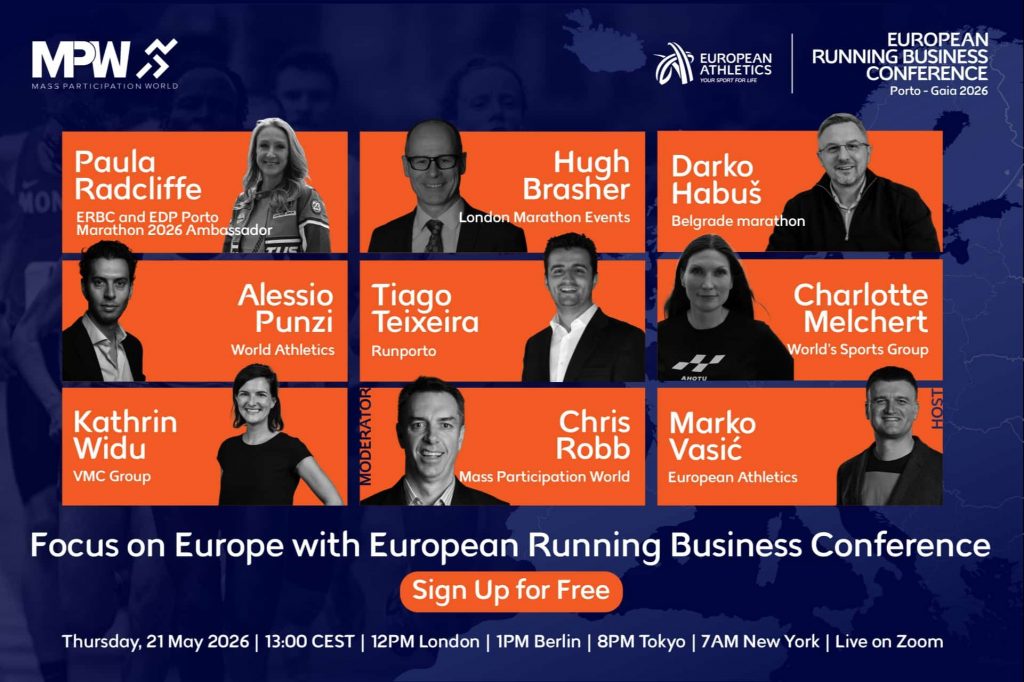
A recent high-level industry forum convened by Mass Participation World (MPW) and European Athletics brought together many of Europe’s leading race directors, federation executives and commercial stakeholders to discuss the future of the sector. The webinar, Focus on Europe with European Running Business Conference, explored how running events are becoming far more than competitions — transforming into cultural experiences capable of connecting cities, communities and generations, while also setting the agenda for discussions that will continue at the European Running Business Conference (ERBC) in Porto-Gaia this November.
Opening the discussion, Chris Robb, CEO of Mass Participation World, framed the broader significance of the moment facing the industry.
“This isn’t simply a running boom — it’s a real lifestyle shift. People are recognising the importance of community, health and real human connection. Running has become one of the most powerful ways of bringing people together in an increasingly fragmented world.”
“This isn’t simply a running boom — it’s a real lifestyle shift. People are recognising the importance of community, health and real human connection. Running has become one of the most powerful ways of bringing people together in an increasingly fragmented world.”
The Structural Shift From Isolation to Unity
For decades, major metropolitan marathons operated within a largely restrictive operational model. Municipal authorities often evaluated races through the lens of road closures, transport disruption and clean-up costs. However, changing consumer expectations and mounting evidence around health, tourism and social impact are fundamentally rewriting the relationship between race organisers and cities.
That transformation was perhaps best articulated by Hugh Brasher, Chief Executive of London Marathon Events, reflecting on the extraordinary scale and atmosphere of the recent London Marathon.
“What marathon running does, it brings nations of the world together and shows our similarities, and that our similarities are so much greater than our differences are. In a world that we’re moving into, in terms of AI, real-life experiences… those are going to be even more and more important.”
Brasher’s comments captured the growing belief across the sector that running events now occupy a far broader societal role. They are increasingly viewed not simply as sporting events, but as antidotes to social fragmentation — creating shared experiences that unite people across backgrounds, cultures and communities.
“What marathon running does, it brings nations of the world together and shows our similarities, and that our similarities are so much greater than our differences are. In a world that we're moving into, in terms of AI, real-life experiences... those are going to be even more and more important.”
Former marathon world record holder Paula Radcliffe reinforced this message, highlighting how running uniquely combines elite sport, accessibility and social connection.
“It is the only sport where we can have 60,000 people taking part in the same race, going through the same emotions with pretty much zero conflict. It’s a whole lot of people coming together and being supported on the streets by a whole lot more people.”
“It is the only sport where we can have 60,000 people taking part in the same race, going through the same emotions with pretty much zero conflict. It’s a whole lot of people coming together and being supported on the streets by a whole lot more people.”
The Two-Day Model and the Reinvention of Urban Racing
One of the clearest themes emerging from the discussions was the growing move toward multi-day race formats designed to reduce pressure on cities while enhancing participant experience.
The Belgrade Marathon has become one of the leading examples of this operational evolution as it prepares to host the European Running Championships in 2027. Rather than concentrating activity into a single day, organisers have adopted a weekend-long structure that distributes races across two days.
Darko Habuš, CEO of the Belgrade Marathon, explained that the model has fundamentally changed how cities engage with major running events.
“Once we started analysing the operational side in detail together with the city, we realised that this two-day format actually reduced pressure instead of increasing it. Road closures become shorter and more focused, traffic flow becomes easier to manage and the city can breathe during the weekend. We are not closing the streets, we are opening the streets.”
The approach reflects a wider shift in thinking across Europe’s running ecosystem. Rather than seeing races as temporary disruptions, cities are increasingly embracing them as urban activation platforms capable of generating tourism, community engagement and economic value over multiple days.
The evening 10km race concept introduced in Belgrade also points toward the changing expectations of younger audiences, who increasingly seek immersive social and cultural experiences alongside competition itself.
“Once we started analysing the operational side in detail together with the city, we realised that this two-day format actually reduced pressure instead of increasing it. Road closures become shorter and more focused, traffic flow becomes easier to manage and the city can breathe during the weekend. We are not closing the streets, we are opening the streets.”
Running as a Cultural Marketplace
This operational evolution is occurring alongside growing collaboration across Europe’s major races. The launch of the European Marathon Classics — bringing together several iconic races across the continent — demonstrates how organisers are increasingly choosing cooperation over isolation.
Kathrin Widu, CEO of VCM Group and a key figure behind the initiative, explained that the series was created not only to encourage participation, but to showcase the cultural richness of European cities.
“It’s really necessary for organisers not to think only from the starting line to the finish line. It’s about culture. Together you’re stronger.”
“It’s really necessary for organisers not to think only from the starting line to the finish line. It’s about culture. Together you’re stronger.”
That philosophy aligns closely with wider market trends identified during the discussions. Increasingly, runners are behaving less like traditional participants and more like experiential travellers — combining races with family holidays, cultural tourism and destination experiences.
Charlotte Melchert, CEO and Founder of World Sports, noted that runners are increasingly choosing events not purely based on athletic prestige, but on the wider experience surrounding them.
“People now want to combine races with culture, gastronomy, travel and memories,” she explained during the forum. “They want stories and experiences that go beyond the finish line.”
“People now want to combine races with culture, gastronomy, travel and memories,. They want stories and experiences that go beyond the finish line.”
Alessio Punzi, Head of Running and Mass Participation at World Athletics, also emphasised the importance of creating stronger connections between elite competition, participation sport and the wider running ecosystem. Discussions throughout the webinar highlighted how global championships, city races and mass participation events are increasingly converging to create more inclusive and engaging running experiences capable of attracting new audiences and sustaining long-term growth.
“The future of running depends on creating experiences that connect elite athletes, everyday runners and entire communities. We are seeing participation sport, tourism, culture and major championships becoming increasingly interconnected, and that creates enormous opportunities for the long-term growth and relevance of running around the world.” — Alessio Punzi, Head of Running and Mass Participation, World Athletics
“The future of running depends on creating experiences that connect elite athletes, everyday runners and entire communities. We are seeing participation sport, tourism, culture and major championships becoming increasingly interconnected, and that creates enormous opportunities for the long-term growth and relevance of running around the world.”
Democratising Participation and Securing the Future
Despite the optimism surrounding the sector’s growth, speakers also acknowledged mounting challenges around accessibility and affordability. Rising entry costs and broader economic pressures risk excluding younger demographics and underrepresented communities if participation pathways are not carefully protected.
The response increasingly centres on long-term grassroots development — particularly through youth participation programmes, school integration initiatives and family engagement.
London Marathon Events’ continued expansion of the Mini London Marathon was repeatedly highlighted as an example of how participation pipelines can generate wider societal impact. As Hugh Brasher observed, engaging children often creates a “virtuous circle” that encourages entire families to become more active.
The broader consensus across the forum was clear: the future of running will depend not simply on bigger events, but on preserving the human, inclusive and community-centred values that underpin the sport’s rapid growth.
The discussions throughout the forum also reflected a broader strategic ambition emerging across European Athletics and the mass participation sector: to reposition running events not simply as races, but as platforms for healthier societies, stronger communities and more connected cities.
Marko Vasic, who heads up the Running Unit for European Athletics, who hosted the event, said the evolution of running across Europe is increasingly being driven by a wider social purpose beyond competition itself.
“Running has the unique ability to connect elite sport, grassroots participation, cities and communities in one shared experience. Across Europe we are seeing races evolve into cultural and social platforms that bring people together, promote healthier lifestyles and showcase the power of sport far beyond competition. The future of running is not only about performance — it is about connection, inclusion and opening cities to people.”
"Running has the unique ability to connect elite sport, grassroots participation, cities and communities in one shared experience. Across Europe we are seeing races evolve into cultural and social platforms that bring people together, promote healthier lifestyles and showcase the power of sport far beyond competition. The future of running is not only about performance — it is about connection, inclusion and opening cities to people.” —
Purpose Beyond the Finish Line
The growing societal role of major running events is also increasingly reflected within the forthcoming Global Sustainable Sport (GSS) Sustainable Purposeful Impactful (SPI) Index, which measures how organisations embed sustainability, purpose and impact across the 7 Sustainable Pillars of Sport. Within the forthcoming Index, London Marathon Events is set to feature among the Top 50 most purposeful sports organisations in the world, reflecting its growing influence not only in participation sport, but across community engagement, health, inclusion and wider societal impact.
Many of the themes explored during the webinar — including urban activation, destination storytelling, participation growth, inclusivity, sustainability, technology and the future role of running within society — are expected to continue at the European Running Business Conference in Porto-Gaia this November. The event is set to bring together race organisers, federations, brands and industry leaders from across the global running ecosystem to explore how running can continue to evolve as both a sporting movement and a platform for wider social impact.
As cities, organisers and governing bodies continue to reimagine the future of running, one message increasingly stands above the rest: the sport’s greatest value may no longer lie solely in competition itself, but in its ability to reconnect people in an increasingly disconnected world. From London to Belgrade, Porto to Vienna, Europe’s running ecosystem is no longer simply staging races — it is opening streets, rebuilding communities and redefining what sport can mean in the modern era.
Read moreEuropean Running Business Conference

Join the GSS Alliance Partners programme today
Stay ahead of the game with our FREE weekly newsletter, delivering the latest sport and sustainability news from around the globe straight to your inbox

11th Hour Racing
Join the GSS Network programme today


Register for GSS Workshops today
Join the GSS Education programme today