
To access our unique news archive of over 1,400 articles with insights on over 500+ sustainable sports organisations, join the GSS Network today.
Login here if you are a registered network subscriber.
News article
Top storyFIFA World Cup 2026: From “Be Active” to Big Business — But How Sustainable, Purposeful & Impactful Will It Be?
With one month to go until kick-off, FIFA has positioned the 2026 World Cup not just as the biggest tournament in football history, but as a global platform for social impact.
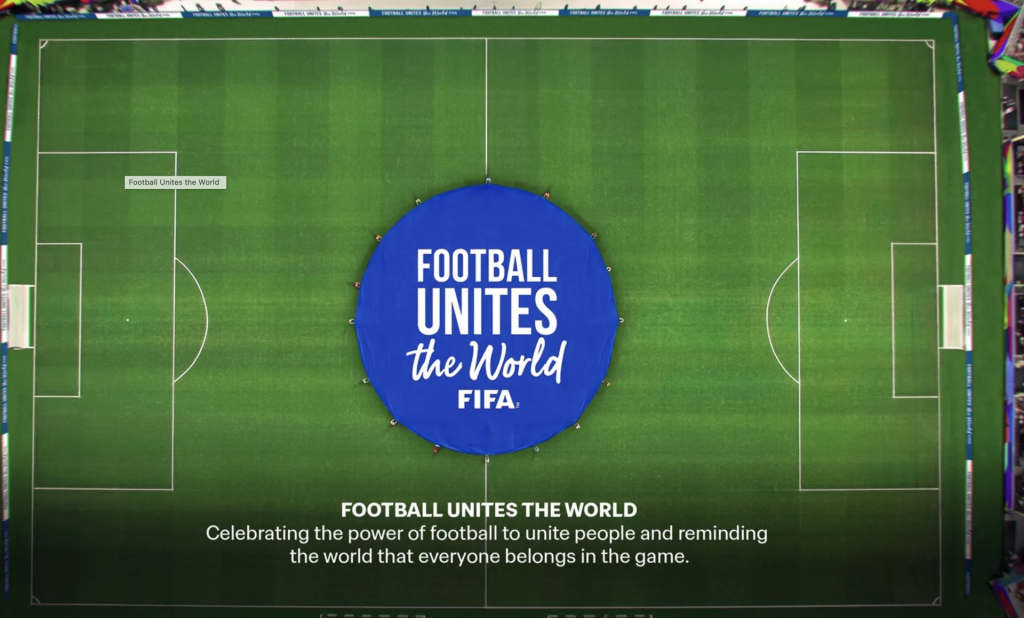
At the heart of this ambition is a suite of campaigns designed to extend the game’s influence far beyond the pitch. FIFA’s social impact programme will be highly visible across all 16 host venues, promoting unity, education, anti-racism and physical activity through initiatives such as Football Unites the World, No Racism and Be Active.
The Be Active campaign, delivered in partnership with the World Health Organization, aims to encourage children globally to engage in at least 60 minutes of daily exercise — translating the visibility of the World Cup into behavioural change at scale.
On the surface, this is a compelling narrative: football as a force for good.
But beneath these campaigns sits a far more comprehensive — and far less visible — framework: FIFA’s Sustainability & Human Rights Strategy for the 2026 World Cup.
A Five-Pillar Strategy — Comprehensive in Scope
FIFA’s approach is structured across five interconnected pillars: social, environmental, economic, governance and human rights — aligned with international standards such as ISO 20121 and the UN Guiding Principles on Business and Human Rights.
The ambition is clear: to maximise positive impact across every stage of the tournament lifecycle — from preparation through to post-event legacy.
Across the pillars, the commitments are extensive:
- Social: delivering inclusive fan experiences, safeguarding, anti-discrimination systems and community legacy programmes
- Environmental: measuring and reducing emissions, promoting sustainable transport, reducing waste and protecting biodiversity
- Economic: supporting local procurement and ensuring long-term use of infrastructure and assets
- Governance: embedding sustainability through a Sustainable Event Management System, stakeholder engagement and reporting structures
- Human Rights: integrated across all pillars, including labour standards, grievance mechanisms, protection of vulnerable groups and alignment with UN frameworks
At a strategic level, FIFA has created a framework that aligns with global best practice and, on paper, has the potential to deliver meaningful impact.
A Decentralised Model — and a Measurement Problem
However, the delivery model introduces a fundamental challenge.
Responsibility for implementation is largely decentralised across the 16 Host Cities, each required to develop and deliver their own environmental and human rights plans alongside FIFA’s overarching strategy.
This creates a system that is broad in ambition but fragmented in execution.
And with one month to go, there is limited publicly available evidence showing how consistently these plans are being implemented across cities, stadiums and supply chains.
This is particularly critical when viewed through the lens of purpose and impact.
Because purpose is not defined by campaigns or commitments — it is defined by outcomes.
And impact is not measured by intent — it is measured by evidence.
Without clear, consistent standards, metrics and reporting frameworks applied across all 16 host cities, it becomes almost impossible to assess:
- how environmental targets are being delivered in practice
- whether human rights commitments are being enforced consistently
- how social programmes are translating into long-term outcomes
- or whether economic benefits are being distributed equitably
While FIFA references governance mechanisms, stakeholder engagement and post-event reporting, whether these systems are sufficiently standardised, transparent and comparable across the tournament remains unclear.
In reality, the scale and decentralisation of the World Cup may make it one of the most difficult sporting events in the world to measure in a consistent and credible way.

Purpose Meets Profit
At the same time, the financial narrative surrounding the 2026 World Cup is unequivocal — and increasingly dominant.
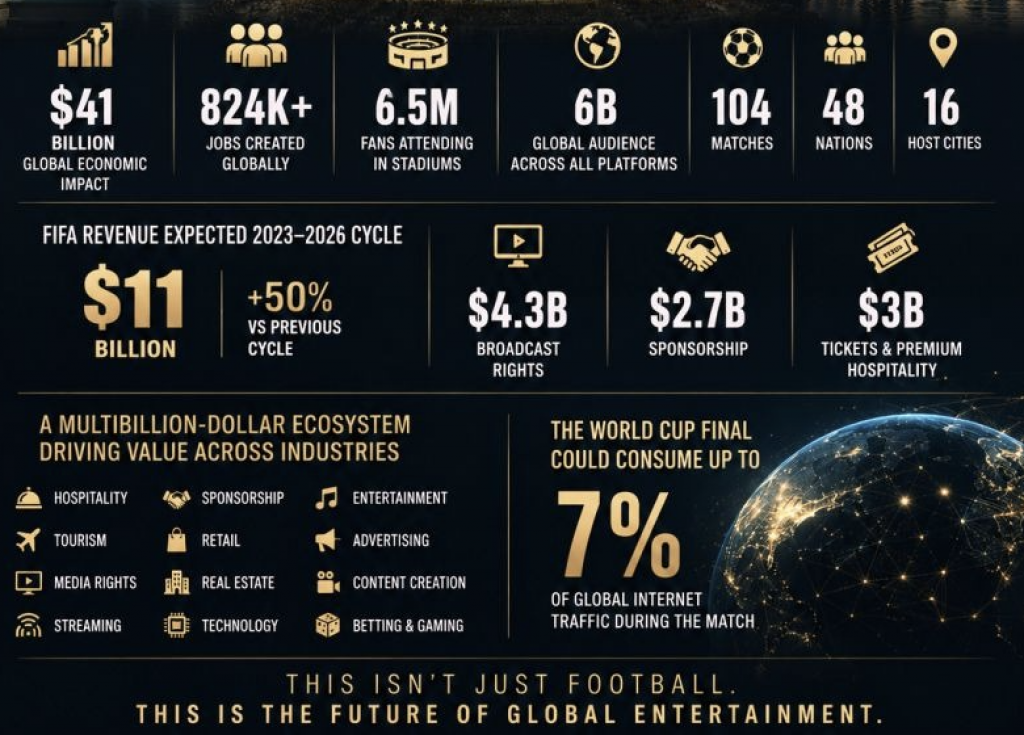
Analysis linked to Bank of America Global Research and wider economic modelling suggests the tournament could generate in excess of $40–41 billion in global GDP impact, while supporting more than 800,000 jobs worldwide.
The scale of the event itself reinforces this positioning:
- 48 teams competing — the largest World Cup ever staged
- 104 matches across the tournament
- 16 host cities spanning the United States, Canada and Mexico
- A projected global audience exceeding 5–6 billion people
This is not simply a sporting event.
It is a continent-wide economic system — spanning travel, infrastructure, media, sponsorship, betting, retail and digital engagement.
Football, in this context, is no longer just a sport. It is:
- an investment platform with scalable commercial returns
- a global attention architecture capable of reaching billions
- and a vehicle for corporate and sovereign positioning on the world stage
And that is where the tension sharpens.
Because while FIFA’s sustainability strategy is built around purpose, inclusion and long-term impact, the financial system surrounding the World Cup is optimised for scale, growth and return.
A Defining Question for 2026
The FIFA World Cup 2026 represents more than a tournament.
It is a test of whether global sport can move beyond narrative-led sustainability and demonstrate real, measurable impact at scale — across all five pillars, not just the most visible ones.
The campaigns will be seen and the economic impact will be felt.
The strategy is in place but the defining question remains:
just how purposeful and impactful will it actually be?
Within the forthcoming Global Sustainable Sport Purpose & Impact (P&I) Assessment Programme, FIFA is notably not currently included in the Top 100 most purposeful sports organisations globally based on their publicly avaibale data.
That absence reflects a deeper structural challenge.
Because without clarity, consistency and transparency in how sustainability is implemented and measured across the 16 host cities, proving impact may be almost impossible.
Whether the necessary standards, frameworks and comparable metrics are truly in place — and being applied consistently — is, at this stage, difficult to determine.
And in 2026, in a world increasingly driven by data, evidence and accountability, that may ultimately define how the tournament will be assessed.
Read moreFIFA




Join the GSS Alliance Partners programme today
Stay ahead of the game with our FREE weekly newsletter, delivering the latest sport and sustainability news from around the globe straight to your inbox

11th Hour Racing
Join the GSS Network programme today

Register for GSS Workshops today
Join the GSS Education programme today