
To access our unique news archive of over 1,400 articles with insights on over 500+ sustainable sports organisations, join the GSS Network today.
Login here if you are a registered network subscriber.
News article
Copenhagen Sprint: From Race to Roadmap for Sustainable Sport
The Copenhagen Sprint has been recognised by the UCI with the UCI Climate Action Award, presented at the UCI Mobility & Bike City Forum, recently held in Athens. The award reflects the event’s ability to deliver measurable environmental impact from its very first edition, with documented results including reductions in emissions and waste, alongside a strong shift towards circular operations and sustainable mobility.
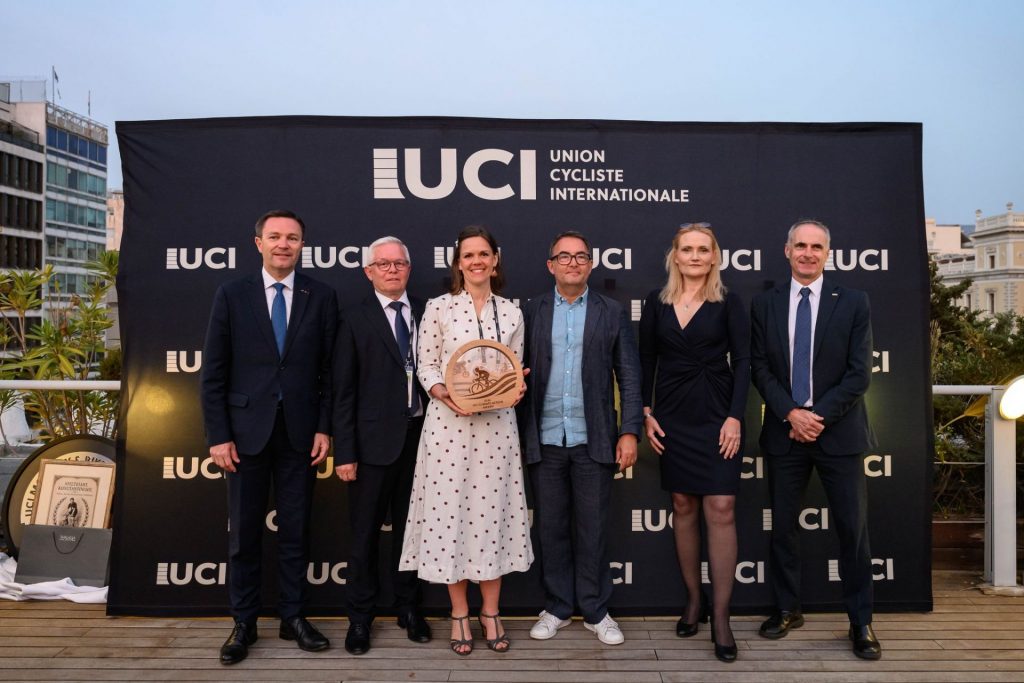
Among the results highlighted were over 23,000 pieces of reusable tableware, more than 8,000 public transport tickets issued, and measurable reductions in both CO₂ emissions and event waste — early indicators that a different model of event delivery is not only possible but already being realised.
From Recognition to Reality: A Model in Motion
Speaking to Global Sustainable Sport at the Forum in Athens, Freja Fischer-Møller, Head of Event Delivery, emphasised that the recognition is not an endpoint, but an early validation of a longer-term ambition.
“This recognition from UCI is an important encouragement,” she said. “From the beginning, we wanted to show that major international sporting events can combine elite sport with responsible event delivery and long-term sustainability ambitions.”
That distinction — between recognition and reality — is central to Copenhagen Sprint’s approach. Rather than positioning itself as a finished solution, the event is deliberately framed as a working model, evolving through data, partnerships and continuous improvement.
“This recognition from UCI is an important encouragement. From the beginning, we wanted to show that major international sporting events can combine elite sport with responsible event delivery and long-term sustainability ambitions.”
More Than a Race: Designing for Legacy
At its core, Copenhagen Sprint has been designed as more than a two-day spectacle.
“It is a celebration of cycling in the most inclusive way possible,” Fischer-Møller told GSS. “We want the masses not only to be spectators, but to be participating — to showcase that events can be a positive enabler to society.”
This philosophy extends beyond participation to long-term relevance.
“We want to use Copenhagen Sprint as a catalyst for change in the sport,” she added. “To get more people cycling — as a hobby, for commuting, and also professionally.”
The ambition is clear: to shift from a transient event model to one that delivers year-round social and behavioural impact.
“It is a celebration of cycling in the most inclusive way possible. We want the masses not only to be spectators, but to be participating — to showcase that events can be a positive enabler to society. We want to use Copenhagen Sprint as a catalyst for change in the sport. To get more people cycling — as a hobby, for commuting, and also professionally.”
Building a Strategy Without Reinventing the Wheel
Rather than starting from scratch, Copenhagen Sprint has taken a pragmatic, evidence-led approach.
“There’s no reason to invent what’s already been tested,” Fischer-Møller explained. “We looked at handball, ice hockey, and other events to see what works — and adapted that.”
This has translated into practical decisions around materials, communications and procurement — from reducing printing to designing reusable branding assets.
“We don’t kid ourselves and think we are some kind of genius,” she added. “We are at the beginning, and we need to learn from others — but our ambitions are high.”
“There’s no reason to invent what’s already been tested. We looked at handball, ice hockey, and other events to see what works — and adapted that. We don’t kid ourselves and think we are some kind of genius. We are at the beginning, and we need to learn from others — but our ambitions are high.”
Financial Reality Meets Environmental Ambition
A defining feature of Copenhagen Sprint’s strategy is its alignment of sustainability with financial viability.
“We could go full speed in year one and do all sorts of things,” Fischer-Møller noted. “But that would not be financially sustainable if we want to continue.”
Instead, the model is built on incremental progress.
“We have to grow in a step-by-step way — bringing partners, sponsors and suppliers with us.”
This approach reflects a broader shift in sport: sustainability is no longer a one-off initiative, but a long-term operational strategy.
“We could go full speed in year one and do all sorts of things. But that would not be financially sustainable if we want to continue. We have to grow in a step-by-step way — bringing partners, sponsors and suppliers with us.”
From Policy to Practice: Power, Food and Waste
Copenhagen Sprint’s credibility lies in its ability to translate strategy into operational delivery.
“It’s about asking the annoying questions,” Fischer-Møller said. “Can you provide me with the data? What is the power use? What do we actually need?”
This mindset has driven bold commitments, including:
- A ban on diesel generators from 2026
- A transition to city land power and battery solutions
- Alignment with Copenhagen’s plant-forward food strategy
- Expansion of reusable systems and circular waste models
“If you don’t try to implement it, you get limited by perceived obstacles rather than real ones,” she added.
“It’s about asking the annoying questions. Can you provide me with the data? What is the power use? What do we actually need? If you don’t try to implement it, you get limited by perceived obstacles rather than real ones,”
Inclusion as a Core Design Principle
Beyond environmental performance, Copenhagen Sprint is designed to broaden participation.
“That is why we offer a closed circuit where everyone can ride — any bike, any ability,” Fischer-Møller said.
From adaptive bikes to initiatives supporting elderly participants, the event actively engages those often excluded from traditional sport formats.
“It’s also about awareness,” she noted. “Many people don’t realise what is possible — for example, that you can get support for adaptive bikes.”
“That is why we offer a closed circuit where everyone can ride — any bike, any ability,. It’s also about awareness. Many people don’t realise what is possible — for example, that you can get support for adaptive bikes.”
The Hardest Challenge: Transport
Despite strong early progress, transport remains the most complex issue.
“The biggest carbon contributor is transport — and I don’t know how to crack that nut,” Fischer-Møller admitted.
As a WorldTour event, international travel is unavoidable — but the organisers are already looking at systemic solutions.
“Can we plan the calendar in a way that reduces travel? Can we make demands at a higher level?” she asked.
“The biggest carbon contributor is transport — and I don’t know how to crack that nut. Can we plan the calendar in a way that reduces travel? Can we make demands at a higher level?”
From Copenhagen to the Global Benchmark
Copenhagen Sprint may still be in its early stages, but its approach is already contributing to a wider shift in how sustainability is understood and measured in sport in Denmark.
“We are still learning and improving… this is about collaboration, transparency and measurable action.”
“We are still learning and improving… this is about collaboration, transparency and measurable action.”
Within Global Sustainable Sport’s emerging GSS SPI Index, the National Olympic Committee and Sports Confederation of Denmark is set to feature among the Top 100 most purposeful sports organisations globally — reflecting strong national leadership across governance, participation and societal impact.
However, the absence of Danish national federations from that cohort highlights a broader gap between ambition and implementation at sport-specific level.
In that context, Copenhagen Sprint stands out not just as an event, but as a practical demonstration of what delivery can look like when sustainability is embedded from the outset — across operations, partnerships and community engagement.
The question now is not whether sustainable events are possible, but whether sport can establish the standards, frameworks and accountability needed to measure them consistently.
Until that happens, initiatives like Copenhagen Sprint will not just lead the conversation — they will help define it. The important question however is how quickly the national federations will follow.
Read moreCopenhagen Sprint














Join the GSS Alliance Partners programme today
Stay ahead of the game with our FREE weekly newsletter, delivering the latest sport and sustainability news from around the globe straight to your inbox



11th Hour Racing
Join the GSS Network programme today




Register for GSS Workshops today
Join the GSS Education programme today