
To access our unique news archive of over 1,400 articles with insights on over 500+ sustainable sports organisations, join the GSS Network today.
Login here if you are a registered network subscriber.
News article
Regulating the Game: Football at a Turning Point
Hosted at the National Football Museum in Manchester the Fair Game conference brought together a broad cross-section of football’s ecosystem—from club executives and policymakers to journalists, campaigners and supporters—to examine the future of the game at a moment of significant change.
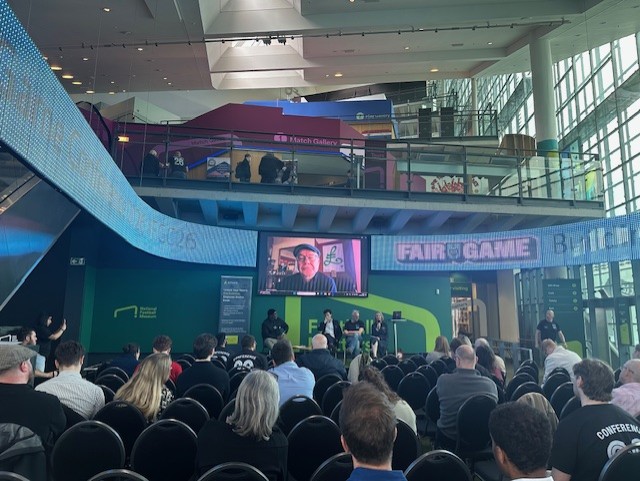
Held over two days, the event forms part of a growing movement to address football’s structural challenges, with a focus on governance, financial sustainability, equality and the long-term health of the pyramid. Through a mix of panels, workshops and stakeholder discussions, the conference set out to explore both the risks facing the game and the practical solutions required to build a fairer future.
Within that context, one session examined the role of the incoming regulator and what it could mean for clubs, competitions and supporters alike.
Chaired by Jordan Jarrett-Bryan, Channel 4 News Correspondent, the discussion gathered voices from across governance, media and advocacy. The message was clear from the outset: regulation is no longer theoretical—it is imminent, and its impact will be profound.
As Adrian Goldberg, broadcaster and author of Where’s the Money Gone, put it:
“The regulation of football always comes one step too late… but given what we’ve seen over the years, it’s an essential step.”
“The regulation of football always comes one step too late… but given what we’ve seen over the years, it’s an essential step.”
What good governance looks like
For David Riley, General Counsel for the Football Regulator, the foundations of good governance are relatively clear—but not yet consistently applied.
“It starts with financial sustainability, proper business planning and contingency… then stronger corporate governance, and finally meaningful fan engagement.”
“It starts with financial sustainability, proper business planning and contingency… then stronger corporate governance, and finally meaningful fan engagement.”
That triad—financial discipline, board accountability and supporter voice—was echoed across the panel. Yet the reality, as Bernadette Young, founder of Indigo, highlighted, is that many clubs are still failing on the basics.
“There’s so much low-hanging fruit… expectations across football have been so low. Bringing structure and common standards could be transformative.”
Her emphasis on “nuts and bolts” governance—risk management, independent directors and stakeholder accountability—highlighted that reform does not always require complexity, but consistency.
“There’s so much low-hanging fruit… expectations across football have been so low. Bringing structure and common standards could be transformative.”
Fans, fairness and the purpose of the game
Few issues generated stronger consensus than the role of supporters. For Niall Couper, CEO of Fair Game, fan involvement is not optional—it is fundamental.
“A football club is not just a business. It’s about community, history and identity… the people who understand that best are the fans.”
Couper reinforced the need for a shift in how supporters are treated:
“We ought to be given a say in the big structural issues about football… not just club badges and kit colours.”
“A football club is not just a business. It’s about community, history and identity… the people who understand that best are the fans. “We ought to be given a say in the big structural issues about football… not just club badges and kit colours.”
The elephant in the room: distribution
While much of the discussion centred on governance, the panel repeatedly returned to financial distribution within the men’s English football pyramid, particularly the relationship between the Premier League and the English Football League.
“The power of the Premier League has to be tamed,” said Goldberg. “Unless you acknowledge that, you’re not really going to move forward.”
“The power of the Premier League has to be tamed. Unless you acknowledge that, you’re not really going to move forward.”
Couper framed the issue in terms of incentives:
“The whole model at the moment is about playing your way up through spending—not about long-term sustainability.”
Young also linked distribution back to governance, noting that financial instability is often compounded by weak oversight:
“It’s just not possible to achieve financial resilience if boards are not really doing their job to govern appropriately.”
The regulator’s proposed backstop mechanism was recognised as a necessary safeguard, but the preference remains for football to find its own solution—one that balances competitiveness with sustainability across the pyramid.
“The whole model at the moment is about playing your way up through spending—not about long-term sustainability.”
A moment of opportunity
Beyond the men’s game, the panel also highlighted a critical inflection point for women’s football. While the regulator has emerged in response to systemic failures in the men’s game, there is a clear opportunity for the women’s game to take a different path.
“The reason there is a football regulator is because the men’s game failed,” noted Couper.
The women’s game, still in a phase of rapid growth, is not burdened by the same entrenched financial structures. That creates a rare window to embed stronger governance, fairer distribution and more inclusive leadership from the outset.
However, the panel was clear that the challenges are not identical. Structural inequalities, including investment gaps, facilities, and safeguarding issues, require tailored solutions.
Rather than replicating the men’s model, the opportunity is to learn from its shortcomings—building a system that prioritises long-term sustainability, equity and integrity as the game scales.
As Couper suggested, the next phase of growth must be intentional:
“There are fundamental issues in the women’s game that need to be addressed… and a real opportunity to do things differently.”
“There are fundamental issues in the women’s game that need to be addressed… and a real opportunity to do things differently.”
What emerges is a rare moment of alignment: a regulatory reset in the men’s game, and a formative phase in the women’s game. Taken together, they present an opportunity not just to fix football—but to reshape it.
Read moreFair Game














Join the GSS Alliance Partners programme today
Stay ahead of the game with our FREE weekly newsletter, delivering the latest sport and sustainability news from around the globe straight to your inbox




11th Hour Racing
Join the GSS Network programme today




Register for GSS Workshops today
Join the GSS Education programme today