
To access our unique news archive of over 1,400 articles with insights on over 500+ sustainable sports organisations, join the GSS Network today.
Login here if you are a registered network subscriber.
News article
Power Down, Game On: Football’s Multi-Stakeholder Race to Net Zero
Football is under increasing pressure to reduce its environmental impact. While clubs are making significant investments in energy efficiency and renewable technologies, the reality is that no single organisation can solve the challenge alone. Modern football depends on a complex ecosystem of clubs, federations, broadcasters, technology providers and fans, all of whom influence the sport's carbon footprint.

That was the central message of the European Broadcasting Union’s (EBU) recent Power Down, Game On webinar, which brought together sustainability leaders from UEFA, Liverpool FC, Atlético de Madrid and the broadcast industry to explore how football can reduce emissions while maintaining the quality and reliability that supporters expect.
Introducing the event, Hemini Mehta, Operations Manager at the EBU, highlighted two interconnected challenges facing the industry: reducing the environmental impact of football operations and using sport’s powerful communications platform to encourage wider behavioural change.
The Matchday Energy Dilemma
One of the most striking insights from the discussion was the extent to which football’s energy consumption is driven by operational and broadcast requirements.
Rocío Torres, Head of Sustainability and Responsible Business at Atlético de Madrid, explained that energy use remains largely consistent whether a match is played during the day or at night because of the technical standards required for broadcasting.
“There is a huge requirement from the broadcasters and the competitions, and we need to comply with that,” she said. “On the other hand, we need to attend the demands from our fans to increase the level of the game.”
"There is a huge requirement from the broadcasters and the competitions, and we need to comply with that," she said. "On the other hand, we need to attend the demands from our fans to increase the level of the game."
Liverpool FC’s Director of Impact, Rishi Jain, highlighted how some regulations can limit opportunities for further energy savings.
“It is a Premier League regulation that every single floodlight is switched on for the broadcast so you don’t allow shadows of players on the pitch,” he explained. “We’ve switched them over to LED technology, but the rule is still that you need 100%.”
The discussion, moderated by sustainability-focused media specialist Moritz Ladwig, underlined the balancing act facing clubs. Broadcasters require absolute reliability and image quality, while clubs are simultaneously expected to reduce emissions and energy consumption.
"It is a Premier League regulation that every single floodlight is switched on for the broadcast so you don't allow shadows of players on the pitch. We've switched them over to LED technology, but the rule is still that you need 100%."
Data, Innovation and Efficiency
For UEFA, progress begins with measurement.
Filippo Veglio, UEFA’s Chief of Social and Environmental Sustainability, emphasised that meaningful reduction strategies depend on robust data.
“Without data, it’s hard to drive reduction because you don’t really know what you are striving for,” he said.
UEFA’s sustainability approach focuses on measuring emissions across key areas including mobility, facilities, logistics and infrastructure. Those insights are then used to identify opportunities for innovation and efficiency across competitions and tournaments.
At UEFA EURO 2024, organisers sought to reduce reliance on traditional diesel-powered systems through renewable energy solutions, advanced battery systems and more efficient generator technologies.
The broadcast sector is also evolving rapidly. Emili Planas Quintana, a senior broadcast technology executive, highlighted the success of remote production models that significantly reduce travel and equipment transportation. Originally introduced as a cost-saving measure, remote production has become one of broadcasting’s most effective sustainability interventions.
"Without data, it's hard to drive reduction because you don't really know what you are striving for,"
Sustainability That Pays Back
While sustainability investments often require significant upfront expenditure, the panellists demonstrated that environmental improvements can also deliver strong financial returns.
At Atlético de Madrid’s training complex, the installation of solar panels and battery storage has produced immediate benefits.
“Just only in one year we have saved 25% of the energy consumption and around 27% of the cost,” said Torres. “It definitely paid out.”
Liverpool FC has adopted a similar approach through investments in LED technology and more efficient broadcast infrastructure. Jain noted that sustainability increasingly succeeds when technical teams identify opportunities themselves and embed environmental thinking into day-to-day operations.
The consensus was clear: sustainability is no longer simply a compliance exercise but an operational and financial opportunity.
"Just only in one year we have saved 25% of the energy consumption and around 27% of the cost. It definitely paid out."
Beyond Infrastructure: The Power of Storytelling
While the first panel focused on reducing football’s operational footprint, the second session shifted attention towards sport’s ability to influence behaviour and communicate environmental issues.
Moderated by sustainability consultant Ben Barrett, the discussion brought together journalist George Timms, French Ski Federation Sustainability Manager and former Paralympian Romain Riboud, and IBU Sustainability Ambassador Ukaleq Slettemark.
Timms argued that environmental messages are most effective when they emerge naturally from athletes’ lived experiences.
“The key thing is when it directly affects the players and the competition itself,” he said. “That’s more authentic than simply attaching environmental messages to a broadcast.”
"The key thing is when it directly affects the players and the competition itself. That's more authentic than simply attaching environmental messages to a broadcast."
Riboud believes the challenge is often not a lack of concern but a lack of confidence.
“They didn’t feel comfortable and legitimate to talk about sustainability,” he explained. “We needed to help them understand that they are on the front line when we talk about climate change.”
Through awareness programmes and athlete education initiatives, the French Ski Federation is encouraging athletes to use their platforms to communicate sustainability issues in ways that are authentic and relevant to their audiences.
"They didn't feel comfortable and legitimate to talk about sustainability. We needed to help them understand that they are on the front line when we talk about climate change."
Slettemark highlighted the growing appetite among fans for sustainability content, noting that some of her most successful social media posts have focused on environmental issues rather than sporting performance.
“My top three most-performing posts were about sustainability,” she said. “People are really interested in these topics and appreciate when athletes are speaking out about more than just their performances.”
The discussion reinforced a broader message from the EBU: broadcasters are not only responsible for reducing the environmental footprint of production, but also have an opportunity to amplify stories that encourage more sustainable behaviours beyond the stadium.
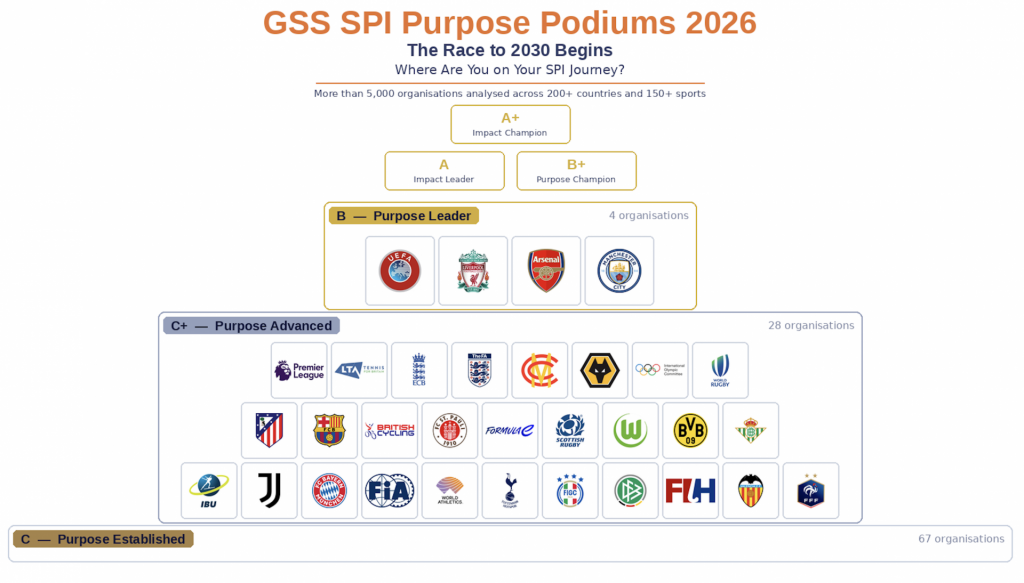
The themes discussed throughout the webinar are reflected in the emerging findings of the Global Sustainable Sport SPI Index. Following the release of the first phase of the Index last week, UEFA, Liverpool FC and Atlético de Madrid are all currently ranked among the Top 15 most purposeful sports organisations globally. Their inclusion reflects sustained efforts to embed sustainability into governance, operations and stakeholder engagement, providing a practical example of how leading organisations are moving beyond commitments and beginning to operationalise sustainability across the sporting ecosystem.
"My top three most-performing posts were about sustainability. People are really interested in these topics and appreciate when athletes are speaking out about more than just their performances."
A Shared Goal
The EBU webinar demonstrated that football’s sustainability challenge extends far beyond floodlights, broadcast compounds and energy bills. It is equally about communication, influence and the ability of sport to shape behaviour at scale.
Throughout the discussion, speakers repeatedly returned to the importance of collaboration between clubs, federations, broadcasters, athletes and technology partners. Progress, they argued, will not come from isolated initiatives but from collective action across the sporting ecosystem.
Closing the webinar, Angelique Ernoul, Head of Sports Rights Sales at the EBU, reflected on the broader significance of the discussion.
“We’ve heard today that there are many different ways organisations can contribute to a more sustainable future for sport,” she said. “Whether through innovation, communication or collaboration, everyone has a role to play.”
"We've heard today that there are many different ways organisations can contribute to a more sustainable future for sport," she said. "Whether through innovation, communication or collaboration, everyone has a role to play."
The message from Power Down, Game On was clear: sustainability is no longer just about how sport is delivered, but about how the entire industry works together to create lasting change. Football’s route to net zero will depend on technology, investment and innovation, but also on communication, collaboration and a shared commitment to action.
Read moreEBU






Join the GSS Alliance Partners programme today
Stay ahead of the game with our FREE weekly newsletter, delivering the latest sport and sustainability news from around the globe straight to your inbox

11th Hour Racing
Join the GSS Network programme today




Register for GSS Workshops today
Join the GSS Education programme today