
To access our unique news archive of over 1,400 articles with insights on over 500+ sustainable sports organisations, join the GSS Network today.
Login here if you are a registered network subscriber.
News article
Top storyThe Air We Ignore: GSS Data Highlights a Critical Gap Ahead of Air Aware Launch and London Marathon
As the global sports sector continues to position itself as a driver of positive change, new data from Global Sustainable Sport highlights a critical and often overlooked issue—air pollution as a direct threat to athlete health and performance.
Unlike many sustainability challenges, air quality is not a distant or abstract risk. It is immediate, measurable and experienced in real time by athletes, participants and fans. From endurance performance and recovery to long-term respiratory health, the impact is direct—and yet, in most cases, largely unaddressed.
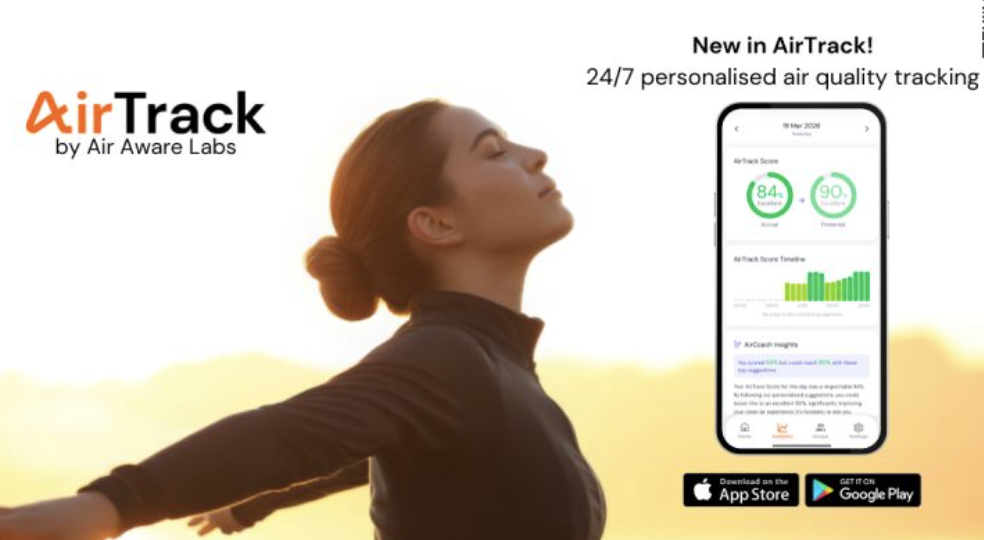
The findings come as Air Aware Labs launches its new AirTrack app ahead of the London Marathon, offering athletes and organisers a clearer picture of exposure to air pollution. The timing is significant—and the gap it reveals is even more so.
Measuring what sport actually does
At the end of April, Global Sustainable Sport will publish the initial findings from its GSS Purpose & Impact (P&I) Assessment Programme 2026, the first global attempt to measure how purposeful and impactful sports organisations are at scale.
The programme is built on a simple but critical premise: before sport can evidence its impact, it must first demonstrate its purpose.
Drawing exclusively on publicly available data—websites, reports, policies and digital communications—the GSS P&I Assessment Programme evaluates organisations against more than 150 criteria across the 7 Sustainable Pillars of Sport: Partnerships, Participation, People, Planet, Power, Profile and Prosperity.
The approach is both scalable and comparable, allowing football clubs to be assessed alongside federations, events and Olympic bodies using a consistent framework.
To date, more than 1,500 organisations have been fully assessed, from a potential pool of around 5,500 currently in scope. A further 5,000+ organisations remain outside scope, largely due to the absence of a functioning website or accessible digital presence—highlighting a broader transparency challenge across the sector.
A sector still at the starting line
The early findings are stark.
Across the dataset, the majority of organisations remain in the early stages of their sustainability journey, with limited publicly available evidence of structured activity—particularly when it comes to environmental performance.
This reflects a wider issue identified by GSS: sport generates enormous social, environmental and economic value, yet lacks a sector-specific standard to measure and report it consistently.
Air quality provides one of the clearest—and most immediate—examples of this gap.
Air quality: the invisible issue
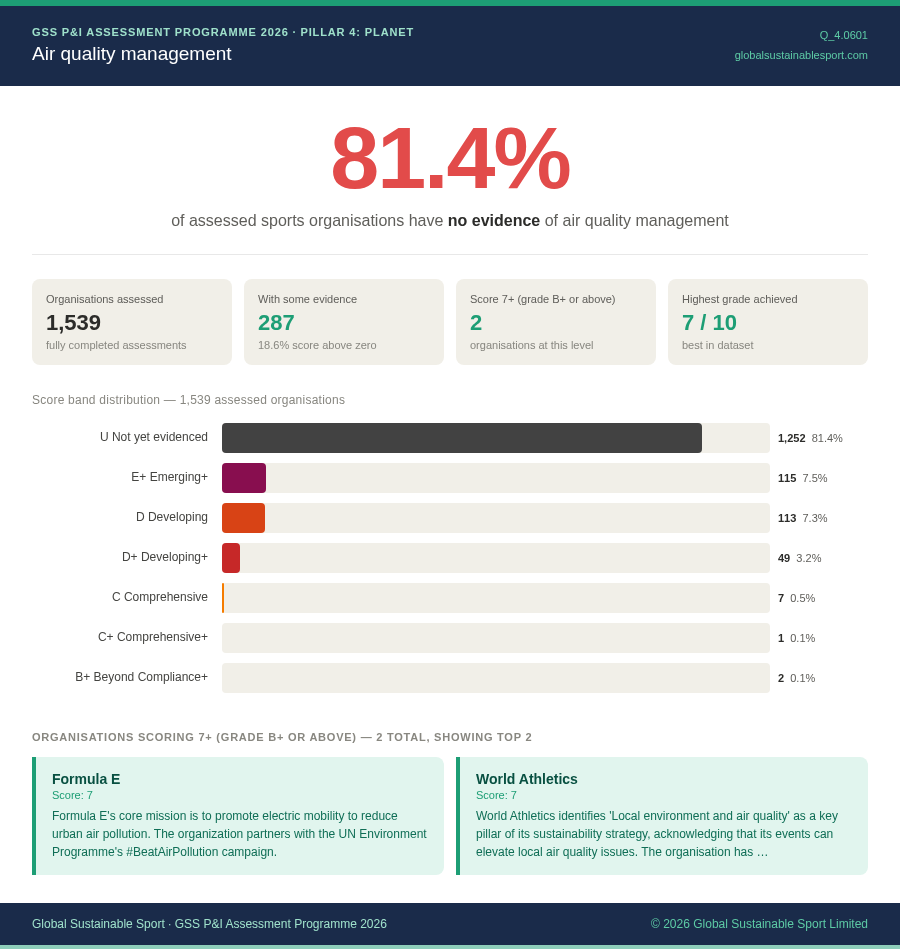
Data from the GSS P&I Assessment Programme shows that:
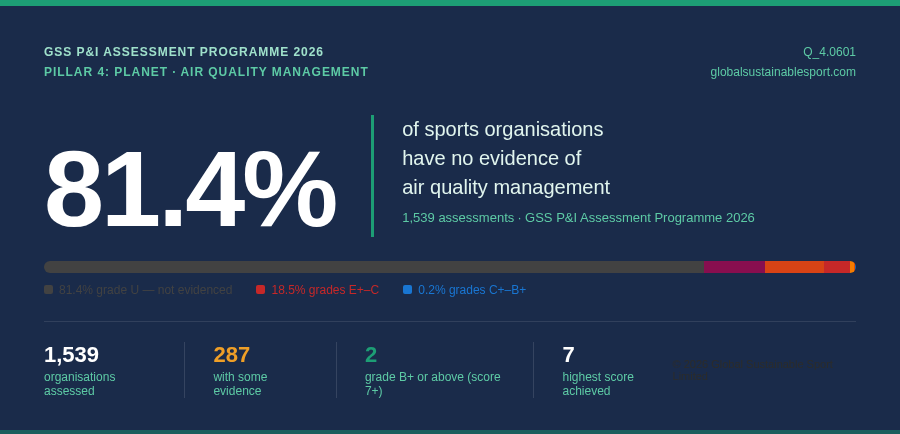
- 81.4% of assessed organisations have no evidence of air quality management
- Only 18.6% show any level of activity
- Just 2 organisations globally reach an ‘established’ level
- No organisation scores at a leading or exemplary level
This is not a marginal issue—it is a systemic blind spot.
For a sector built on physical performance, participation and outdoor environments, the lack of focus on air quality is striking. Poor air quality has been shown to impact endurance, recovery and long-term health—yet it remains one of the least evidenced areas across sport.
Yet where action is taking place, it demonstrates what is possible.
World Athletics has been running an active air quality project since 2018, deploying fixed and bike-mounted monitors to measure NO₂, O₃, PM2.5 and PM10 at World Championship marathons. The programme has now reached a level of methodological maturity, with a peer-reviewed framework published in 2024.
Similarly, Formula E, as a UN #BeatAirPollution partner, has embedded air quality into its event operations. Its Paris race recorded a two-thirds reduction in PM2.5, while live air quality data has been displayed to fans at the Berlin E-Prix. The championship has also introduced a no spectator parking policy to reduce traffic-related emissions.
These examples remain the exception rather than the norm—but they provide a clear blueprint for how sport can begin to address both health and environmental risk in a more integrated way.
As one of the weakest scoring areas across the Planet pillar, air quality highlights the gap between sustainability ambition and operational reality.
From measurement to scalable action
This is where the work of Air Aware Labs becomes particularly relevant.
Speaking to Global Sustainable Sport ahead of the launch, Louise Thomas, CEO and Co-Founder of Air Aware Labs, outlined the ambition behind the new AirTrack app:
“We now have 24/7 tracking of air pollution exposure—whether you’re indoors, outdoors or travelling. It’s about giving people a much clearer understanding of what they’re actually experiencing.”
The platform combines real-time data with AI-driven insights and advanced modelling, enabling users to understand exposure at an individual level.
Crucially, it represents a shift in how sport can approach air quality—from hardware-heavy monitoring and isolated pilots towards digitally enabled, data-led solutions that can be adopted at scale across events, cities and global competitions.
“We now have 24/7 tracking of air pollution exposure—whether you’re indoors, outdoors or travelling. It’s about giving people a much clearer understanding of what they’re actually experiencing.”
For GSS, this represents exactly the type of measurable, scalable intervention the sector needs to move forward.
As noted in discussion with Air Aware, Mike Laflin, CEO & Founder of Global Sustainable Sport, said:
“Air quality is one of the weakest areas across the data we have gathered on sports organisations. Once people can see the data—and see where they stand—it has the potential to drive real change.”
“Air quality is one of the weakest areas across the data we have gathered on sports organisations. Once people can see the data—and see where they stand—it has the potential to drive real change.”
A defining moment for sport?
The convergence of data and technology is creating a new level of accountability.
The GSS P&I Assessment Programme does not rely on self-reporting or surveys. It measures what organisations actually publish, what they evidence and what they prioritise—providing a baseline not just of intent, but of visibility and transparency.
At the same time, the AirTrack app brings real-time environmental exposure into the conversation—making the invisible visible for athletes, organisers and fans alike.
Together, they point towards a shift in how sport understands and manages its impact.
The question now is whether the sector is ready to respond.
Because if sport is serious about athlete performance and participant health, air quality can no longer remain the invisible variable
Read moreAir Aware & Global Sustainable Sport (GSS)












Join the GSS Alliance Partners programme today
Stay ahead of the game with our FREE weekly newsletter, delivering the latest sport and sustainability news from around the globe straight to your inbox


11th Hour Racing
Join the GSS Network programme today





Register for GSS Workshops today
Join the GSS Education programme today