
To access our unique news archive of over 1,400 articles with insights on over 500+ sustainable sports organisations, join the GSS Network today.
Login here if you are a registered network subscriber.
News article
Top storyFrom Track to Tarmac: How Formula E is Driving the Net Zero Transition
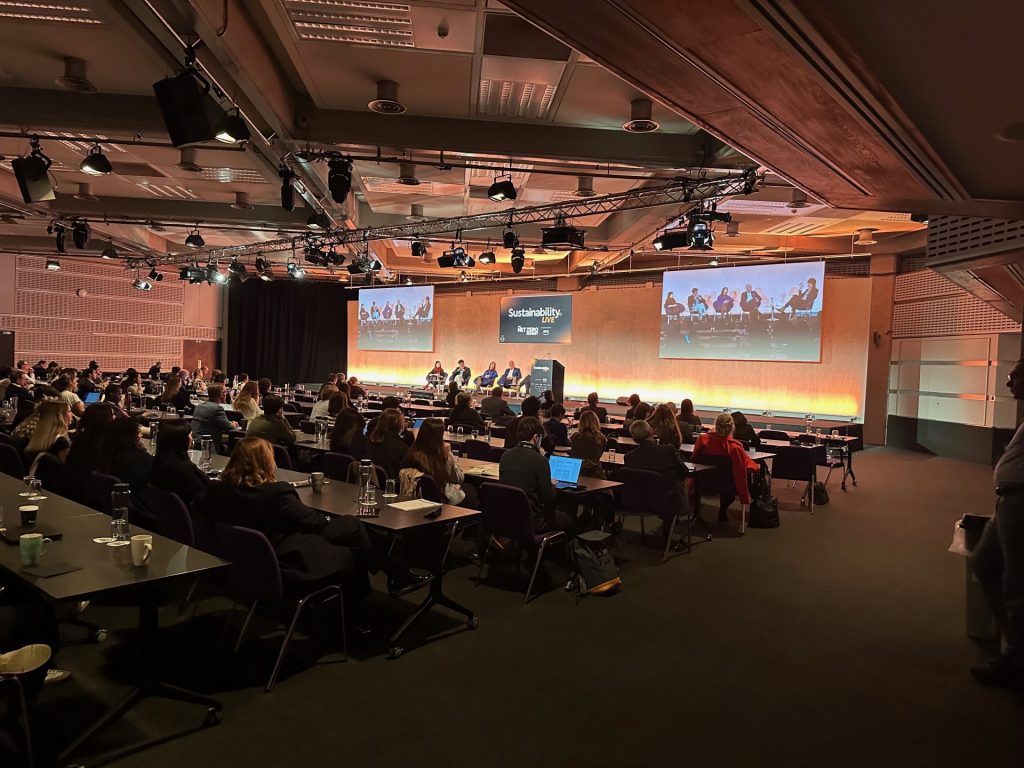
On 4–5 March 2026, the Net Zero Summit in London brought together leaders from energy, mobility and sport to discuss the accelerating transition to a low-carbon future. Two panel sessions — Using Sport and Culture to Promote Sustainability and The Future of Electric Cars in a Net Zero World — explored the role of Formula E and motor racing in electric mobility.
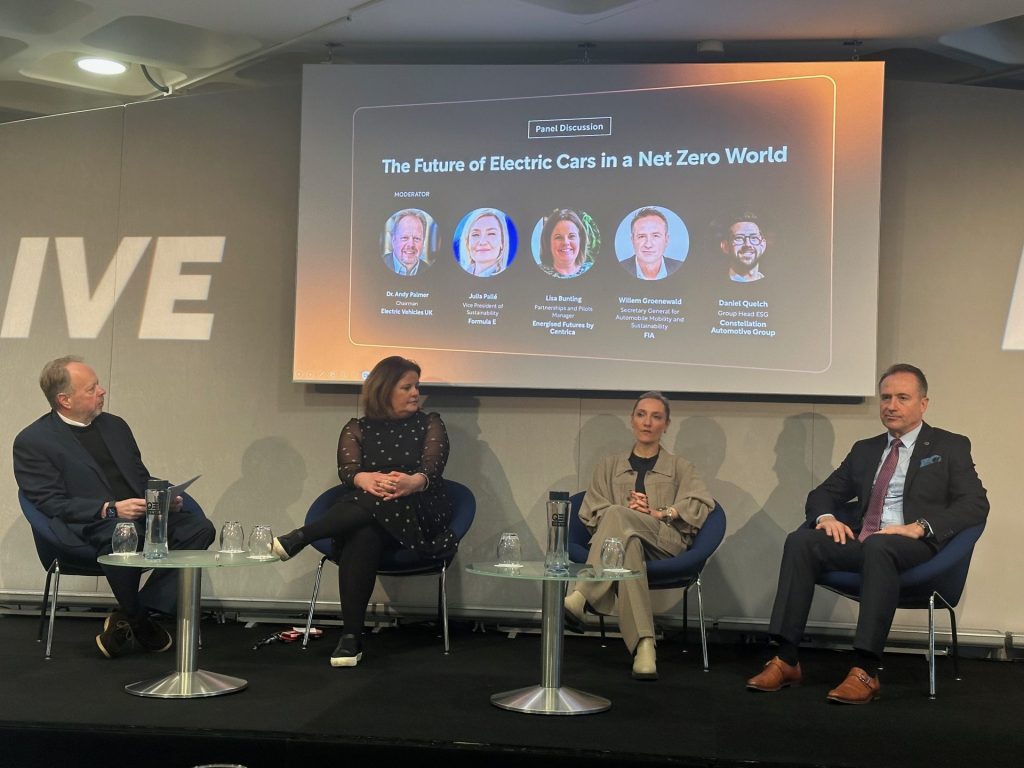
Each session highlighted the different roles that sport can play with one focusing on the power of sport to inspire behavioural change, whilst the the other examined the technical, economic and policy actions that sport is taking to help shape the global EV transition. Together, they illustrated how innovation moves from track to road, and from inspiration to implementation.
The “Pixie Dust” of Sport
The first session highlighted how sport can act as a powerful platform for communicating sustainability and engaging new audiences.
James Mercer, Commercial Director of Envision Racing, described how the team launched its Race Against Climate Change initiative in 2017 with partners including the Rocky Mountain Institute and Sir Richard Branson. Over time, the initiative has evolved from awareness-raising into a broader effort to showcase emerging climate technologies to a global audience.
Formula E’s reach now extends to more than 420 million fans worldwide — providing what Mercer described as a unique communication opportunity.
“It’s our mission now to get those stories out to as many businesses, as many people and as many fans as we possibly can. Motorsport has a kind of ‘pixie dust’ that brings extra interest to these technologies.”
“It’s our mission now to get those stories out to as many businesses, as many people and as many fans as we possibly can. Motorsport has a kind of ‘pixie dust’ that brings extra interest to these technologies.”
The racing platform allows sustainability discussions to happen in environments where they might not otherwise reach mainstream audiences — from race weekends in São Paulo and Tokyo to climate forums and university partnerships.
Rather than relying solely on large conferences, Envision Racing has increasingly shifted towards smaller, more localised events involving businesses, universities and policymakers. The team also runs community initiatives such as the Sustainable Chain pledge programme, launched at COP26, which has now attracted more than 260,000 personal climate pledges.
Bridging Industry and Inspiration
For Envision Energy, a global renewable energy technology company and owner of the racing team, the partnership demonstrates how industrial technologies can gain visibility through sport.
Eustace Furtado, Commercial Director at Envision Energy, explained that while large-scale renewable technologies such as wind turbines or battery storage systems may be critical to the energy transition, they rarely capture public imagination.
Motorsport helps change that.
“Selling wind turbines or battery storage isn’t exactly glamorous. Formula E brings that attractiveness — it makes the technology visible and exciting.”
The partnership also extends into STEM education and workforce development, exposing students to careers in engineering, data science and renewable energy through the racing environment.
For Envision Energy, the collaboration reflects a broader strategy of presenting itself not simply as a technology supplier but as part of a global net-zero ecosystem.
“Selling wind turbines or battery storage isn’t exactly glamorous. Formula E brings that attractiveness — it makes the technology visible and exciting.”
From Inspiration to Infrastructure
If the first panel focused on inspiration, the second addressed the practical realities of scaling electric mobility worldwide.
Julia Pallé, Vice President of Sustainability at Formula E, explained how the championship acts as a technological laboratory for innovations that eventually reach road vehicles.
“In motorsport we try to solve the problems five years before they reach the consumer market,” she said.
During the first decade of Formula E, battery technology was the primary focus. Today, the challenge has shifted toward charging infrastructure.
One recent example is the introduction of ultra-fast charging pit stops during races — a 30-second recharge that demonstrates the potential of rapid charging technologies for everyday vehicles.
“In motorsport we try to solve the problems five years before they reach the consumer market,”
The Reality of Mass Adoption
Lisa Bunting of Energised Futures, part of Centrica, emphasised that the next phase of EV adoption will depend on convincing mainstream consumers — not just early adopters.
While running costs for EVs can be significantly lower than petrol or diesel vehicles, concerns remain around infrastructure reliability, range and charging access.
“Range anxiety still exists,” she said, noting that uneven charging networks across regions can discourage potential buyers.
Willem Groenewald, Secretary General for Mobility & Sustainability at the FIA, added that inconsistent government policies are also undermining consumer confidence.
“The flip-flopping of policy makes it very confusing for consumers and for manufacturers alike.”
He argued that large-scale transitions require long-term regulatory clarity and cooperation between governments, industry and regulators.
“The flip-flopping of policy makes it very confusing for consumers and for manufacturers alike.”
Democratising Electric Mobility
Panel moderator Dr Andy Palmer challenged the perception that electric vehicles remain luxury products. Adoption rates in countries such as Thailand, Ethiopia and Vietnam now exceed those in some Western markets, suggesting the transition may accelerate faster in emerging economies.
Pallé also pointed to China’s rapidly expanding EV manufacturing sector, which is producing lower-cost electric vehicles at scale.
Yet Formula E’s role, she argued, remains constant: accelerating technological innovation and changing perceptions around electric mobility.
A clear example is the evolution of the Nissan LEAF. Insights from Formula E racing helped increase the vehicle’s battery capacity by around 200 percent, demonstrating how lessons learned on the track can directly benefit everyday drivers.
From Track to Tarmac
Across both sessions, a common theme emerged: the transition to electric mobility is not just about technology, it is about confidence, communication and collaboration.
Sport can help inspire the change. Industry and policymakers must deliver the infrastructure and stability needed to support it.
Formula E sits at the intersection of both worlds , using the excitement of motorsport to showcase technologies that could shape the future of mobility.
And as those innovations move from racetrack to roadway, the journey from track to tarmac may become one of the defining stories of the net-zero transition.
Read moreSustainability Live Net Zero 2026













Join the GSS Alliance Partners programme today
Stay ahead of the game with our FREE weekly newsletter, delivering the latest sport and sustainability news from around the globe straight to your inbox



11th Hour Racing
Join the GSS Network programme today




Register for GSS Workshops today
Join the GSS Education programme today