
To access our unique news archive of over 1,400 articles with insights on over 500+ sustainable sports organisations, join the GSS Network today.
Login here if you are a registered network subscriber.
News article
Global sport backs pioneering shared carbon measurement approach
Some of the biggest names in global sport are backing a new, unified approach to measuring and reducing carbon emissions across the sector, marking a significant step forward in sport’s fight against climate change.
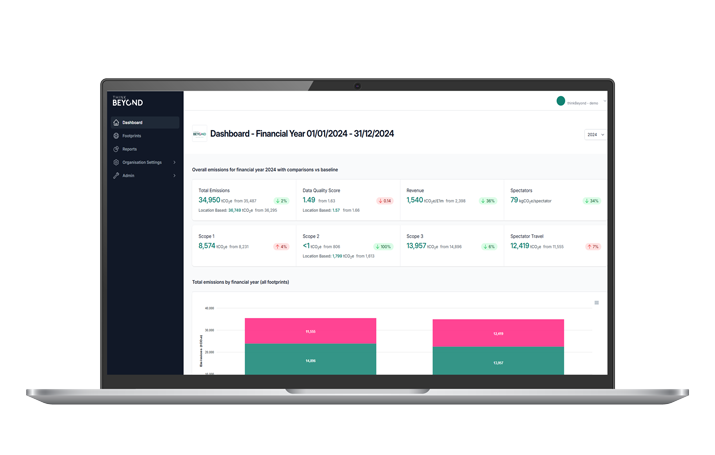
Launched this week by sustainability consultancy Think Beyond, the Carbon Methodology and Calculator for Sport is the first standardised tool designed for clubs, leagues and federations to calculate and benchmark their greenhouse gas emissions.
Backers of the initiative include World Athletics, Liverpool FC, LIV Golf, Cricket Australia and the FA. The methodology aligns with the Greenhouse Gas Protocol, the UNFCCC Sports for Climate Action Framework, and the Science Based Targets initiative, but is tailored to the language and realities of sport.
“Sport has long talked about leading on climate, but without a shared way of measuring emissions the industry has lacked the tools to follow through,” said Dr Susie Tomson, Senior Partner at Think Beyond. “This approach changes that. We’ve developed a practical, user-friendly methodology that meets global standards but speaks the language of sport so clubs and competitions at any point in their journey can measure what matters, benchmark progress, and lead with credibility”.
“Sport has long talked about leading on climate, but without a shared way of measuring emissions the industry has lacked the tools to follow through. This approach changes that. We’ve developed a practical, user-friendly methodology that meets global standards but speaks the language of sport so clubs and competitions at any point in their journey can measure what matters, benchmark progress, and lead with credibility”.
A sector-wide breakthrough
Until now, the sports industry has lacked a consistent method for tracking emissions, hampering transparency and making it difficult to benchmark progress or credibly report climate action. Sport-specific tools have existed, but this is the first approach designed for sector-wide adoption.
A key innovation of the methodology is the inclusion of Scope 3 emissions, such as fan travel and merchandise sales, which often represent a significant portion of sport’s climate impact but are frequently overlooked.
“If sport is willing to claim the economic benefits of hosting fans and selling products, it also has to account for the environmental costs,” Tomson added. “Leadership means full transparency, not selective accounting”.
Already, 35 organisations spanning football, motorsport, athletics, sailing, golf and cycling have adopted the methodology.
“If sport is willing to claim the economic benefits of hosting fans and selling products, it also has to account for the environmental costs. Leadership means full transparency, not selective accounting”.
Leading voices in support
World Athletics President Lord Sebastian Coe underlined the importance of shared metrics: “One of the most important things we at World Athletics have found in combating our impact on climate change is the importance of simple metrics and sharing them across our own and all sport”.
Liverpool FC’s Director of Impact, Rishi Jain, said the methodology is now integral to the club’s sustainability drive: “Accurate carbon data is a cornerstone of The Red Way, and our continued commitment to ensure transparency and authenticity in our approach to sustainability. This methodology gives us a credible baseline to take action and lead by example”.
Jake Jones, Senior Vice President of Sustainability and Impact at LIV Golf, added: “The more that global sport is aligned on data and standards, the more we can deepen our connections with millions of fans year-round”.
“One of the most important things we at World Athletics have found in combating our impact on climate change is the importance of simple metrics and sharing them across our own and all sport”
“Accurate carbon data is a cornerstone of The Red Way, and our continued commitment to ensure transparency and authenticity in our approach to sustainability. This methodology gives us a credible baseline to take action and lead by example”
“The more that global sport is aligned on data and standards, the more we can deepen our connections with millions of fans year-round”.
Driving collective progress
The tool and methodology are free for any sport, supplier or consultant to use, with the calculator available for a nominal fee. They support sport’s shared goal of cutting emissions by 50% by 2030 and achieving net zero by 2040 under the UN framework.
“It’s not just about tracking tonnes of carbon. It’s about building resilience, sharing what works, and ensuring sport is prepared for the realities of a warming world”.
Think Beyond will also publish an annual State of Sport Carbon Report, using anonymised data to highlight where emissions reductions are working and where more effort is needed.
“It’s not just about tracking tonnes of carbon,” Tomson concluded. “It’s about building resilience, sharing what works, and ensuring sport is prepared for the realities of a warming world”.
Read moreThinkBeyond




















Join the GSS Alliance Partners programme today
Stay ahead of the game with our FREE weekly newsletter, delivering the latest sport and sustainability news from around the globe straight to your inbox

11th Hour Racing
Join the GSS Network programme today






Register for GSS Workshops today
Join the GSS Education programme today