
To access our unique news archive of over 1,400 articles with insights on over 500+ sustainable sports organisations, join the GSS Network today.
Login here if you are a registered network subscriber.
News article
Top storyDriving Sustainable Sport: World Athletics Secures ISO Re-Certification as Denmark Targets Gold Standard for Road Running Championships
World Athletics has reinforced its position as one of sport's leading sustainability organisations after achieving re-certification to ISO 20121:2024, the internationally recognised standard for sustainable event management. The achievement confirms that sustainability is being systematically embedded across the federation's operations and event portfolio, while also raising expectations for organisers of future World Athletics competitions.

The announcement comes as organisers of the 2026 World Athletics Road Running Championships in Copenhagen prepare to deliver one of the most ambitious sustainability programmes ever seen at a mass participation athletics event. In discussions with Global Sustainable Sport, representatives from Sport Event Denmark and Sparta Athletics & Running, the Copenhagen-based running and events organisation responsible for delivering the Championships on behalf of the Danish Athletics Federation and World Athletics, outlined how they are translating World Athletics’ global framework into practical action on the ground.
Originally developed ahead of the London 2012 Olympic and Paralympic Games, ISO 20121 was revised in 2024 to align with modern sustainability priorities, including the UN Sustainable Development Goals, the Paris Agreement and evolving expectations around human rights, climate action and legacy planning. World Athletics’ re-certification follows a rigorous audit of its sustainability management systems and reinforces the growing importance of measurement, accountability and continuous improvement across international sport.
World Athletics President Sebastian Coe said the certification demonstrated that sustainability was becoming embedded across the organisation’s activities.
“This independent review recognises the progress we are making to ensure that sustainability considerations are being embedded across all of our operations. It shows that the path we’re creating for all of our events, member federations and other stakeholders is leading to meaningful and verifiable impact.”
"This independent review recognises the progress we are making to ensure that sustainability considerations are being embedded across all of our operations. It shows that the path we're creating for all of our events, member federations and other stakeholders is leading to meaningful and verifiable impact."
From Certification to Implementation
Central to World Athletics’ approach is the Athletics for a Better World (ABW) Standard, a sustainability evaluation framework covering 55 action areas across environmental, social and governance themes. Sustainability reporting under the ABW Standard became mandatory for most World Athletics competitions in 2024, with more than 120 events completing reporting for their 2025 editions.
The Copenhagen Championships are now aiming to achieve Gold-level performance under this framework. Scheduled for September 2026, the event will welcome elite athletes alongside approximately 65,000 mass participation runners and more than 100,000 spectators, creating both a significant opportunity and a substantial sustainability challenge.
To reach this level, organisers must demonstrate measurable progress across all 55 action areas, ranging from climate impact and waste management to social inclusion, procurement and governance.
Every Action Counts
Rather than focusing on a single headline sustainability target, Sparta has adopted what it describes as an “every action counts” approach.
Explaining the philosophy to Global Sustainable Sport, Nynne Ammundsen, Head of Sustainability at Sparta Athletics & Running, said:
“Both options have great potential, but we thought we could make the most change with this approach. For us, our ‘every action counts’ also taps into a major framework for us, that it’s not only one part of the event that needs to focus on sustainability, but it’s actually everyone and everywhere. With this approach, it’s more about team spirit than a one-man army.”
That philosophy is reflected in the event’s sustainability slogan: Do less. Do greener. Do it together.
"Both options have great potential, but we thought we could make the most change with this approach. For us, our 'every action counts' also taps into a major framework for us, that it's not only one part of the event that needs to focus on sustainability, but it's actually everyone and everywhere. With this approach, it's more about team spirit than a one-man army."
Five key focus areas have been identified, including behavioural nudges, greener procurement, public transport, social inclusion initiatives and responsible event delivery. Organisers will track progress across a wide range of indicators, including transport choices, waste management, catering, supplier performance and community engagement programmes.
For Sparta, the social dimension remains particularly important. As Ammundsen explained:
“My favourite must be the areas that cover the human interaction, for example social initiatives tailored to different target groups. The difference we can make together with athletes, vendors, partners and spectators gives me goosebumps.”
"My favourite must be the areas that cover the human interaction, for example social initiatives tailored to different target groups. The difference we can make together with athletes, vendors, partners and spectators gives me goosebumps."
Raising the Bar for Sporting Events
Sport Event Denmark has played a key role in shaping the sustainability ambitions of the Championships through its green minimum requirements, which are now integrated into bidding and hosting processes for major events.
Hanne Sejer, Deputy Head of Sustainability at Sport Event Denmark, told Global Sustainable Sport:
“At Sport Event Denmark, we have introduced green minimum requirements because we believe that international sporting events must be part of the transition towards more responsible and sustainable ways of bringing people together.”
Importantly, those requirements were never intended to be the finish line.
"At Sport Event Denmark, we have introduced green minimum requirements because we believe that international sporting events must be part of the transition towards more responsible and sustainable ways of bringing people together."
“We are extremely pleased to see that the organisers of the World Athletics Road Running Championships have gone much further than we had expected or even hoped for. Our minimum requirements have helped set a direction, but the organisers have truly taken ownership of the agenda.”
The Championships will include initiatives ranging from sustainable transport and climate-conscious food choices to programmes supporting schools, students and people living with dementia. Organisers also intend to develop a set of transferable best-practice guidelines — known as “Ways of Doing” — that can be applied to future events across Denmark and beyond.
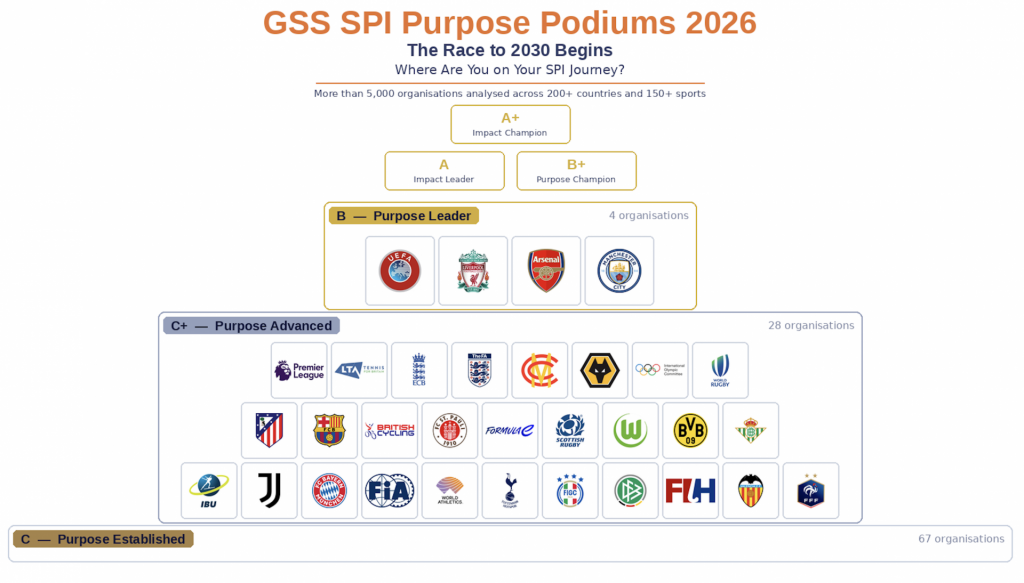
The progress being made in athletics and within Denmark is reflected in the recently published Global Sustainable Sport (GSS) SPI Index, with World Athletics and the National Olympic Committee and Sports Confederation of Denmark both currently ranked among the Top 50 most purposeful sports organisations in the world.
"We are extremely pleased to see that the organisers of the World Athletics Road Running Championships have gone much further than we had expected or even hoped for. Our minimum requirements have helped set a direction, but the organisers have truly taken ownership of the agenda."
A Blueprint for the Future
The significance of World Athletics’ ISO 20121 re-certification extends beyond governance and process. It demonstrates that the federation is building a framework capable of driving measurable sustainability performance across an increasingly complex global events portfolio.
The challenge now is implementation.
The progress being made by athletics and within Denmark is reflected in the recently published Global Sustainable Sport (GSS) SPI Index, with World Athletics and the National Olympic Committee and Sports Confederation of Denmark both ranked among the Top 50 most purposeful sports organisations in the world.
Copenhagen 2026 will provide one of the most visible tests yet of whether international standards can be translated into meaningful action on the streets of a host city. If organisers can achieve their Gold ambition while delivering lasting social, environmental and community benefits, the Championships could become a blueprint for the future of sustainable mass participation sport.
As Sejer observed:
“There is a tendency to underestimate the value of telling the story of sustainable progress. We need courageous examples that others can build on.”
"There is a tendency to underestimate the value of telling the story of sustainable progress. We need courageous examples that others can build on."
And that may ultimately be the real significance of Copenhagen 2026: not simply demonstrating what sustainable sport looks like but showing how others can follow.
Read moreSport Event Denmark










Join the GSS Alliance Partners programme today
Stay ahead of the game with our FREE weekly newsletter, delivering the latest sport and sustainability news from around the globe straight to your inbox

11th Hour Racing
Join the GSS Network programme today






Register for GSS Workshops today
Join the GSS Education programme today