
To access our unique news archive of over 1,400 articles with insights on over 500+ sustainable sports organisations, join the GSS Network today.
Login here if you are a registered network subscriber.
News article
Beyond the Podium: Sailing’s Inclusion Challenge Runs Deeper Than Elite Success
The glittering imagery of the Women’s America’s Cup and the high-octane offshore battles of the Vendée Globe suggest a sport undergoing a progressive transformation. At the elite level, sailing increasingly showcases women competing, leading campaigns and shaping the narrative of the sport’s future. Yet beneath these high-profile moments, a different reality persists.
A landmark study released by The Magenta Project suggests that while sailing’s image is evolving, the everyday experience for much of the sailing community and marine industry remains tethered to long-standing patterns of exclusion.
The Data Behind the Divide
The 2×25 Review, developed in collaboration with 11th Hour Racing and World Sailing, represents the most comprehensive examination of equity and inclusion in sailing since the World Sailing Trust’s 2019 Strategic Review. Drawing on around 2,500 responses from 68 countries, the study paints a complex picture of progress alongside persistent barriers.
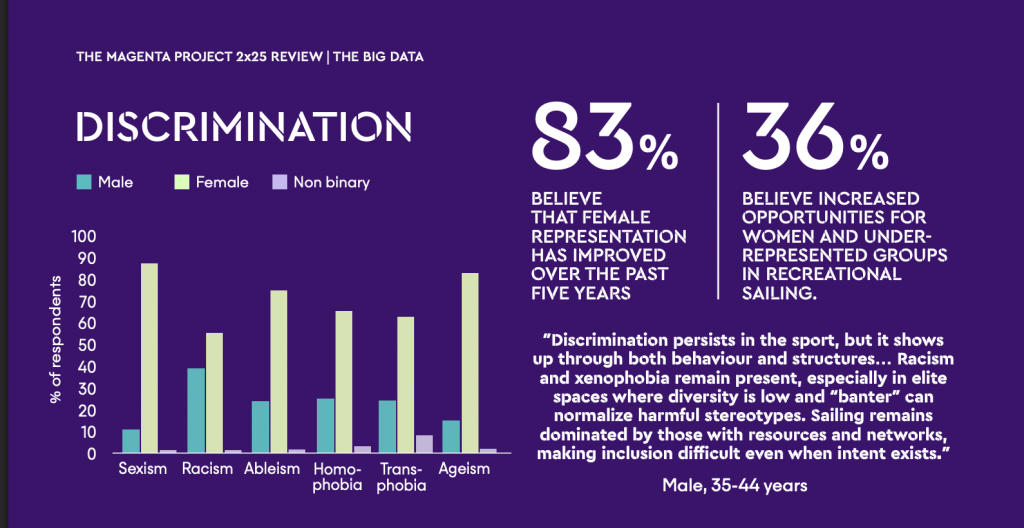
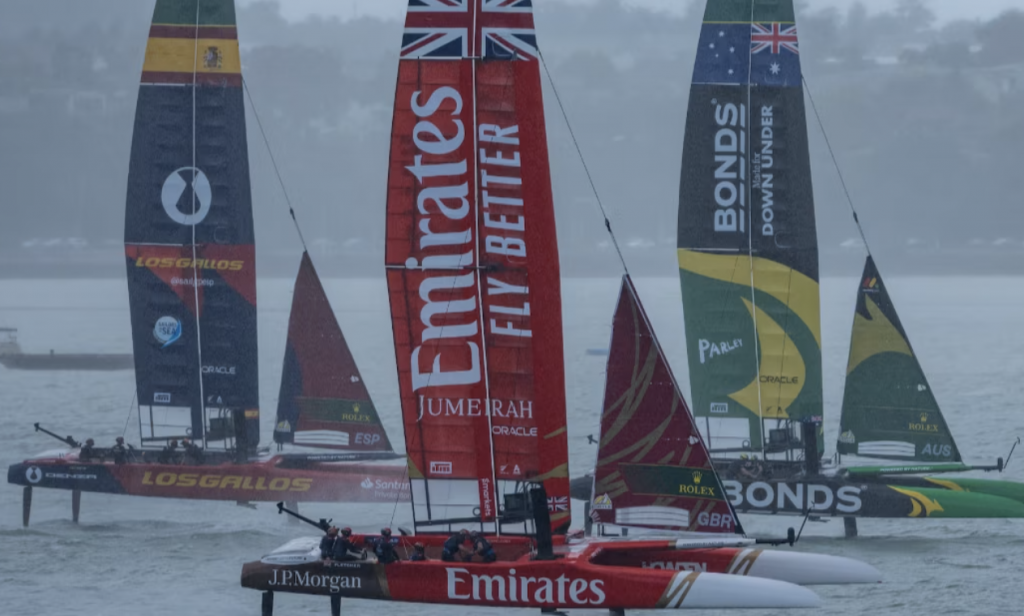
On the surface, perceptions of change are emerging. More than 80% of respondents believe female representation has improved over the past five years, with high-profile events such as SailGP and the Women’s America’s Cup reshaping the sport’s image.
But the deeper data reveals more stubborn realities.
Sixty-five percent of respondents report experiencing discrimination within sailing or the wider marine industry, with sexism cited as the most prevalent form.
The report also highlights a 29% gender pay gap, with women earning a median annual salary of $35,000 compared with $49,000 for men.
However, the research suggests the disparity is driven less by unequal pay within identical roles than by unequal access to the positions where experience, influence and earnings accumulate.
Breaking the Experience Barrier
For Victoria Low, CEO of The Magenta Project, closing the pay gap requires confronting deeper structural barriers within the sport and the wider marine industry.
“The pay gap exists because women aren’t getting into the rooms where decisions are made and where the highest-value work happens,” Low explains. “You can’t fix that with equal pay policies alone — you have to address the access problem.”
According to Low, progress depends on creating deliberate pathways into senior roles rather than relying on traditional career routes that often exclude women from gaining the experience required for leadership positions.
“The pay gap exists because women aren't getting into the rooms where decisions are made and where the highest-value work happens. You can’t fix that with equal pay policies alone — you have to address the access problem.”
Structured mentoring programmes, internships and secondments that expose women to high-level decision-making environments can accelerate career development. Equally important is transparency around advancement criteria so women can clearly see the path forward.
“If senior roles require experience that can only be gained in senior roles, you’ve created a closed loop,” Low says. “Breaking that requires sponsors — senior leaders who actively advocate for talented women and create opportunities for them to gain that experience.”
Encouragingly, she points to initiatives such as the IMOCA Female Leadership Development Programme and The Magenta Project’s own mentoring work as examples of how structured pathways can begin to shift the landscape.
“If senior roles require experience that can only be gained in senior roles, you’ve created a closed loop. Breaking that requires sponsors — senior leaders who actively advocate for talented women and create opportunities for them to gain that experience.”
From Representation to Belonging
Beyond pay and career progression, the report highlights deeper cultural challenges within sailing.
Nearly 60% of women and 64% of non-binary respondents say they have had to adapt their behaviour simply to feel accepted within sailing environments, while almost half of
These findings point to what the report describes as a widening “belonging gap” between the sport’s increasingly inclusive image and the day-to-day experiences of many participants.
For Michelle Carnevale, President of 11th Hour Racing, the findings reinforce the importance of using data to drive meaningful change.
“For over a decade, 11th Hour Racing has backed efforts to make sailing more welcoming and accessible,” she said. “We’ve seen first-hand that when you remove barriers and create real opportunities, the entire sport becomes stronger, more innovative and more resilient. The 2×25 Review confirms what we have long believed: you can’t fix what you don’t measure.”
“For over a decade, 11th Hour Racing has backed efforts to make sailing more welcoming and accessible. We’ve seen first-hand that when you remove barriers and create real opportunities, the entire sport becomes stronger, more innovative and more resilient. The 2x25 Review confirms what we have long believed: you can’t fix what you don’t measure.”
Safeguarding is another area where the report identifies urgent challenges.
Nearly half of respondents (49%) say they are unaware of any reporting structure for violence, abuse or harassment, while 42% report awareness of incidents of non-accidental violence within the sailing community.
For Low, these figures represent a serious gap in the sport’s basic safety infrastructure.
“Nearly half the sport doesn’t know how to report violence or harassment. That’s not just a gap, it’s a crisis of basic safety infrastructure,” she says.
Improving visibility, she argues, should be an immediate priority.
“If you can find the notice board with course information, you should be able to find information about how to report harassment. Policies don’t matter if people don’t know they exist or how to access them.”
“Nearly half the sport doesn’t know how to report violence or harassment. That’s not just a gap, it’s a crisis of basic safety infrastructure. If you can find the notice board with course information, you should be able to find information about how to report harassment. Policies don’t matter if people don’t know they exist or how to access them.”
Governance and Accountability
For World Sailing CEO David Graham, the findings also highlight the challenge of translating leadership-level progress into meaningful change across the wider sport.
“Ensuring sailing is a safe, welcoming place for everyone is a shared commitment we all hold if we truly care about the future of our sport,” Graham said. “Sailing has achieved meaningful change in recent years — including a gender-balanced board — but the 2×25 Review makes it clear that progress at the top doesn’t automatically translate to a sense of belonging for everyone.”
“Ensuring sailing is a safe, welcoming place for everyone is a shared commitment we all hold if we truly care about the future of our sport. Sailing has achieved meaningful change in recent years — including a gender-balanced board — but the 2x25 Review makes it clear that progress at the top doesn’t automatically translate to a sense of belonging for everyone.”
Linking Funding to Inclusion
Among the report’s more ambitious recommendations is the proposal to link organisational funding to measurable inclusion outcomes.
While this may raise concerns among smaller, volunteer-run clubs, Low argues that the intention is not to create bureaucratic hurdles but to ensure public and grant funding supports organisations that are genuinely committed to inclusion.
“For small clubs this doesn’t need to be complicated,” she explains. “It’s about asking basic questions: Are you actively recruiting women into coaching roles? Do you have a visible code of conduct and reporting mechanism? Are women who join your club still there a year later?”
“For small clubs this doesn’t need to be complicated. It’s about asking basic questions: Are you actively recruiting women into coaching roles? Do you have a visible code of conduct and reporting mechanism? Are women who join your club still there a year later?”
Simple indicators such as retention rates, leadership representation and participation trends can provide powerful insight into whether clubs are creating genuinely inclusive environments.
“If an organisation can’t demonstrate basic commitment to inclusion and can’t track whether women are participating and staying involved, we should be asking whether they deserve public funding,” Low argues.
“If an organisation can’t demonstrate basic commitment to inclusion and can’t track whether women are participating and staying involved, we should be asking whether they deserve public funding,”
Beyond the Podium
For sailing, the past decade has produced powerful symbolic breakthroughs — women competing in elite events, leading campaigns and gaining greater visibility.
But the 2×25 Review suggests that representation at the summit does not automatically reshape the foundations beneath it.
If sailing is to build a truly sustainable future, the wind of change must reach far beyond the podium, into the clubs, pathways, boatyards and boardrooms that ultimately determine who belongs in the sport.
Read moreThe Magenta Project










Join the GSS Alliance Partners programme today
Stay ahead of the game with our FREE weekly newsletter, delivering the latest sport and sustainability news from around the globe straight to your inbox

11th Hour Racing
Join the GSS Network programme today




Register for GSS Workshops today
Join the GSS Education programme today